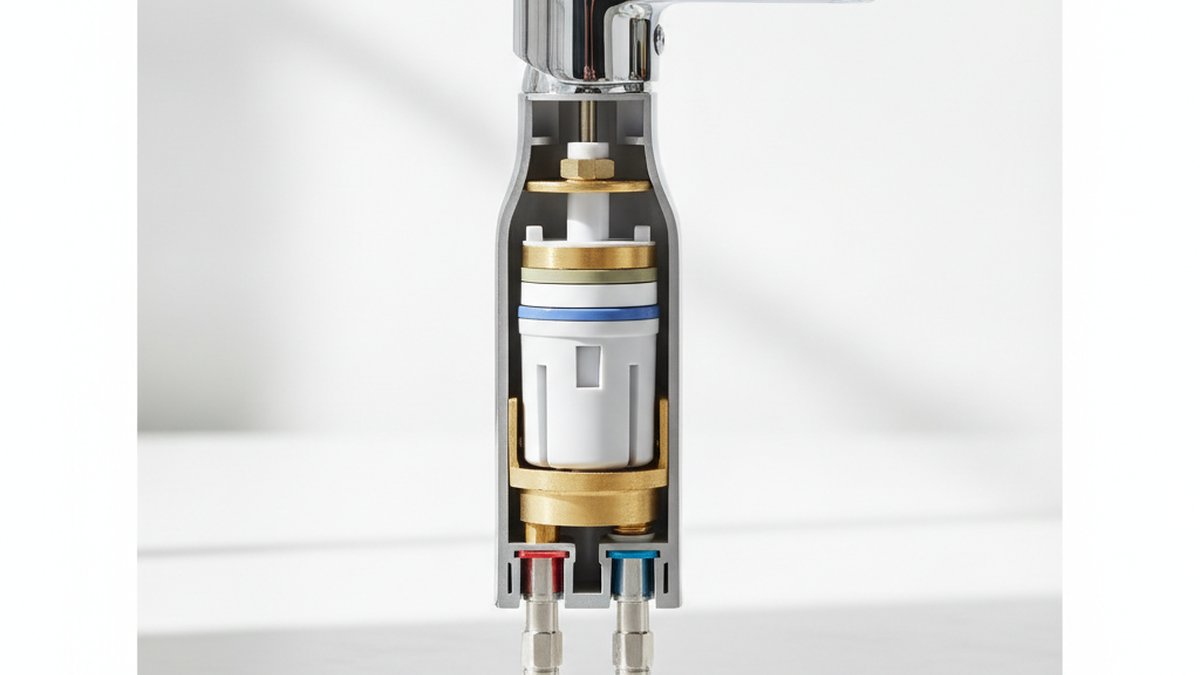
If you’ve ever stood in front of a leaking faucet wondering why it won’t stop dripping no matter how hard you crank the handle, you’re really asking a question about kitchen faucet valve types. The valve is the heart of the faucet — it’s the part that starts, stops, mixes, and regulates the water. Everything else (the spout, the handle, the finish) is just packaging around it. Understanding the four main valve types tells you how long your faucet will last, how easy it is to fix, and which replacement cartridge you’ll need when it inevitably wears out.
This guide breaks down each valve type in plain language, shows you how to tell which one you have, and helps you pick the right one whether you’re buying a new faucet or repairing the one you’ve got. Let’s get into it.
What are the four main kitchen faucet valve types?
There are four kitchen faucet valve types: compression, ball, cartridge, and ceramic disc. They differ in how they open and close the water flow, how many moving parts they have, and how they wear over time. Here’s the short version before we dig into each one:
- Compression valve — the oldest design. Uses a rubber washer pressed against a seat. Cheap, simple, but drips as the washer wears.
- Ball valve — a slotted metal or plastic ball that rotates to align with hot and cold inlets. Common in older single-handle faucets. Many small parts.
- Cartridge valve — a self-contained insert (often with rubber O-rings) that moves up/down or rotates. Easy to replace as one unit.
- Ceramic disc valve — two polished ceramic discs slide against each other. The modern gold standard: almost no wear, very drip-resistant.
Technically, “cartridge” and “ceramic disc” overlap — most modern cartridges contain a pair of ceramic discs. When someone says “ceramic cartridge,” that’s what they mean. We’ll treat them separately here because that’s how the plumbing world (and most product spec sheets) describe them.
How does a compression valve work, and why does it drip so much?
A compression valve drips because it relies on a soft rubber washer being physically squeezed against a metal seat, and that washer wears out — usually within a few years. When you turn the handle, a threaded stem screws down and presses the washer tight to stop the water. Every time you shut it off, you’re grinding rubber against metal. Eventually the washer flattens, cracks, or the seat corrodes, and you get that steady drip that no amount of extra tightening fixes.
Compression valves are the design your grandparents’ house had — two separate handles, one for hot and one for cold. They’re genuinely cheap to buy and dead simple to repair (a washer costs pennies), but they’re also the highest-maintenance type. If you’re chasing a persistent drip on an old two-handle faucet, a worn washer or seat is almost always the culprit. In many cases the real fix is a full faucet stem replacement, which you can absolutely do yourself without calling a plumber.
What’s the difference between a ball valve and a cartridge valve?
The core difference is parts count and repairability: a ball valve uses a single rotating ball plus multiple small springs, seats, and O-rings, while a cartridge valve packs everything into one replaceable insert. Ball valves live inside many single-handle kitchen faucets — that lever you push up for more water and swivel left-right to change temperature is rotating a slotted ball over two inlet holes.
The upside of a ball valve is smooth, intuitive one-hand control. The downside is that it has the most individual components of any valve type, and those little rubber seats and springs are the first things to fail. When a ball-valve faucet starts dripping or gets hard to move, you typically rebuild it with a repair kit rather than swapping one clean part.
A cartridge valve solves that headache. The whole working assembly is a single tube you pull out and replace — no fiddling with individual springs. Cartridges come in both stem-style (older) and ceramic-disc-style (modern). Because it’s one unit, repair is faster and cleaner, which is a big reason cartridge faucets dominate today’s market.
Why is a ceramic disc valve considered the best kitchen faucet valve type?
A ceramic disc valve is considered the best because it has essentially no soft parts to wear out — two ultra-hard, mirror-polished ceramic discs slide against each other to control flow, and ceramic barely degrades even after tens of thousands of on/off cycles. That’s why quality ceramic disc faucets are commonly rated for 500,000+ cycles and carry lifetime drip-and-leak warranties.
Here’s why that matters day to day:
- Drip resistance: No rubber washer to flatten, so the shut-off stays tight for years.
- Hard water tolerance: The polished discs resist mineral scoring better than rubber-on-metal designs (though sediment can still cause grinding — more on that below).
- Precise control: A quarter-turn goes from off to full flow with a smooth, solid feel.
- Longevity: Realistically 15–25 years of normal home use.
The one caveat: ceramic discs don’t love grit. In areas with sandy or heavily sedimented water, tiny particles can lodge between the discs and cause a scratchy feel or a slow drip. A simple inline sediment filter — or just flushing the lines after any plumbing work — protects them. This is a real consideration for anyone dealing with rough municipal supply; our guide on choosing kitchen taps for hard water and low pressure digs into how valve choice interacts with water quality.
Which kitchen faucet valve type should I buy in 2026?
For a new kitchen faucet in 2026, buy a ceramic disc (ceramic cartridge) valve — it’s the best balance of durability, drip resistance, and easy repair, and it’s what nearly every reputable brand, including cobbe, now uses in mid-range and premium faucets. Only choose another type if you have a specific reason: matching an antique fixture, an ultra-tight budget, or repairing an existing faucet you don’t want to replace.
Here’s a side-by-side comparison to make the choice concrete:
| Valve Type | Typical Lifespan | Drip Resistance | Hard Water Handling | Repair Difficulty | Best For |
|---|---|---|---|---|---|
| Compression | 3–8 years | Low (washer wears) | Poor | Easy & cheap | Vintage/two-handle setups, tight budgets |
| Ball | 8–15 years | Medium | Fair | Moderate (many parts) | Older single-handle faucets |
| Cartridge (stem) | 10–20 years | Medium–High | Good | Easy (one unit) | Reliable everyday faucets |
| Ceramic disc | 15–25 years | High | Very good* | Easy (one unit) | Most modern kitchens |
*Very good against mineral buildup, but sensitive to loose grit and sediment — use a filter in sandy-water areas.
Budget-wise, the valve type rarely adds much to the price of a modern faucet — a ceramic disc faucet and a ball-valve faucet at the same finish and features usually cost within $20–$40 of each other. So the decision is less about upfront cost and more about how many times you want to be under the sink with a wrench over the next decade. For most people, ceramic disc wins easily.
How do I tell which valve type my current faucet has?
You can usually identify your valve type in under five minutes by counting the handles and feeling how they move — no disassembly required at first. Here’s a quick decision path:
- Two separate handles that you screw down tight to stop the water? You almost certainly have compression valves (or old-style stem cartridges).
- One handle that lifts up and swings side to side, with a slightly loose or “wiggly” feel? That’s typically a ball valve.
- One handle with a smooth, quarter-turn feel and a solid stop? That’s a ceramic disc cartridge.
- Handle rotates but the whole unit pulls straight out when serviced? Cartridge (stem or ceramic).
To confirm for certain, shut off the water under the sink, pull the handle, and look at the valve. Compression stems have a visible rubber washer at the bottom. Ball valves reveal a rounded metal or plastic ball with slots. Cartridges look like a cylindrical tube. If the handle itself feels wobbly before you even get that far, the problem might not be the valve at all — a loose sink faucet handle with no visible screws often just needs a hidden set screw tightened.
The single most important detail to record before you buy a replacement is the brand and model number, usually stamped on the faucet body or printed in the original manual. Valve cartridges are not universal — a Moen cartridge won’t fit a Delta, and even within one brand there are multiple sizes.
How long do kitchen faucet valves last, and when should I replace one?
A quality ceramic disc valve lasts 15–25 years, a cartridge 10–20, a ball valve 8–15, and a compression washer just 3–8 — and you should replace the valve (not the whole faucet) the moment you get a persistent drip, hard-to-turn handle, or temperature that won’t hold steady. Swapping a cartridge is a $15–$40 part and a 20-minute job; replacing the whole faucet is neither.
Watch for these signs that the valve — not something else — is the problem:
- Constant dripping from the spout even when fully shut off (worn washer or scored disc).
- Handle gets stiff or gritty to move (mineral buildup or debris in the valve).
- Water temperature drifts or won’t mix properly (cracked cartridge or failed seals).
- Reduced or uneven flow that isn’t fixed by cleaning the aerator.
Before you buy a replacement cartridge, measure carefully — length and diameter both matter, and installing the wrong size means another trip to the store. We wrote a full walkthrough on figuring out exactly what kitchen faucet valve size you need so you get the right part the first time.
Can I replace a faucet valve myself, or do I need a plumber?
Yes — replacing a cartridge or stem valve is a genuine DIY job for most people, requiring only an adjustable wrench, maybe a cartridge-puller tool, and about 20–30 minutes. You don’t need a plumber for a routine valve swap. The basic steps are the same across most single-handle faucets:
- Turn off both hot and cold shut-off valves under the sink and open the faucet to release pressure.
- Remove the handle (look for a set screw under a decorative cap).
- Unscrew the retaining nut or clip holding the cartridge.
- Pull the old cartridge straight out — note its orientation.
- Drop in the identical new cartridge in the same orientation and reassemble.
The only jobs where a plumber earns their fee are corroded valves seized into the faucet body, or leaks coming from the supply lines rather than the valve itself. If your faucet handle keeps working loose after you tighten it, that’s a separate mechanical issue — our guide on why a water faucet handle goes loose and how to tighten it fast covers that fix.
Do valve types differ between pull-down, pull-out, and standard faucets?
No — the valve type is independent of the spout style. A pull-down, pull-out, or fixed-spout faucet can each use any of the four valve types, though in practice nearly all modern pull-down and pull-out kitchen faucets use ceramic disc cartridges because that’s the current standard. The spray head, hose, and quick-connect fittings are separate systems from the valve.
This matters when you’re troubleshooting: a leak at the spray head or hose has nothing to do with your valve. If water is dripping from the sprayer or the connection under the sink, you’re looking at the hose or the kitchen faucet quick connector, not the valve cartridge. Diagnosing the right component saves you from buying a part you don’t need.
Author’s note & why you can trust this guide
This guide was written by the cobbe product team, drawing on years of designing, testing, and servicing kitchen faucets. cobbe manufactures pull-down and pull-out kitchen faucets built around ceramic disc valve cartridges, and every valve we ship is cycle-tested against industry durability standards (the same 500,000-cycle benchmark used across the North American plumbing industry) and backed by our warranty. We’ve handled thousands of customer repair questions, so the advice here reflects what actually goes wrong in real kitchens — not just spec-sheet theory. When we say ceramic disc valves drip less and last longer, it’s because we’ve watched both the test rigs and the return data.
As a rule, we recommend matching any replacement cartridge to your faucet’s exact brand and model, keeping your original documentation, and registering your faucet so your warranty stays valid. A valve is a small part, but it’s the one that decides whether your faucet is a joy or a chore for the next 20 years.
FAQ
What is the most reliable kitchen faucet valve type?
The ceramic disc valve is the most reliable. Its two hard ceramic discs have no soft parts to wear out, so it resists dripping for 15–25 years and is commonly rated for 500,000+ open/close cycles. It’s the standard in modern mid-range and premium faucets, including cobbe’s.
Are cartridge and ceramic disc valves the same thing?
Not exactly, but they overlap. “Cartridge” describes the self-contained, replaceable format of the valve. Most modern cartridges contain a pair of ceramic discs — that’s a “ceramic cartridge.” Older cartridges use a stem-and-seal design instead. So all ceramic disc valves are cartridges, but not all cartridges are ceramic disc.
Why does my faucet still drip after I replaced the washer?
If a washer replacement didn’t stop the drip, the valve seat it presses against is probably corroded or pitted, so the new washer can’t seal. On compression faucets you may need to resurface or replace the seat, or move up to a full stem or cartridge replacement. On single-handle faucets, a scored ceramic disc or debris trapped in the valve is the usual cause.
Can hard water damage a ceramic disc valve?
Mineral hardness alone rarely damages ceramic discs — they resist scale far better than rubber parts. The real threat is loose grit or sediment, which can lodge between the discs and cause a scratchy feel or slow drip. In sandy-water areas, install an inline sediment filter and flush the lines after any plumbing work.
How much does it cost to replace a kitchen faucet valve?
The cartridge itself typically costs $15–$40 depending on brand, and the job takes 20–30 minutes with basic tools if you do it yourself. Hiring a plumber adds roughly $75–$150 in labor. Because the part is cheap and the work is straightforward, replacing the valve is almost always smarter than replacing the whole faucet.
Do all faucet brands use the same valve cartridge?
No. Cartridges are brand- and model-specific — a Moen cartridge won’t fit a Delta or a Kohler, and brands offer several sizes even within their own lineup. Always record your faucet’s brand and model number, and measure the old cartridge’s length and diameter before buying a replacement.
Pingback: Where Can You Find a Great Kitchen Faucet on Sale — Without Buying Junk? - Cobbe
Pingback: What Should a Kitchen Faucet Buying Guide Actually Tell You Before You Spend a Dime? - Cobbe
Pingback: What Are the Best Kitchen Faucet Replacement Parts, and How Do You Find the Right One for Your Faucet? - Cobbe
Pingback: What Is the Best Faucet Under 200 Dollars in 2026? - Cobbe