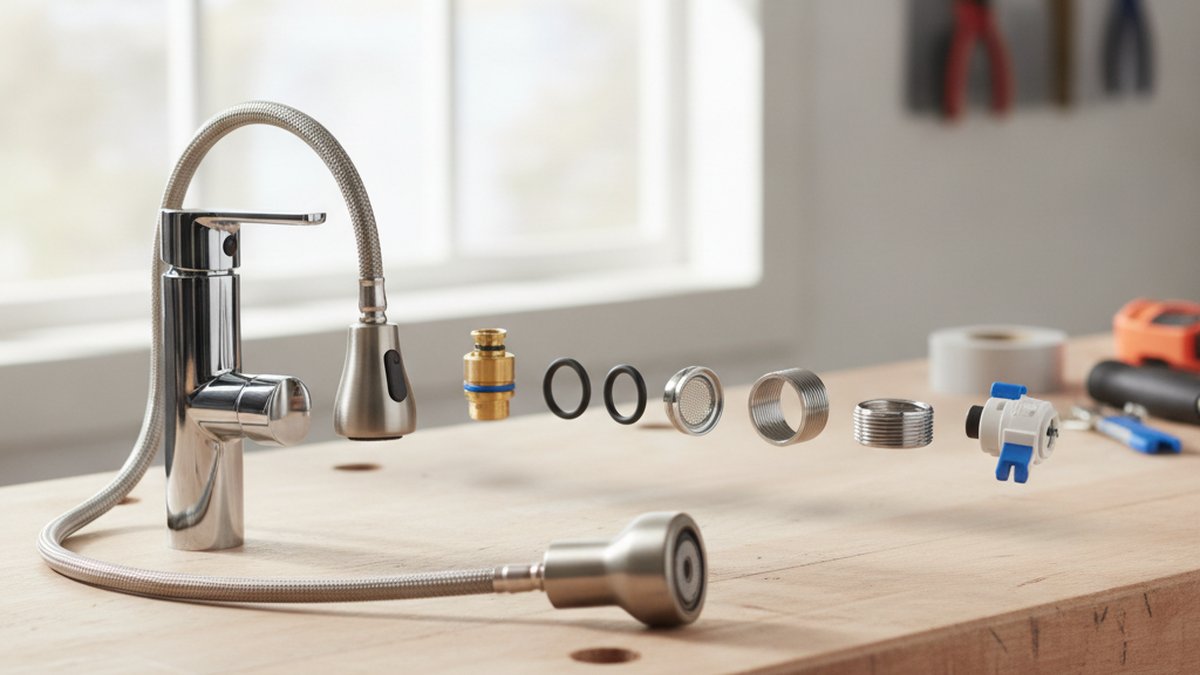
When people search for kitchen faucet replacement parts, they’re almost never shopping for fun — they’ve got a faucet that drips, sprays sideways, won’t swivel, or delivers a sad trickle, and they want to fix it cheaply without ripping the whole thing out. The good news: about 80% of kitchen faucet problems come down to five or six small, inexpensive components. The trick is knowing which part is failing and how to match it to your faucet. This guide walks through every common part, how to identify what you need, what it costs, and when a repair stops making sense.
At Cobbe, we design and test pull-down and pull-out kitchen faucets and their internal components, so we spend a lot of time with the guts of these fixtures. Below is the same reasoning our support team uses when a customer emails “my faucet is doing X — what do I buy?”
What are the most common kitchen faucet replacement parts people actually need?
The parts that fail most often, in rough order, are the cartridge/valve, the aerator, the O-rings and seals, the pull-down spray head, and the hose. Everything else — handles, mounting hardware, escutcheon plates — fails rarely and is usually a cosmetic or install issue rather than wear.
Here’s what each part does and the symptom that points to it:
- Cartridge (or valve): the heart of the faucet that mixes hot and cold and turns flow on/off. Symptom: dripping when off, hard-to-turn handle, or a handle that spins loosely. This is the #1 cause of a leaking faucet.
- Aerator: the small mesh screen that screws into the tip of the spout or spray head. Symptom: weak, uneven, or splashy flow. Often just clogged with mineral scale — a $6 fix.
- O-rings and seals: rubber rings that stop water sneaking out around the base or spout. Symptom: water pooling at the base of the faucet or a leak when the spout swivels.
- Spray head (wand): the pull-down nozzle itself. Symptom: cracked housing, stuck spray/stream toggle, or the head won’t dock/stay up.
- Hose and quick connector: the flexible line inside the spout plus the coupling that joins it. Symptom: leaking under the sink or a spray head that won’t retract.
If you can name your symptom, you can usually name your part. The rest of this guide helps you do exactly that.
How do I know which kitchen faucet replacement part is causing my problem?
Match the symptom to the part — most kitchen faucet issues map cleanly to one component. Below is the diagnostic table our team uses so you don’t buy the wrong thing.
| Symptom | Most likely part | Typical cost (USD) | DIY difficulty |
|---|---|---|---|
| Faucet drips when fully off | Cartridge / valve | $15–$45 | Medium |
| Weak, splashy, or uneven flow | Aerator (clean or replace) | $6–$15 | Easy |
| Water pooling at the base | O-rings / seals | $5–$12 | Medium |
| Cracked or stuck spray nozzle | Spray head / wand | $18–$40 | Easy |
| Leak under the sink | Supply hose or quick connector | $10–$30 | Easy–Medium |
| Spray head won’t retract | Hose weight or hose | $8–$25 | Easy |
| Handle loose / wobbly | Set screw, adapter, or cartridge nut | $0–$10 | Easy |
A quick real-world example: a customer says “my faucet drips a little and the handle is stiff.” That’s a classic worn cartridge — sediment and mineral buildup have chewed up the internal seals. Cleaning won’t fix it long-term; you replace the cartridge. Another says “flow got weak overnight.” Nine times out of ten that’s a clogged aerator, and unscrewing it to soak in vinegar costs nothing. If your handle is the problem rather than the flow, our guide on why a kitchen faucet keeps coming loose walks through the fixes step by step.
How do I find the right replacement part for my exact faucet model?
Match the part to your faucet’s brand and model number — parts are almost never universal, especially cartridges and spray heads. Cartridges in particular are proprietary: a Moen 1225 will not fit a Delta, and a Cobbe cartridge is sized for Cobbe valve bodies. Buying by “it looks the same” is the single biggest reason people order the wrong part twice.
Here’s how to nail down your model:
- Check the original box or manual if you still have it — the model number is printed on the label and the spec sheet.
- Look under the sink. Many faucets have a sticker, laser etching, or stamped code on the valve body or supply lines.
- Look on the faucet itself. Some brands print a model or series name on the base, spout, or under the handle.
- Search your purchase history. If you bought online, the order confirmation has the exact SKU.
- Photograph the part and compare it to the manufacturer’s parts diagram. For cartridges, measure length, diameter, and count the number of tabs/splines.
Two measurements matter most for internal parts: the cartridge dimensions and the valve size. If you’re replacing a cartridge, our breakdown of what kitchen faucet valve size you need shows exactly how to measure so the new cartridge seats correctly. And if you’re not even sure which valve mechanism your faucet uses — ceramic disc, ball, compression, or cartridge — read the different kitchen faucet valve types first, because the type dictimes which part you buy.
Can I replace just the spray head or hose instead of the whole faucet?
Yes — and you almost always should when only the wand or hose is the problem. Replacing a $25 spray head is far smarter than replacing a $150 faucet, and on most pull-down models it’s a two-minute job: unscrew the old head from the hose, check the connector type, and thread on the new one.
The catch is the connector. Spray heads attach to the hose with a coupling, and there are several standards. If the threads or the quick-connect clip don’t match, the new head won’t seat or will leak. Before you buy, read what a kitchen faucet quick connector is and how to know which one fits — it saves a lot of return trips. For the head itself, our guide on doing a sprayer head replacement without replacing the whole faucet covers the exact steps, and how to pick the right replacement head explains matching flow rate, spray patterns, and finish.
The hose is just as replaceable. If you see water dripping under the sink only when the sprayer is pulled out, the hose has likely cracked or its connection has loosened — a common failure once the outer coating wears through from rubbing on the cabinet edge. Swapping a pull-down hose is a 10-minute job with no special tools.
| Repair scenario | Replace the part? | Or the whole faucet? |
|---|---|---|
| Clogged aerator | ✔ Yes — clean or $6 replace | No |
| Worn cartridge, faucet 1–5 yrs old | ✔ Yes — $15–$45 | No |
| Cracked spray head | ✔ Yes — $18–$40 | No |
| Leaking hose | ✔ Yes — $10–$25 | No |
| Corroded valve body / spout won’t swivel | Maybe | Often yes if 10+ yrs |
| Finish flaking + multiple failing parts | No | ✔ Replace faucet |
How much do kitchen faucet replacement parts cost, and when is it cheaper to replace the whole faucet?
Most individual parts run $6–$45, so a single repair almost always beats buying a new faucet. The math flips only when you’re facing multiple failing parts at once, a corroded valve body, or a faucet old enough that parts are discontinued.
A practical rule of thumb we give customers: if the repair costs less than one-third of a comparable new faucet and the faucet body is still solid, fix it. A $30 cartridge on a $180 faucet is an easy yes. But if you’re looking at a new cartridge plus new O-rings plus a new spray head on a 12-year-old faucet with a flaking finish, you’re spending $80+ to prolong something that’s near end-of-life — that’s when a new faucet makes sense.
Watch for these “replace it” signals:
- Parts are discontinued. Older or off-brand faucets often have no available cartridges — a dealbreaker.
- The valve body is corroded. If the metal seat the cartridge sits in is pitted, a new cartridge still won’t seal.
- The finish is failing. Peeling or flaking plating means the whole fixture is aging out.
- You’re on your third repair this year. Cumulative small fixes add up past the cost of a new, better faucet.
If you land on “replace it,” don’t overpay — our guide to finding a great kitchen faucet on sale without buying junk and the broader kitchen faucet buying guide will steer you toward a fixture whose parts stay available for years.
How do I actually install a new cartridge or O-ring myself?
You can replace most kitchen faucet parts with a screwdriver, an adjustable wrench, and 20–30 minutes — no plumber required. The single most important step is turning off the water first. Here’s the general process for the two most common repairs.
Replacing a cartridge:
- Shut off both hot and cold supply valves under the sink, then open the faucet to release pressure.
- Plug the drain so you don’t lose small screws.
- Remove the handle — usually a hidden set screw under a decorative cap, or an Allen screw at the base.
- Unscrew the retaining nut or clip holding the cartridge.
- Pull the old cartridge straight up. If it’s stuck with mineral buildup, a cartridge puller or gentle wiggling helps.
- Insert the new cartridge in the same orientation (note the alignment tab), reinstall the nut and handle, then turn the water back on slowly and check for leaks.
Replacing O-rings: remove the spout the same way, roll off the old rings, clean the groove, coat the new rings in plumber’s silicone grease (never petroleum jelly — it degrades rubber), and reassemble. That silicone grease is what keeps the seal supple and prevents the next leak.
If your specific issue is a loose handle rather than a leak, that’s often a set screw or adapter — not a cartridge — and our article on what’s really wrong when a faucet handle feels loose covers it in detail. For deeper stem-style repairs, see how to do a faucet stem replacement yourself. And if the leak is specifically under the sink from the sprayer line, why a pull-out hose leaks and how to fix it fast is the targeted fix.
Are Cobbe kitchen faucet replacement parts compatible with my faucet?
Cobbe replacement parts are engineered for Cobbe faucet bodies, and many of our universal-fit components — aerators, common quick connectors, and standard spray heads — also fit a range of major-brand faucets that use the same industry-standard threading. Cartridges, however, are model-specific: always match by your faucet’s model number.
If you own a Cobbe faucet, the fastest path is to find your model number and match the part directly, or contact our support team with a photo and we’ll identify it for you. If you own another brand and want a universal aerator or spray head, check the connector standard first using the resources linked above. When in doubt, measure and ask before you buy.
FAQ
Are kitchen faucet cartridges universal?
No. Cartridges are proprietary to each brand and often to specific model series. A cartridge is defined by its length, diameter, spline/tab pattern, and how it seats in the valve body — get any of those wrong and it won’t seal. Always match a cartridge by your faucet’s brand and model number, not by appearance.
How do I know if I need a new cartridge or just to clean it?
If your faucet drips when fully off, the handle is stiff or the flow won’t fully stop, the cartridge is worn and should be replaced. If the water flow is simply weak or splashy, that’s usually a clogged aerator — unscrew it and soak it in vinegar before spending money on anything else. Cleaning fixes flow problems; it rarely fixes a persistent drip.
Can I use a different brand’s replacement part on my faucet?
For universal components like aerators and some spray heads, yes — as long as the threading matches (the most common is 55/64″-27 for aerators). For cartridges, valves, and proprietary quick connectors, no. Mixing brands on internal parts almost always causes leaks or a part that won’t seat.
How long do kitchen faucet replacement parts last?
A quality ceramic-disc cartridge typically lasts 5–10 years, and often longer in soft-water areas. O-rings last 3–7 years. Aerators can clog within months in hard-water homes but simply need cleaning, not replacement. Spray heads and hoses usually last the life of the faucet unless physically damaged. Hard water is the biggest factor shortening the life of any wear part.
Where can I buy the right kitchen faucet replacement parts?
Buy from the faucet’s own manufacturer whenever possible, using your model number — that guarantees fit. For Cobbe faucets, order directly from cobbe.net or contact support with a photo. Avoid generic “fits most faucets” cartridges from unknown sellers; the small savings isn’t worth the leak. If you find the parts are discontinued, that’s usually your sign to replace the faucet instead.
Do I need to turn off the water to replace an aerator?
No — the aerator is at the very tip of the spout, downstream of the valve, so you can unscrew and clean or swap it with the water supply on. For any repair involving the cartridge, O-rings, hose, or valve, though, always shut off both supply valves under the sink first and relieve pressure by opening the faucet.
A note on trust
Author’s note: This guide was written by the Cobbe product and support team, drawing on the questions we field every day from customers repairing their own faucets. Cobbe designs, manufactures, and independently tests kitchen faucets and their internal components, and our faucets are built to meet North American standards for lead-free wetted surfaces (NSF/ANSI 61 & 372) and cUPC certification. Cobbe replacement parts are backed by our warranty, and our support team can identify the correct part for your model from a single photo. We recommend repairs over replacement wherever it’s the honest, cost-effective choice — because a faucet you can maintain is a faucet worth owning.