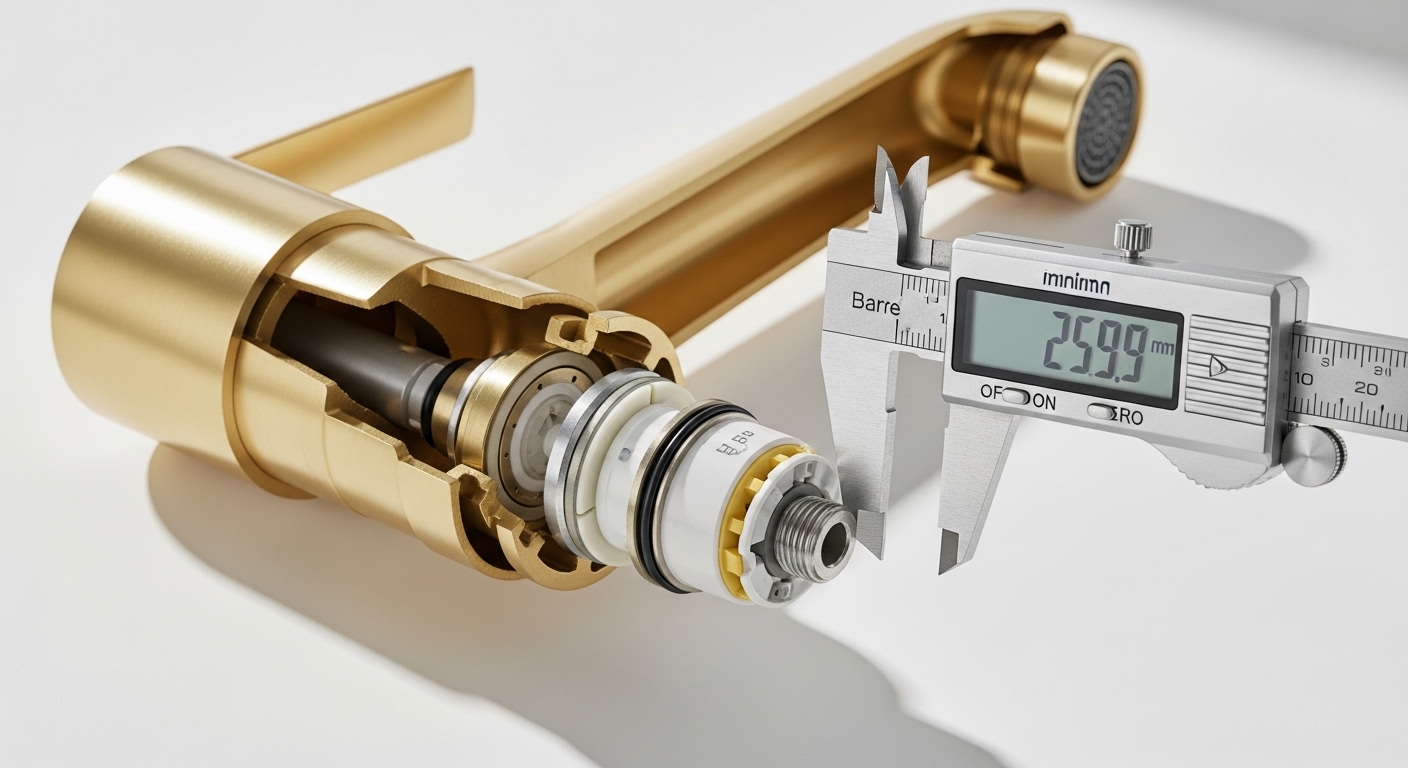
If you’re standing at your sink with a dripping single-handle mixer and someone told you to “just swap the cartridge,” the first question you hit is the kitchen faucet valve size — and it’s the one detail that stops most DIY repairs cold. The valve (also called the cartridge) is the plastic-and-ceramic core that controls how much hot and cold water passes through, and its diameter has to match the pocket it sits in. Get the size wrong and it either won’t seat, won’t seal, or won’t turn. Below I’ll show you exactly how to measure it, the sizes that actually exist, how to match a replacement, and when a valve swap is the right fix versus when you should replace the whole faucet.
What Exactly Is the “Valve Size” on a Kitchen Faucet?
Valve size is the outside diameter of the cartridge barrel, measured in millimeters across the widest part of the round body — not the height, not the spout, not the supply line. On a single-handle kitchen faucet, that cartridge is a ceramic-disc valve: two polished ceramic discs stacked inside a plastic housing. When you move the handle, one disc slides over the other, and the alignment of the ports mixes hot and cold and sets the flow. The barrel diameter is what “35 mm” or “40 mm” refers to.
Here’s why the number matters: the cartridge drops into a machined pocket in the brass faucet body and is locked down by a retaining nut or clip. That pocket is cut for one diameter. A 35 mm cartridge will rattle loose in a 40 mm pocket and leak around the sides; a 40 mm cartridge simply won’t fit a 35 mm body. So “valve size” is really “which cartridge family does my faucet body accept” — and it’s set at the factory when the faucet is cast.
How Do I Measure My Kitchen Faucet Valve Size at Home?
Shut off the water, pull the cartridge, and measure the outside diameter of the round barrel with a caliper or ruler in millimeters — that number is your valve size. You cannot reliably measure it while it’s installed; you have to get the old one out first. Here’s the clean sequence:
- Turn off both shutoff valves under the sink and open the faucet to release pressure. If there are no shutoffs, close the main.
- Pop the handle cap (a small plastic button on the front or top), then remove the set screw underneath with a hex/Allen key and lift the handle off.
- Unthread the dome/bonnet nut or remove the retaining clip holding the cartridge down. Some brands use a horizontal brass clip you pull out with pliers.
- Pull the cartridge straight up. If it’s stuck with mineral scale, wiggle gently or use a cartridge-puller tool — don’t crank on it and crack the housing.
- Measure the barrel’s outside diameter across the top with calipers. Round to the nearest common size: 25, 35, or 40 mm. Also note the total length and the number/shape of the ports on the bottom.
Snap a photo of the bottom of the cartridge too — the port pattern and any tabs or keyways are how a supplier confirms the exact match, since two cartridges can share a diameter but have different keying. If the leak is what sent you here in the first place, our walkthrough on why your kitchen faucet is dripping and how to stop it fast covers whether the cartridge is even the culprit before you tear it apart.
What Are the Common Kitchen Faucet Valve Sizes?
The three sizes that cover the vast majority of home kitchen faucets are 25 mm, 35 mm, and 40 mm — with 35 mm being the most common on mid-range single-handle pull-down models. Bathroom lav faucets and compact bar faucets often run smaller (down to 25 mm), while heavier commercial-style and high-arc kitchen units lean toward 40 mm because the bigger disc handles higher flow. Here’s how they stack up:
| Valve size (barrel Ø) | Typical use | Flow feel | Common on |
|---|---|---|---|
| 25 mm | Bar/prep, bathroom, compact single-handle | Lighter, shorter handle throw | Small kitchen & lavatory faucets |
| 35 mm | Standard residential kitchen (most common) | Balanced, smooth | Most pull-down / pull-out kitchen faucets |
| 40 mm | High-arc, commercial-style, high-flow | Wider ports, more volume | Heavy-duty & pro-style kitchen faucets |
Two cautions. First, diameter alone doesn’t guarantee interchangeability — the port layout, stem length, and keyway have to match too, so a 35 mm Brand A cartridge won’t necessarily drop into a 35 mm Brand B body. Second, some major brands use proprietary cartridges that don’t map neatly to a millimeter size at all (more on that next). Treat the mm size as the first filter, not the whole answer.
Are Kitchen Faucet Valves Universal, or Brand-Specific?
They are mostly brand-specific — there is no single “universal” kitchen faucet cartridge, so your safest path is to match the faucet’s brand and model number, not just the diameter. Big names each run their own cartridge families: Moen’s 1255 Duralast, Delta’s ceramic and older ball/DIAMOND Seal designs, Kohler’s proprietary valves, and so on. Generic ceramic-disc cartridges sold by size (25/35/40 mm) fit a large pool of unbranded and import faucets, but you still confirm by port pattern.
The practical rule: if your faucet is from a named brand and still in warranty, get that brand’s exact replacement cartridge — often free from the manufacturer. If it’s a generic or private-label faucet, measure the diameter, photograph the ports, and match a ceramic-disc cartridge of the same size and keying. When you’re weighing a repair against buying new, our comparison of Moen vs Delta faucets breaks down how each brand handles cartridges and warranty support, which directly affects how easy your next valve replacement will be.
Should I Replace the Valve or the Whole Faucet?
Replace just the valve if the faucet body is sound and you can source the exact cartridge; replace the whole faucet if the body is corroded, the brand is unknown and unmatchable, or the fixture is old and cheaply made. A cartridge runs roughly $10–$45; a decent kitchen faucet is $80–$300+. So the math usually favors a cartridge swap — but only when three things are true:
- The body isn’t damaged. Cracked brass, stripped threads, or a seized retaining nut can make a cartridge swap pointless.
- You can identify or measure the valve. An orphan import with no model number and an odd port pattern may be un-sourceable — at that point a new faucet is the realistic fix.
- The faucet is otherwise worth keeping. If the finish is flaking, the sprayer hose is shot, and it’s a decade old, put the money toward a replacement instead of chasing parts.
If you decide to replace the whole unit, our step-by-step guide on how to install a kitchen faucet walks through supply lines, mounting, and the sprayer hookup so you’re not guessing. And before you blame the valve for weak flow, check the aerator — a clogged screen mimics a failing cartridge. Our guide to cleaning a clogged faucet aerator takes five minutes and often solves “low pressure” without touching the valve at all.
How Do I Match and Install the Right Replacement Valve?
Match by three data points — barrel diameter, overall length, and port pattern — then reinstall in the reverse order you removed it, seating the cartridge fully and lining up the keyway before you tighten. Rushing the alignment is the number-one cause of a “new cartridge that still leaks or has hot and cold reversed.”
- Confirm the match. Diameter (25/35/40 mm), length, and the tab/keyway orientation must all agree. When in doubt, bring the old cartridge to the counter or send photos to the supplier.
- Clean the pocket. Wipe mineral scale out of the cartridge bore and lightly grease the O-rings with silicone plumber’s grease so it seals and slides.
- Seat it with the keyway aligned. Most cartridges have a flat, notch, or tab that must point a specific way (usually toward the spout) so hot and cold land on the correct sides.
- Re-lock it. Reinstall the retaining nut or clip snugly — hand-tight plus a nudge, not gorilla-tight, which can crack ceramic.
- Reassemble and test. Handle, set screw, cap. Turn the water back on slowly and check for drips at full open and fully closed.
If the handle feels loose after reassembly, that’s almost always the set screw or an unseated cartridge — the same failure pattern we cover in our fix for a loose handle on a faucet.
How Do I Know the Valve — Not Something Else — Is the Problem?
A bad cartridge shows up as a persistent drip from the spout when the handle is fully off, hot/cold that won’t mix or won’t get hot, a handle that’s suddenly stiff or gritty, or water seeping around the base of the handle. If instead the whole faucet trickles everywhere or pressure dropped across the whole house, the valve is probably fine and the issue is the aerator, the supply lines, or house pressure. A quick diagnostic:
- Drips from the spout, handle off → worn ceramic discs or seals — valve.
- Weak stream from the spout tip only → clogged aerator, not the valve.
- Water at the handle base → failed cartridge O-ring or loose retaining nut.
- No hot water at this faucet only → cartridge installed rotated, or a debris-jammed port.
FAQ
Is a 35 mm kitchen faucet valve the same as a 40 mm one?
No. They are different diameters and are not interchangeable — a 40 mm cartridge won’t fit a 35 mm body, and a 35 mm cartridge will leak inside a 40 mm pocket. Always match the exact diameter, plus length and port pattern.
Can I use a generic ceramic cartridge instead of the brand’s part?
Sometimes, if your faucet is unbranded or private-label and the generic matches the diameter, length, and keyway. For a named brand still under warranty, use the manufacturer’s exact cartridge — it’s often free, and a generic can void coverage or seat imperfectly.
How do I find my valve size without a caliper?
Remove the cartridge and measure the barrel across the top with a metric ruler, or lay it against a coin for reference and photograph it next to the ruler. Then match it to 25, 35, or 40 mm. Your faucet’s model number, if you have it, is even more reliable than measuring.
Why does my brand-new cartridge still drip?
Usually it’s not fully seated, the keyway is misaligned, the retaining nut is under-tightened, or debris got trapped on the ceramic disc during install. Pull it, clean the bore, re-grease the O-rings, align the tab, and re-seat it fully.
How long should a kitchen faucet valve last?
A quality ceramic-disc cartridge typically lasts 8–15 years in average water. Hard water shortens that by depositing scale on the discs, which is why mineral buildup is a leading cause of stiff handles and early leaks. Periodic cleaning and a good cartridge extend its life.
Does hard water affect which valve I should buy?
Not the size, but the material. In hard water, stick with ceramic-disc cartridges (not rubber-seat or ball valves), because ceramic resists scale and abrasion far better. The size still has to match your faucet body regardless of water quality.
The Bottom Line
Kitchen faucet valve size comes down to three numbers you can get in ten minutes: the barrel diameter (25, 35, or 40 mm), the length, and the port pattern. Match those to a ceramic-disc cartridge — ideally the brand’s exact part — and a leaking single-handle faucet is a $15 fix instead of a $200 replacement. Measure before you buy, align the keyway on install, and don’t over-torque the retaining nut, and you’ll get years more life out of a faucet you already own.
Author’s note — written by the Cobbe fixtures team. Cobbe designs and sells kitchen and bathroom faucets and has hands-on tested cartridge fitment across 25/35/40 mm ceramic-disc valves and major-brand bodies. Our faucets use ceramic-disc cartridges rated to industry cycle-life standards (tested to 500,000+ open/close cycles) and are backed by our finish-and-function warranty. This guide is for general repair reference; when a faucet is under a manufacturer’s warranty, always use that brand’s specified replacement cartridge to keep coverage valid. Learn more at cobbe.net.
Pingback: Why Is My Grohe Bathroom Faucet Handle Loose, and How Do I Tighten It? - Cobbe