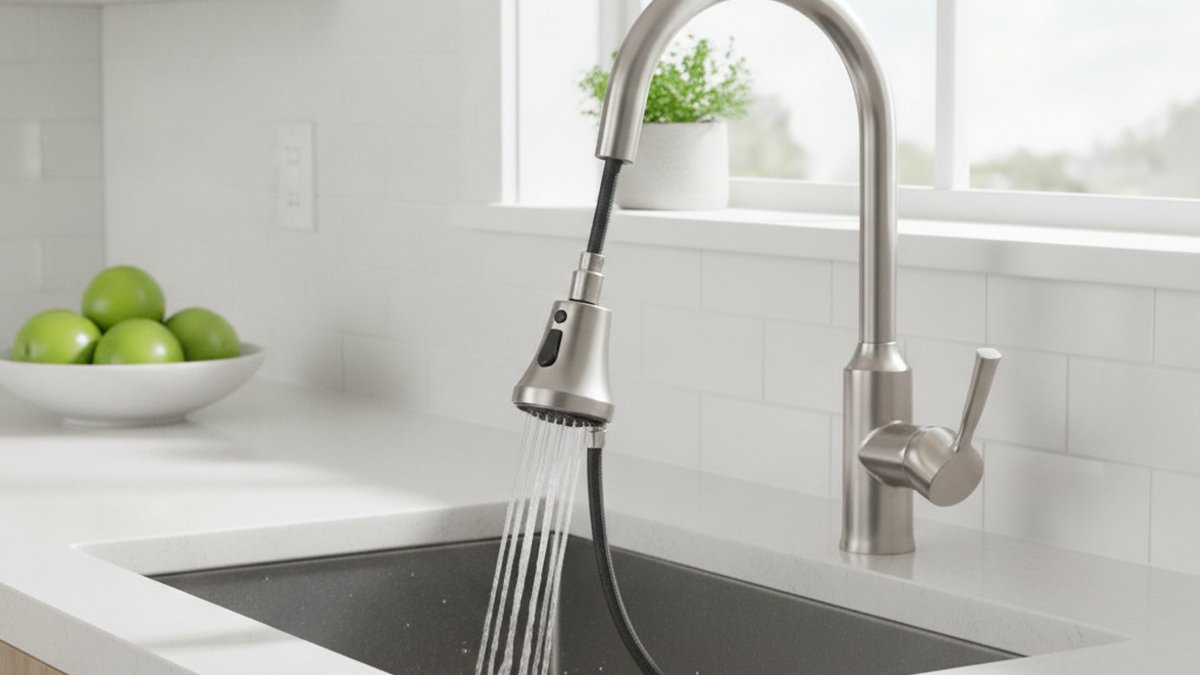
This kitchen faucet buying guide skips the fluff and walks you through the decisions that actually change how your faucet feels every day: mounting, reach, valve type, spray style, finish, and price. Buy the wrong height and you’ll splash the counter; buy the wrong number of mounting holes and you’re staring at ugly exposed cutouts. Get these six things right and even a mid-priced faucet will outlast the trendy expensive one your neighbor regrets.
We’ll answer the real questions people ask before buying — the ones you’d type into Google or ask an AI at 11pm with a leaky faucet in front of you — and give you numbers, not vague advice.
How do I know how many mounting holes my kitchen faucet needs?
Count the holes already drilled in your sink or countertop — that’s your starting point. Most modern faucets are designed for a single hole, but many sinks come pre-drilled with three or four holes for older-style setups. The fix is simple: a faucet that mounts in one hole can cover the extras with an included deck plate (also called an escutcheon), so you don’t have to re-drill or replace the sink.
Here’s the practical rule:
- 1 hole: Single-handle faucet mounts directly. Cleanest look.
- 2 holes: Usually a faucet plus a separate side sprayer or soap dispenser.
- 3 holes: Either a widespread faucet (two handles + spout) or a single-hole faucet with a 10-inch deck plate hiding the outer two.
- 4 holes: Faucet, two handles, plus an accessory like a soap dispenser or air gap.
If you’re switching from a three-hole to a modern single-hole faucet, just confirm the deck plate is included (many are) or buy one separately. Measure the center-to-center distance on a widespread setup — the standard spread is 8 inches, and that measurement matters if you keep two handles.
What spout height and reach do I actually need over my sink?
Match the spout to your basin depth and the space above it. As a baseline, you want the water stream to land roughly in the center of the sink, with enough clearance to fit a large stockpot underneath but not so tall that water splashes out of a shallow bowl. For a standard sink, a spout with 8–10 inches of clearance and a 8–9 inch reach hits the sweet spot.
Two numbers control this:
- Spout height — vertical distance from the deck to the highest point. Tall gooseneck faucets (10″+) look great and fit big pots, but paired with a shallow sink they splash. If you have a window behind the sink, measure so the faucet clears the sill when the handle lifts.
- Spout reach — how far the water lands from the base. Too short and you’re washing dishes against the back wall of the basin. Aim for the stream to hit the drain area.
For a deep single-bowl sink (9″+ deep), a high-arc pull-down works beautifully. For a shallow or double-bowl sink, a mid-height faucet or one with an adjustable spray reduces splash. If counter space is tight or you have low cabinets above, skip the dramatic gooseneck.
Which faucet type is best — pull-down, pull-out, or a fixed spout?
For most kitchens, a pull-down faucet is the best all-rounder: the spray head pulls straight down into the sink, giving you reach and control without hogging counter space. Pull-out and fixed-spout designs still have their place, though — it depends on your sink and how you cook.
| Type | Best for | Pros | Watch out for |
|---|---|---|---|
| Pull-down | Deep single-bowl sinks, everyday cooking | Great reach, tall arc fits big pots, spray head docks magnetically | Needs clearance above; too tall for low windows |
| Pull-out | Shallow sinks, sinks under a window | Lower profile, spray head pulls toward you, easy to fill pots on the counter | Shorter arc, hose can be shorter |
| Fixed spout (with side sprayer) | Traditional or budget setups | Simple, fewer moving parts, cheap to repair | Separate sprayer is another leak point over time |
| Commercial/spring-neck | High-use, large-basin kitchens | Huge clearance, pro look, powerful rinse | Very tall, splashes shallow sinks, pricier |
If you’re torn, a pull-down with a magnetic dock and at least two spray modes (aerated stream + a stronger rinse spray) covers 95% of what home cooks need. If you want to go deeper on spray heads and how the sprayer mechanism differs between models, our breakdown of what a kitchen faucet spray head is and how to pick one is worth a read before you commit.
What’s the most important part inside the faucet — and what fails first?
The valve (the cartridge) is the single most important component, because it’s the part that controls water flow and temperature — and it’s what fails first when a faucet starts dripping. A quality ceramic-disc valve is what separates a faucet that lasts 15+ years from one that drips within two.
You’ll mainly run into three valve technologies:
- Ceramic disc — two polished ceramic plates that slide against each other. Extremely durable, resists hard-water grit, smooth handle feel. This is what you want.
- Ball valve — common in older single-handle faucets; more small parts and springs, more leak points.
- Compression/washer — old-school, uses rubber washers that wear out fast. Avoid in a new purchase.
Before you buy, it genuinely helps to understand what’s happening inside the handle. Our guide to kitchen faucet valve types and which one you actually need explains why the cartridge matters more than the finish or the brand badge. One practical tip: buy a faucet whose replacement cartridge is easy to source, because a $15 cartridge swap is far cheaper than a new faucet when the valve eventually wears.
Which finish holds up best in a real kitchen — and which shows every fingerprint?
For a busy kitchen, a brushed/satin finish or a “spot-resist” stainless finish hides water spots and fingerprints best; polished chrome and shiny gold show every smudge. Matte black looks stunning but can show hard-water mineral film if your water is very hard. Finish is where looks and maintenance collide, so choose for your water and your cleaning tolerance, not just the showroom photo.
| Finish | Fingerprints/spots | Vibe | Maintenance |
|---|---|---|---|
| Brushed / spot-resist stainless | Hides them well | Neutral, modern, works with anything | Low — wipe with a damp cloth |
| Matte black | Hides fingerprints, shows white mineral film | Bold, contemporary | Medium — wipe hard-water spots promptly |
| Polished chrome | Shows everything | Classic, bright | Medium-high — frequent wiping |
| Brushed gold / champagne bronze | Hides moderately | Warm, upscale | Low-medium |
| Oil-rubbed bronze | Hides well | Traditional, farmhouse | Low, but finish can wear at touch points |
A quick note on hard water: if your area has hard water, mineral buildup will dull any finish over time and clog the aerator. That’s normal — unscrew the aerator every few months, soak it in white vinegar, and rinse. It’s the cheapest maintenance habit there is, and it keeps your flow strong regardless of finish.
How much should I spend, and where’s the best value?
For a durable, good-looking faucet you’ll be happy with for a decade, budget $120–$250. Below about $80 you start gambling on valve quality and thin finishes; above $300 you’re mostly paying for brand prestige, designer styling, or smart features. The value sweet spot for most homeowners sits squarely in the middle.
Here’s a realistic price map:
- Under $80: Fine for a rental or a short-term fix, but check the valve type and read reviews about leaks.
- $120–$250: The sweet spot — solid brass or stainless body, ceramic-disc valve, magnetic dock, good warranty.
- $250–$450: Premium brands, designer finishes, touchless/touch activation, longer warranties.
- $450+: Luxury and pro-style. Great, but you’re paying for the name and the look as much as the function.
Don’t pay full price if you don’t have to — kitchen faucets go on sale constantly, and a $220 faucet at 30% off is often better value than an $80 unknown. Just make sure a discount isn’t hiding an outdated valve or a discontinued model with no replacement parts. Our guide on finding a great kitchen faucet on sale without buying junk covers exactly how to tell the difference. And if you’d rather shop in person to feel the handle action and check the finish under real light, here’s how to find the best kitchen faucets near you, in-store or online.
Do I need touchless, and is it worth the extra money?
Touchless is a genuine convenience if you cook with messy hands often — raw chicken, sticky dough, muddy garden veg — because you turn water on with a wave instead of smearing the handle. But it adds cost, needs batteries or a plug, and introduces electronics that can eventually fail. For most people it’s a nice-to-have, not a must-have.
If you go touchless, look for a model that still works manually when the power or batteries die — the best ones let you use the handle normally as a fallback. Touch-activated (tap anywhere on the spout) is a middle ground: less finicky than motion sensors, still hands-friendlier than a bare handle. If your budget is tight, put the money into a better valve and finish first; add smart features only if the convenience genuinely fits how you cook.
What flow rate should I look for?
Most modern kitchen faucets are capped at 1.8 gallons per minute (GPM), and some water-efficient models run at 1.5 GPM — that’s plenty for a kitchen. Don’t chase a higher number; a well-designed aerator delivers a strong, satisfying stream at 1.5–1.8 GPM while saving water. Faucets sold in the U.S. must meet federal flow standards, and models certified to WaterSense or NSF/ANSI 61 for drinking-water safety are a smart pick. A faucet that “feels weak” is almost always a clogged aerator, not a low GPM rating.
Quick step-by-step: how to choose your faucet in order
- Count your sink’s mounting holes and decide if you need a deck plate.
- Measure clearance above the sink (windowsills, cabinets) and your basin depth.
- Pick a type — pull-down for most, pull-out for shallow/under-window sinks.
- Insist on a ceramic-disc valve and confirm replacement cartridges are available.
- Choose a finish for your water hardness and cleaning tolerance.
- Set a budget of $120–$250 and check the warranty before you buy.
FAQ
What’s the best type of kitchen faucet for a small kitchen?
A single-handle pull-down or pull-out faucet in a mid-height arc. Single-handle designs need only one hand and one hole, and a moderate spout height avoids crowding a small window or upper cabinet while still fitting pots underneath.
How long should a kitchen faucet last?
A quality faucet with a ceramic-disc valve should last 10–20 years. The body and finish usually outlast the cartridge, so expect one inexpensive cartridge swap somewhere along the way rather than a full replacement. Choosing a brand with easy-to-find parts is what makes that repair painless.
Is a more expensive faucet always better?
No. Past roughly $250 you’re mostly paying for brand name, designer styling, and smart features — not core durability. A mid-priced faucet with a solid brass or stainless body and a ceramic-disc valve will outperform a flashy budget faucet with a cheap plastic cartridge, and often matches a luxury one on everyday function.
Can I install a kitchen faucet myself?
Yes, most single-hole faucets are a 30–60 minute DIY job with basin wrench, a bucket, and the flexible supply lines included in the box. Shut off the water under the sink first, disconnect the old lines, drop the new faucet through the hole, tighten the mounting nut, and reconnect the supply lines. If your shutoff valves are old or seized, that’s the one point where calling a plumber can save headaches.
What should I check before buying to avoid a leaky faucet later?
Confirm three things: the valve is ceramic disc (not rubber-washer compression), the body is brass or stainless (not thin zinc/plastic), and replacement cartridges are readily available for that model. Then check the warranty — a lifetime or limited-lifetime warranty on the finish and function is a strong signal the maker trusts the build.
Does the faucet brand really matter?
It matters for parts availability and warranty support more than raw performance. Established brands make it easy to buy a replacement cartridge or spray head years later, which is what keeps a faucet alive long-term. If you’re comparing big names, our Kohler vs Grohe comparison shows how two respected brands stack up on price, parts, and durability.
A note on how we test and who wrote this
This guide was written by the Cobbe product team, who design and pressure-test kitchen faucets for real-world use — including cartridge cycle testing, finish durability checks, and flow verification against U.S. water-efficiency standards. Cobbe (cobbe.net) specializes in faucets and bathroom fixtures, and our recommendations come from hands-on installation and long-term use, not spec sheets alone. We stand behind our fixtures with a manufacturer warranty and stock replacement parts — because the best faucet is the one you can keep running for years, not just the one that looks good on day one.
Pingback: What Are the Best Kitchen Faucet Replacement Parts, and How Do You Find the Right One for Your Faucet? - Cobbe
Pingback: Which Kitchen Faucet With Sprayer Pull-Out Spray Should You Actually Buy in 2026? - Cobbe