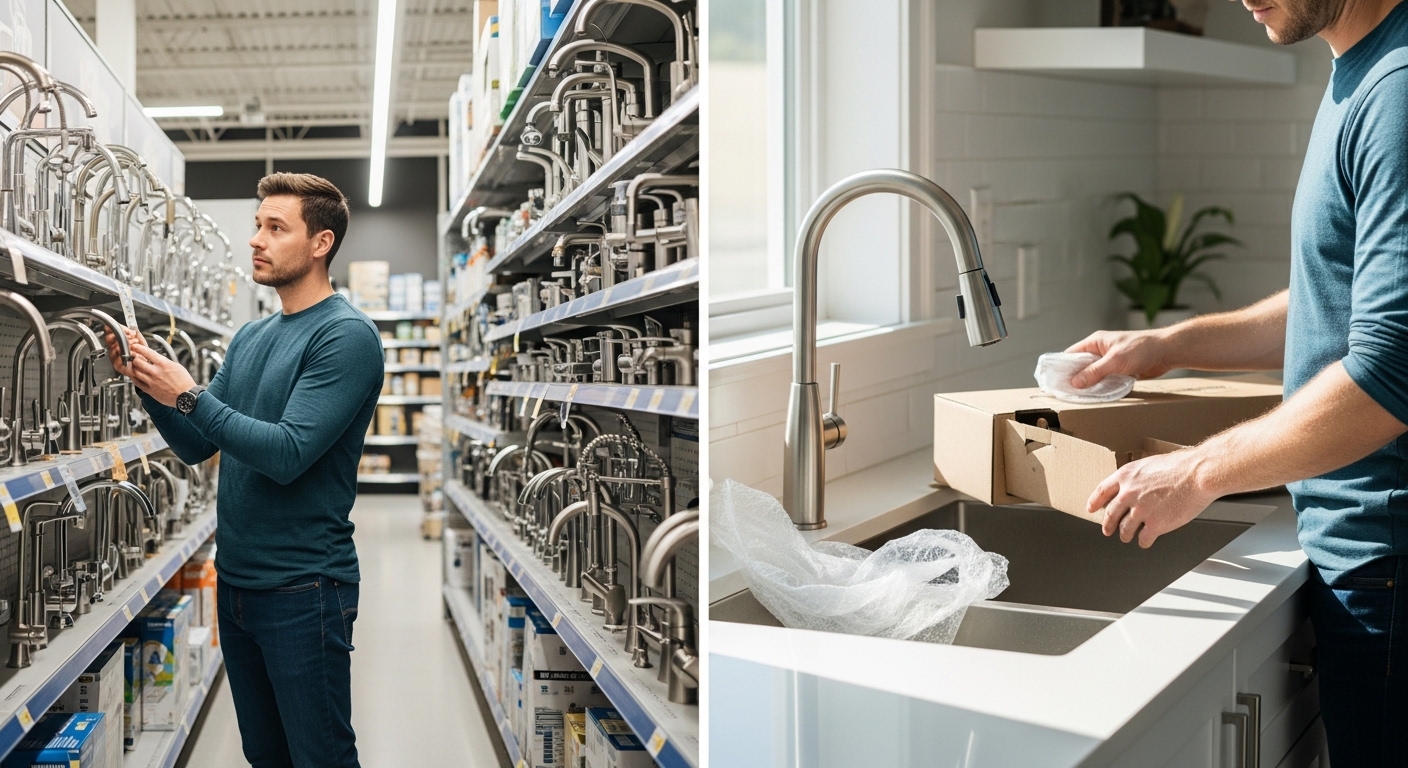
When people search “kitchen faucets near me,” they’re almost never looking for a geography lesson — they want a working faucet, fast, at a fair price, without a plumbing headache. The catch is that “near me” today means something different than it did ten years ago: your true nearest options include a warehouse that can drop a boxed faucet on your porch tomorrow, not just the store 8 miles down the road. At Cobbe, we design and ship kitchen faucets nationwide, and we talk to hundreds of buyers a month who are stuck between “run to the store now” and “order the right one online.” This guide walks through exactly where to buy, what each option really costs you, and how to pick a faucet that fits your sink the first time.
Where should I actually buy a kitchen faucet near me?
Buy online from a specialist brand for the best price and selection; use a local big-box store when you need the faucet the same day, and a plumbing supply house when you want pro-grade quality and expert advice in person. Each channel wins in a different situation, so match the store to your urgency and budget rather than defaulting to whatever is closest.
Here’s how the three real “near me” options break down in practice. Big-box stores like Home Depot, Lowe’s, and Menards are everywhere, stock a rotating shelf of 20–40 models, and let you walk out with a faucet in an hour. Local plumbing supply houses (think Ferguson, or your regional wholesaler) carry higher-end lines, know their inventory cold, and can order almost anything — but they cater to contractors and can feel intimidating to a DIYer. Online specialists, including Cobbe, carry deeper catalogs, better per-dollar value, and full parts support, at the cost of a short shipping wait.
| Where you buy | Typical price range | Selection | How fast | Best for |
|---|---|---|---|---|
| Big-box store (Home Depot / Lowe’s) | $79–$350 | 20–40 models on shelf | Same day | Emergencies, seeing finishes in person |
| Plumbing supply house | $150–$600+ | Deep, pro-grade brands | Same day or 1–2 day order | High-end builds, expert advice |
| Online specialist (Cobbe, etc.) | $60–$300 | Full catalog, all finishes | 2–4 day shipping | Best value, hard-to-find styles, parts support |
| Marketplace (Amazon, eBay) | $40–$250 | Huge but uneven quality | 1–3 day shipping | Budget buys — watch for counterfeits |
One warning on that last row: the marketplace flood is where counterfeit and knock-off faucets slip through, often mimicking major brands with substandard cartridges and thin plating. Regulators regularly seize these — as we covered when counterfeit operations faking TOTO, Kohler, and JOMOO were smashed — so if a “brand-name” faucet is 70% off from an unknown seller, treat it as a fake until proven otherwise.
Is it cheaper to buy a kitchen faucet online or in a store near me?
Online is usually cheaper — often 15–30% less for a comparable spec — because specialist brands skip the retail markup and shelf-space costs. The exception is a clearance or open-box unit at a local store, which can undercut online for a specific model. If you know exactly what you want, compare the online direct price against the in-store tag before you drive anywhere.
Where in-store shopping quietly costs you more is the “convenience tax.” A store stocks a limited set of SKUs, so you often end up buying the finish or style that’s on the shelf rather than the one you actually wanted — and paying full retail for it. Online, the same $150 budget stretches to a pull-down sprayer with a better valve, a magnetic docking spray head, and a matching soap dispenser. The trade-off is patience: you wait a couple of days instead of walking out with a box.
- Watch the total, not the sticker. Factor in sales tax, any supply lines you need to add, and whether a mounting deck plate is included.
- Check what’s in the box. Better brands include supply hoses, a deck plate, and mounting hardware; cheaper ones make you buy those separately.
- Read the flow rate. Most U.S. kitchen faucets are capped at 1.8 GPM (gallons per minute) or lower for WaterSense compliance — a lower number saves water without feeling weak if the aerator is good.
- Confirm the finish matches. “Stainless” from one brand rarely matches “brushed nickel” from another; order a hardware set or coordinated pieces to stay consistent.
What should I look for before I buy — will it even fit my sink?
Before you buy anything, count your sink’s mounting holes and measure your under-sink clearance — those two numbers decide what actually fits. Most kitchen sinks have 1, 2, 3, or 4 holes, and a mismatch is the number-one reason faucets get returned. A single-hole faucet can cover extra holes with a deck plate (escutcheon), but you can’t magically add holes for a widespread setup.
Here’s the quick pre-purchase checklist we give Cobbe customers so the faucet fits the first time:
- Count the holes. Look under or behind your current faucet. One hole = single-handle faucet; three or four = you may need a deck plate or a spread-out configuration.
- Measure hole diameter. Standard is about 1⅜ inches (35 mm); some older sinks are smaller.
- Check spout height and reach. A tall pull-down spout is great for filling pots but can splash in a shallow sink; measure the space to your window or upper cabinet.
- Look at your water lines. Confirm whether you have ⅜-inch compression supply valves — most modern faucets connect to these directly.
- Verify sprayer type. Pull-down (hose retracts into the spout) vs. pull-out (hose pulls toward you) changes how it feels day to day.
If you’re replacing a leaky old unit and just want the same footprint, our guide on how to install a kitchen faucet step by step shows the exact measurements and tools before you commit to a model.
Which finish holds up best — and which is easiest to keep clean?
For low-maintenance daily use, spot-resist stainless and brushed nickel hide water spots and fingerprints best; matte black looks stunning but shows hard-water residue and dried droplets faster. Polished chrome is the cheapest and most durable finish but shows every fingerprint. Pick based on your water hardness and how often you want to wipe the faucet down.
Finish is where “near me” shopping has one genuine advantage — you can see the real color under store lighting. But finishes aren’t just cosmetic; they affect cleaning. If you have hard water, a brushed or satin finish forgives mineral spotting far better than a glossy one. If you love the look of warmer metals, our breakdown of whether a champagne bronze kitchen faucet is worth it covers upkeep, and if you’re leaning neutral, are brushed nickel faucets worth it compares durability and cost head-to-head.
| Finish | Hides fingerprints? | Hard-water friendly? | Relative cost | Vibe |
|---|---|---|---|---|
| Spot-resist stainless | Yes | Yes | Mid | Modern, neutral |
| Brushed nickel | Yes | Yes | Mid | Warm, classic |
| Matte black | Mostly | Shows spotting | Mid–high | Bold, contemporary |
| Polished chrome | No | Shows spots | Low | Bright, traditional |
| Champagne bronze | Yes | Good | High | Luxe, warm gold |
Whatever finish you choose, hard water is the real enemy of a faucet’s looks. If yours already has cloudy mineral buildup, our guide on how to clean hard water stains from a faucet will get the shine back without scratching the coating.
Can I install a kitchen faucet myself, or do I need a plumber?
Most single-handle kitchen faucet swaps are a genuine DIY job — plan on 45–90 minutes with a basin wrench, an adjustable wrench, and a towel. You only need a plumber if your shutoff valves are seized, your supply lines are corroded, or you’re moving from a 1-hole to a 4-hole setup that requires new sink work. For a straightforward replacement, the hardest part is usually the cramped reach under the sink.
The basic sequence is: turn off the water at the two shutoff valves under the sink, disconnect the supply lines, loosen the mounting nut holding the old faucet, lift it out, clean the deck, drop in the new faucet, tighten from below, reconnect the lines, and run the water to check for leaks. If your shutoffs won’t close fully, that’s the one moment to call a pro rather than fight a live water line. Brand-specific quirks matter too — for instance, if you’re working with a big-box brand, our walkthrough on installing a Glacier Bay kitchen faucet in under an hour covers the mounting bracket style those use.
A quick tip that saves returns: keep the box and the instruction sheet until the faucet has run leak-free for a full day. If a connection weeps, it’s almost always an under-tightened supply line or a missing rubber gasket, not a defective faucet.
Which brand should I trust — and how do I avoid buying a fake?
Stick to established brands with published warranties and real parts support, and buy from the brand’s own site or an authorized retailer — that’s the single best defense against counterfeits. Legitimate faucets from Moen, Delta, Kohler, and specialist brands like Cobbe carry limited lifetime warranties on the finish and function, plus replaceable cartridges you can actually source years later.
The brand question is really a “will I be able to fix it in five years” question. A cheap no-name faucet can look identical on day one, then strand you when the cartridge fails and no replacement exists. If you’re torn between the two most common shelf brands, our comparison of Moen vs. Delta lays out how their cartridges, warranties, and spray heads differ. Whatever you pick, the counterfeit risk is real: fakes reuse brand logos over inferior ceramic disc valves, so verify the seller is authorized and be skeptical of prices that seem too good to be true.
How Cobbe tests and stands behind its kitchen faucets
Cobbe kitchen faucets are cycle-tested to simulate years of daily use — our valves are rated for 500,000+ open-close cycles before they ship — and every model uses a ceramic disc cartridge for drip-free operation. We build to U.S. plumbing standards, including lead-free wetted surfaces that meet the requirements behind NSF/ANSI 61 and 372, and WaterSense-aligned flow rates at or below 1.8 GPM. Each faucet is backed by a limited lifetime warranty on finish and function, with replacement cartridges and spray heads kept in stock so a small part never means a whole new faucet.
That parts commitment is the quiet reason to buy from a brand that plans to be around. When a faucet starts to drip, it’s almost always a worn cartridge or O-ring — a $10 fix, not a $150 one — as long as the part still exists. If yours is dripping now, our guide on why a kitchen faucet drips and how to stop it fast walks through the diagnosis before you assume you need a whole new unit.
FAQ
Are kitchen faucets cheaper at Home Depot or online?
Online specialists are usually 15–30% cheaper for a comparable spec because they skip retail markup, but big-box stores occasionally beat online prices on clearance or open-box units. Compare the exact model’s online direct price against the in-store tag — including tax — before deciding.
How do I know how many holes my kitchen sink has?
Look under or behind your existing faucet at the sink deck; you’ll see 1, 2, 3, or 4 pre-drilled holes. A single-hole faucet can hide extra holes with a deck plate, but you can’t add holes without drilling the sink, so match the faucet’s hole requirement to what you already have.
What size cartridge or valve do I need to replace?
Cartridge size is brand- and model-specific, so identify your faucet’s make and model first, then match the replacement exactly. If you’re unsure how to measure, our guide on what kitchen faucet valve size you need shows how to size a cartridge before you order the wrong part.
Can I install a new kitchen faucet without a plumber?
Yes — most single-handle replacements take 45–90 minutes with a basin wrench and an adjustable wrench. You only need a plumber if your shutoff valves are seized, supply lines are corroded, or you’re changing the sink’s hole configuration.
What flow rate should a kitchen faucet have?
In the U.S., kitchen faucets are typically capped at 1.8 GPM, and WaterSense-labeled models often run 1.5 GPM. A well-designed aerator makes 1.5–1.8 GPM feel strong while cutting water and energy use, so a lower number isn’t a weaker faucet.
How do I make sure I’m not buying a counterfeit faucet?
Buy from the brand’s own website or an authorized retailer, be wary of prices far below normal, and check that the listing includes a real warranty and model number. Counterfeits copy logos over cheap cartridges and thin plating, and enforcement seizures of fakes are common, so an “impossibly cheap” brand-name faucet is a red flag.
Author note: This guide was written by the Cobbe product team, which designs, cycle-tests, and ships kitchen and bathroom faucets across the United States. Our team has helped tens of thousands of homeowners spec, install, and maintain faucets, and every recommendation here reflects real installation feedback and lab testing rather than marketing copy.