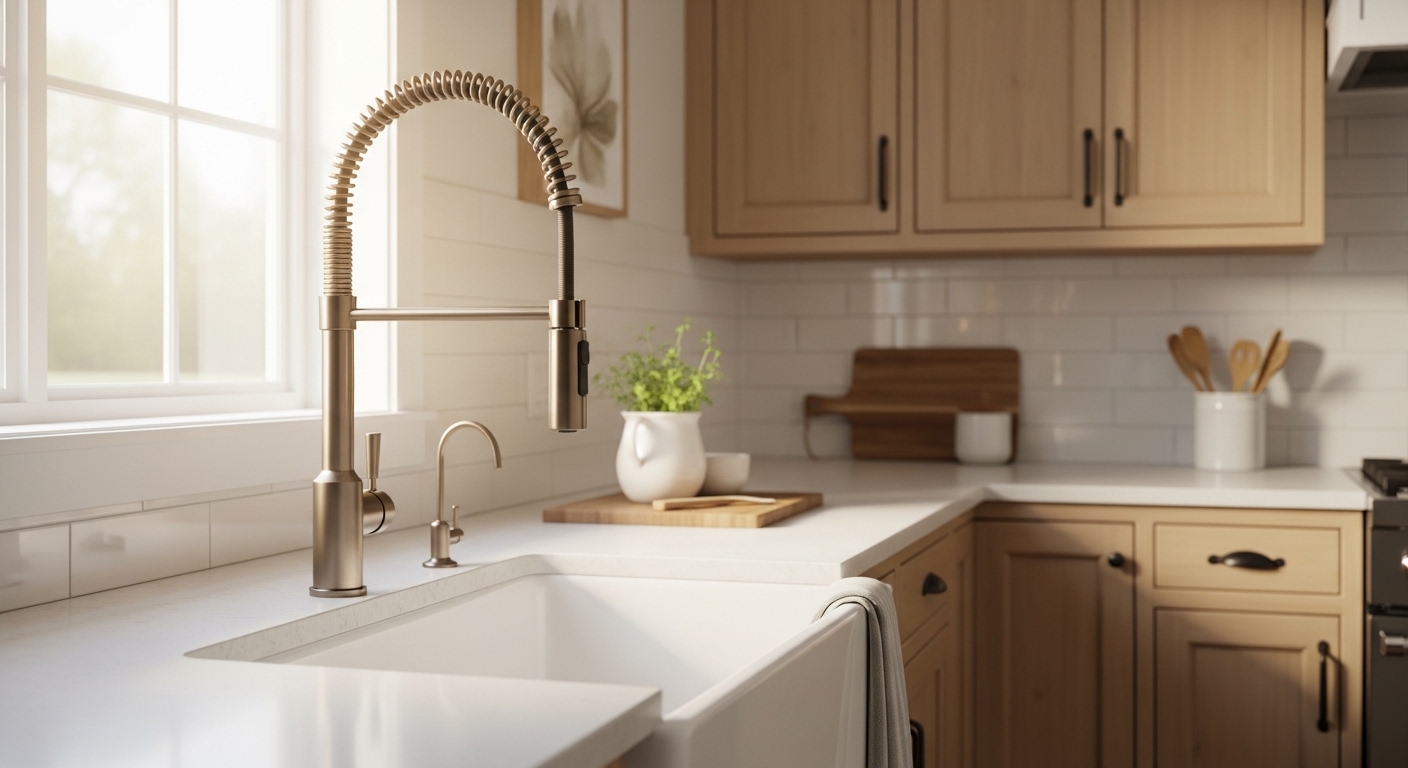
A kitchen faucet champagne bronze finish sits right in the sweet spot between flashy polished brass and cold stainless steel: it reads as a muted, brushed rose-gold that feels expensive without shouting. Over the last few years it’s gone from “trendy” to one of the most-requested finishes for mid-range and premium kitchens, and for good reason — it’s forgiving to live with, flatters warm wood tones and matte black hardware alike, and photographs beautifully. But not all champagne bronze faucets are built the same, and the difference between a $90 impulse buy and a $300 keeper usually comes down to the finish technology underneath the color. Below, we answer the real questions people actually ask before buying one.
What exactly is champagne bronze, and is it the same as brushed gold or brass?
Champagne bronze is a warm, lightly brushed metallic finish with a soft pinkish-gold tone — think “rose gold’s more understated cousin.” It is not raw solid bronze, and it’s usually not real brass either; it’s a color-and-texture finish applied over a solid brass or zinc-alloy faucet body. Delta popularized the name “Champagne Bronze,” but you’ll see the same look sold as brushed gold, brushed brass, warm brass, or satin gold from other brands.
The practical takeaway: don’t shop by name alone. Two faucets labeled “champagne bronze” can look noticeably different — some lean more gold, some more rose, some more bronze-brown. Always judge by a real photo (ideally in natural light) and, if you can, order a finish sample or a return-friendly faucet so you can hold it next to your cabinet color and existing hardware before committing.
How is the champagne bronze color actually applied?
There are two main methods, and they perform very differently over a decade of daily use:
- PVD (Physical Vapor Deposition): the color is bonded to the metal at a molecular level in a vacuum chamber. It’s extremely hard, scratch-resistant, won’t tarnish, and is dishwasher-splash and citrus-proof. This is what you want.
- Electroplating or lacquer/powder coat: a cheaper surface layer that can chip, wear thin at the handle and spout, or discolor near heat and cleaners over time.
If a product page says “PVD champagne bronze,” that’s a strong quality signal. If it’s silent about the finish process and the price seems too good, assume it’s a coating and factor in that it may not age gracefully.
Does a champagne bronze kitchen faucet show water spots and fingerprints?
Much less than chrome or polished finishes — that’s one of the biggest real-world reasons people choose it. The brushed, satin texture of champagne bronze scatters light, so mineral spots, dried droplets, and greasy fingerprints simply don’t stand out the way they do on a shiny mirror finish. In a busy family kitchen, that means the faucet still looks clean even when you haven’t wiped it down that day.
That said, “less visible” isn’t “invisible.” If you have hard water, you’ll still get chalky limescale buildup over weeks, especially around the aerator and base. The good news is it’s easy to manage and easy to hide. If you’re already fighting mineral deposits elsewhere, our guide on how to clean hard water stains from a faucet walks through the exact safe method — and yes, it applies to champagne bronze too, with one important caveat covered in the care section below.
Will champagne bronze go out of style, or does it match my kitchen?
Champagne bronze is a warm neutral, which makes it far more timeless than a bold color trend. Because it’s muted rather than bright, it behaves more like a “metallic neutral” — the same way brushed nickel did for the 2010s. It pairs naturally with a huge range of kitchens, which is exactly why designers reach for it.
Here’s what it tends to pair well with:
- White or cream shaker cabinets — the warm gold keeps an all-white kitchen from feeling clinical.
- Natural and medium wood tones — oak, walnut, and butcher-block countertops echo the warmth.
- Navy, forest green, and deep greige cabinets — the metallic gold pops as a jewelry-like accent.
- Matte black accents — the black-and-gold combination is a modern classic. If you’re leaning that direction elsewhere in the home, our take on a matte black bathroom faucet and shower pairing shows how the two finishes play together.
The one place to be careful is mixing metals. Champagne bronze reads as “warm gold,” so it fights slightly with cool-toned polished chrome. Brushed nickel and champagne bronze can coexist if done deliberately (nickel on appliances, bronze on the faucet), but if you want a seamless look, match your cabinet pulls and soap dispenser to the faucet finish.
How much should a good champagne bronze kitchen faucet cost in 2026?
Expect to spend roughly $120 to $350 for a quality pull-down champagne bronze kitchen faucet with a PVD finish and a ceramic-disc cartridge. Below about $90, you’re usually looking at a thin coating over a lightweight body and a rubber-seal valve that will drip within a couple of years. Above $350, you’re mostly paying for brand name, touchless/voice tech, or a heavier solid-brass body.
Here’s how the tiers actually break down:
| Price tier | What you typically get | Finish type | Best for |
|---|---|---|---|
| Under $90 | Zinc/plastic body, rubber-seal valve, basic sprayer | Lacquer or electroplate (may chip) | Rentals, short-term use |
| $120–$200 | Solid-brass or heavy-alloy body, ceramic-disc cartridge, dual-function pull-down sprayer, magnetic dock | PVD (scratch & tarnish resistant) | Most home kitchens — the value sweet spot |
| $200–$350 | Heavy solid brass, high-arc gooseneck, smoother sprayer, sometimes touch-on activation | Premium PVD | Long-term “forever kitchen” installs |
| $350+ | Touchless/voice control, designer branding, extended warranty | Premium PVD | Tech lovers, high-end remodels |
For most people, the $120–$200 band is where the smart money goes: you get the PVD finish that makes champagne bronze worth owning, plus a ceramic-disc cartridge that won’t drip. Speaking of which — a dripping faucet is the number-one regret with cheap models. If you ever run into it, here’s why a kitchen faucet drips and how to stop it fast.
What features actually matter when buying one? (A quick buyer’s checklist)
Focus on four things: the finish process, the valve, the body material, and the sprayer. Get those right and the rest is preference. Use this checklist while you shop:
- PVD finish — non-negotiable for champagne bronze longevity. Confirm it explicitly.
- Ceramic-disc cartridge — this is what prevents drips. Avoid rubber-washer valves.
- Solid brass body (or heavy alloy) — heft is a decent proxy for quality; a too-light faucet often means thin metal.
- Dual-function pull-down sprayer — stream + spray, with a magnetic dock so the wand snaps back cleanly instead of drooping over time.
- Spout height and reach — a high-arc gooseneck (around 8″–10″ clearance) makes filling pots easy; just make sure it clears any window sill behind the sink.
- Number of mounting holes — match your sink’s existing holes, or get a deck plate to cover extras.
- Certifications — look for cUPC/UPC and NSF/ANSI 61 & 372 (lead-free) compliance for water safety and code approval.
Champagne bronze vs. brushed nickel vs. matte black — which finish should you pick?
Pick champagne bronze for warmth and a touch of luxury, brushed nickel for a safe all-rounder that matches almost anything, and matte black for bold modern contrast. There’s no single “best” — it depends on your cabinets and how much of a statement you want the faucet to make.
| Finish | Look & vibe | Hides spots/prints? | Best kitchen match |
|---|---|---|---|
| Champagne bronze | Warm, soft rose-gold, quietly luxe | Very well | White, wood, navy, green |
| Brushed nickel | Neutral, cool-warm silver, safe | Very well | Almost anything |
| Matte black | Bold, modern, high contrast | Hides prints, shows dust/limescale | White, gray, industrial |
| Polished chrome | Bright, shiny, classic | Shows everything | Traditional, glossy |
Still torn between the warm-gold and the silver route? Our deeper dive on whether brushed nickel faucets are worth it lays out the trade-offs, and it’s a useful gut-check — if you find yourself wanting “a little more personality than nickel,” champagne bronze is almost always the answer.
How do you keep a champagne bronze faucet looking new? (Care & cleaning)
Clean it with warm water, a drop of mild dish soap, and a soft microfiber cloth — then dry it. That’s it, and that’s the whole secret. The single most important rule for champagne bronze: never use abrasive pads, scouring powders, or acidic/bleach-based cleaners. Those attack the finish (even PVD dislikes prolonged acid contact) and are the fastest way to dull or discolor that warm gold tone.
A simple routine that keeps it flawless:
- Daily-ish: a quick wipe with a damp cloth, then buff dry to prevent water spots at the base.
- Weekly: wash with a few drops of dish soap in warm water, rinse, dry.
- For stubborn limescale: lay a cloth soaked in a 50/50 white vinegar–water solution on the spot for no more than 5 minutes, then rinse thoroughly and dry. Do a spot test first, and never leave vinegar on a coated (non-PVD) finish.
- Never: Comet, Barkeeper’s Friend, steel wool, magic-eraser style pads, or all-purpose sprays with bleach.
Keep the aerator clean too — mineral buildup there causes weak or splashy flow. Unscrew it every few months, soak it in vinegar, rinse, and reinstall. It’s a two-minute job that keeps your pressure consistent.
Is installing a champagne bronze faucet a DIY job?
For most single-handle pull-down models, yes — it’s a manageable 45–90 minute DIY project if you’re comfortable working under the sink. The finish makes no difference to installation; the process is identical to any other kitchen faucet. You’ll shut off the water supply, disconnect the old faucet, drop the new one through the mounting holes, connect the supply lines, and secure it from below.
The two things people underestimate are working room under the sink and old, corroded supply-line nuts. If you want a full walkthrough before you start, follow our step-by-step kitchen faucet installation guide. If the connections look badly corroded or you have a garbage disposal crowding the space, it’s reasonable to call a plumber — a botched connection that leaks under the cabinet costs far more than the install fee.
A note on authenticity: because the champagne bronze look is popular, counterfeit and mislabeled “brass” faucets do circulate. Buy from the brand or an authorized retailer, and be skeptical of no-name listings claiming premium finishes at rock-bottom prices — the industry has seen real crackdowns on counterfeit faucet operations for exactly this reason.
Who should skip champagne bronze?
Skip it if your kitchen is committed to cool-toned polished chrome hardware and appliances that you’re not replacing, or if you genuinely prefer a finish that disappears rather than adds warmth. Champagne bronze is a subtle statement finish — it wants to be at least a little noticed. If your goal is “faucet nobody thinks about,” brushed nickel or stainless is the safer pick. Everyone else — especially anyone with white, wood, or dark cabinets who wants a warmer, more custom-feeling kitchen — is a great candidate.
FAQ
Does champagne bronze tarnish or turn green over time?
A genuine PVD champagne bronze finish will not tarnish, oxidize, or turn green — the color is molecularly bonded and chemically stable. Cheaper lacquered or electroplated versions can discolor or wear thin at high-touch spots. This is the single best reason to confirm “PVD” before buying.
Is champagne bronze the same as Delta’s “Champagne Bronze”?
“Champagne Bronze” is Delta’s specific trademark name, but the finish itself — a warm brushed gold-bronze — is offered by many brands under names like brushed gold, warm brass, or satin bronze. The colors are close but can vary slightly, so match by photo and, ideally, an in-hand sample rather than relying on the name.
Will a champagne bronze faucet match my stainless steel sink and appliances?
Yes, surprisingly well. Stainless steel is a fairly neutral silver-gray, so a warm gold faucet reads as an intentional accent rather than a clash — it’s one of the most popular pairings in modern kitchens. Just keep your cabinet pulls and any soap dispenser in the same champagne bronze for a coordinated look.
Can I use vinegar to clean a champagne bronze faucet?
Sparingly and carefully. A short (under 5-minute) contact with diluted white vinegar is fine on a PVD finish to remove limescale, but always rinse and dry immediately, and never soak or scrub. On a coated (non-PVD) finish, avoid vinegar entirely — it can eat the coating.
How long should a good champagne bronze kitchen faucet last?
A quality PVD faucet with a ceramic-disc cartridge should last 15–20+ years with basic care, and the finish should still look new. The cartridge is usually the first part to wear, and it’s a cheap, replaceable part — so a drip after a decade doesn’t mean you need a whole new faucet.
Does champagne bronze cost more than chrome or brushed nickel?
Usually a small premium — often $20–$50 more than the same model in chrome or nickel — because the PVD gold finish is an extra process. It’s rarely a big jump, and given how much better it hides spots and elevates the look, most buyers find it well worth the modest upcharge.
About the author: This guide was written by the Cobbe fixtures editorial team, drawing on hands-on testing of pull-down kitchen faucets across finishes, valves, and price tiers. Cobbe designs and sells kitchen and bathroom faucets built around solid-brass bodies, PVD finishes, and ceramic-disc cartridges, and our products are manufactured to cUPC and NSF/ANSI 61 & 372 lead-free standards and backed by a limited lifetime warranty on finish and function. We recommend finishes based on real durability and livability, not just what photographs well.
Not sure champagne bronze is your finish after all? If you’re weighing brands and styles more broadly, our comparison of Moen vs. Delta is a helpful next read before you check out.
Pingback: Is a Vintage Kitchen Faucet Worth It, and How Do You Choose One That Actually Works? - Cobbe
Pingback: Which Kitchen Faucet Vintage Style Is Right for Your Kitchen in 2026? - Cobbe