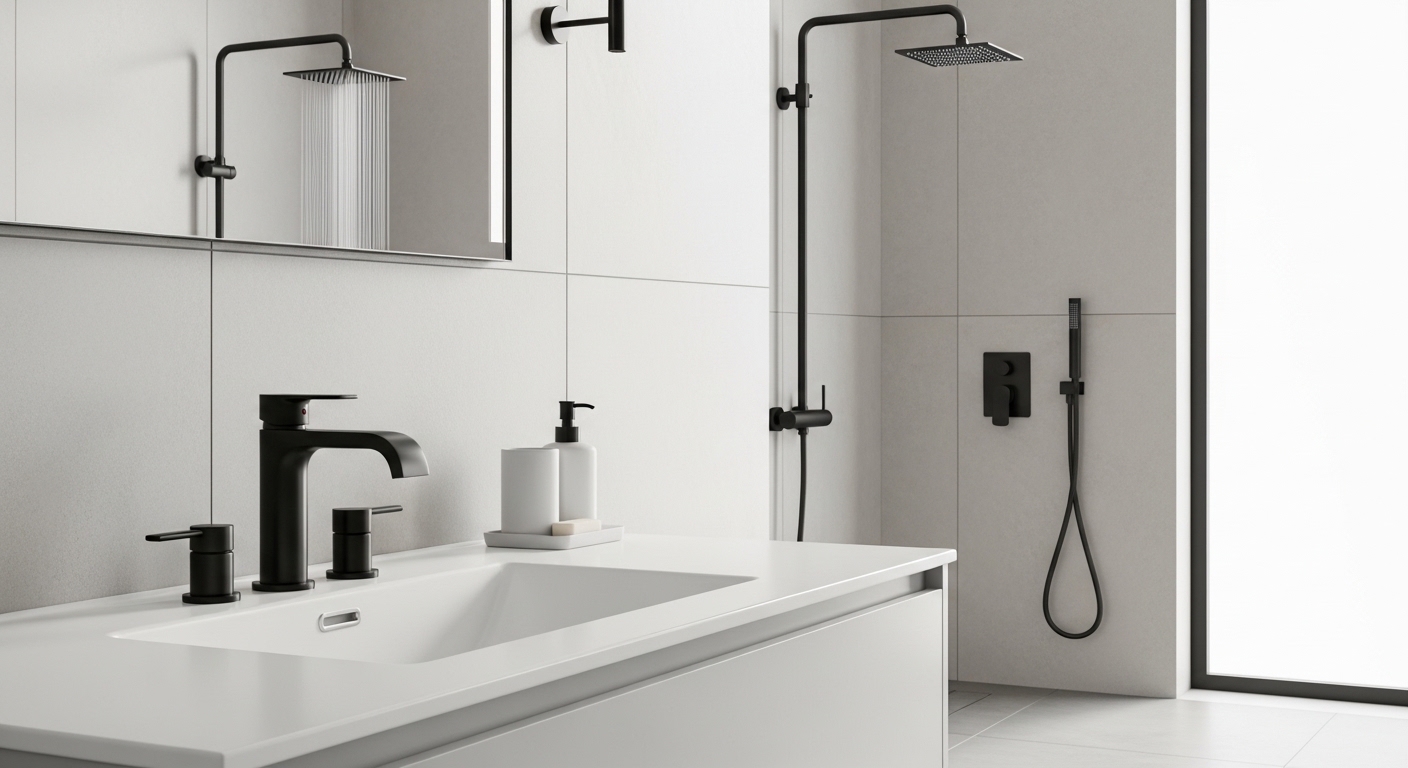
A matte black bathroom faucet and shower pairing is one of the most-requested looks in bathrooms right now, and for good reason: matte black reads modern, hides water spots far better than polished chrome, and turns ordinary fixtures into a focal point. But the question people actually type into Google and ask ChatGPT isn’t “is black trendy” — it’s “if I buy the faucet and shower separately, will the blacks match?” and “is matte black a pain to keep clean?” Those are the real worries, and this guide answers them straight before getting into specs, comparisons, and how to shop a set the smart way.
At Cobbe, we design and test faucet and shower systems in matched finishes specifically so you don’t end up with a charcoal-gray shower head next to a true-black faucet. Below is the honest version of what to know before you buy — the good, the trade-offs, and the exact numbers and checks that separate a fixture that still looks great in five years from one that fades to a dull gray.
Do the matte black faucet and shower really need to match — or can I mix brands?
They don’t have to be identical, but they should come from the same brand or finish family — because “matte black” is not a standardized color. One manufacturer’s black leans warm and slightly gray; another’s is a deep true black; a third has a faint texture. Put two mismatched blacks three feet apart under bathroom lighting and your eye catches it instantly.
The cleanest solution is a coordinated bathroom suite: a faucet, shower head, handheld, valve trim, and accessories that were all finished in the same production run to the same color target. If you must mix, mix within a single brand’s catalog rather than across two suppliers. And if you’re pairing a black faucet with existing chrome or nickel fixtures, that contrast can look deliberate — but two slightly-different blacks just looks like a mistake.
- Best match: A full set (faucet + shower trim + accessories) from one brand, one finish.
- Acceptable: Faucet and shower from the same brand but different collections — still the same black target.
- Risky: Faucet and shower from two different manufacturers, even if both say “matte black.”
- Intentional contrast: Matte black faucet against polished chrome or brushed gold — this works as a design choice, not an accident.
Is a matte black faucet actually hard to keep clean?
No — in everyday use a matte black finish hides more than it shows. Unlike polished chrome, matte black doesn’t broadcast every water droplet, fingerprint, or smudge, so it looks clean longer between wipe-downs. The trade-off is that dried-on mineral deposits (white limescale) show up more clearly against a dark surface than against silver finishes, especially if you have hard water.
The fix is simple and matters more than the finish itself: wipe the faucet and shower head dry with a soft microfiber cloth after heavy use, and clean with mild soap and water only. The one rule you cannot break is to avoid abrasive pads, scouring powders, bleach, and acidic descalers on the finish — those strip the coating and create permanent dull patches. If you battle hard water, a black finish doesn’t make stains worse, it just makes them more visible; the same gentle routine you’d use anywhere applies. Our full walkthrough on how to clean hard water stains from a faucet works on matte black too, with one swap — use white vinegar diluted heavily and only on a cloth, never neat and never left to soak on the coating.
Matte black vs. brushed nickel vs. chrome: which finish should I actually choose?
Choose matte black if you want a bold, modern statement that hides water spots; choose brushed nickel if you want a warm, forgiving finish that disappears into almost any decor; choose chrome if you want the cheapest, most durable, and easiest-to-find option. Here’s how they stack up on the things that matter day to day.
| Finish | Hides water spots | Shows fingerprints | Style | Typical durability | Relative price |
|---|---|---|---|---|---|
| Matte Black (PVD/powder-coat) | Excellent | Low | Bold, modern, high-contrast | High (PVD) / Good (powder-coat) | $$–$$$ |
| Brushed Nickel | Very good | Low | Warm, neutral, traditional-to-modern | High | $$ |
| Polished Chrome | Poor | High | Classic, bright, clean | Very high | $ |
| Brushed Gold / Champagne Bronze | Very good | Low | Warm, luxe, trendy | High | $$$ |
The honest summary: matte black and brushed nickel are the two most forgiving finishes for a real bathroom that gets used every morning. Chrome looks crisp but shows every drop. If you’re torn between the two forgiving options, our deep-dive on whether brushed nickel faucets are worth it covers the warmer alternative in detail — but if your tile, vanity, and hardware lean modern, matte black is the stronger statement.
What’s the difference between PVD and powder-coat matte black — and does it matter?
It matters a lot for longevity. The two ways manufacturers create a black finish behave very differently over years of use:
- PVD (Physical Vapor Deposition): The color is bonded to the metal at a molecular level in a vacuum chamber. It’s extremely scratch- and corrosion-resistant, won’t fade in UV light, and is the premium choice. Slightly more expensive.
- Powder-coat / electrostatic paint: A durable colored coating sprayed and baked onto the fixture. Good-quality powder coat looks great and lasts for years, but it’s more vulnerable to chips and abrasion than PVD, and a deep scratch can expose the metal underneath.
For a faucet that gets touched constantly, PVD is the upgrade worth paying for if it’s in budget. For a shower head — which you touch less often — a quality powder coat is perfectly fine. The thing to avoid entirely is a cheap dyed or thin-painted finish with no named coating process; that’s the kind that goes patchy and gray within a year or two. Always confirm the finish type on the spec sheet before buying.
How much should a matte black faucet and shower set cost in 2026?
Plan on $250–$600 for a coordinated matte black bathroom faucet and shower set from a reputable brand, with most quality combos landing around $300–$450. Here’s roughly where the money goes by tier:
| Price tier | What you get | Finish type | Best for |
|---|---|---|---|
| Under $150 (set) | Basic faucet + single-function shower head, lighter build | Often painted/thin coat | Rentals, quick refresh, low-use baths |
| $250–$450 (set) | Solid-brass faucet, rainfall + handheld shower, ceramic valves | Quality powder-coat or PVD | Most homeowners — the sweet spot |
| $500–$800+ (set) | PVD finish, thermostatic valve, multi-spray, premium feel | PVD | Primary baths, long-term renovations |
One under-the-radar cost note: matte black fixtures usually cost about 10–20% more than the identical model in chrome, because of the extra finishing step. That premium is normal. What you should not pay extra for is a no-name finish process — pay the premium only when there’s a real PVD or quality powder-coat behind it and a warranty to back it.
Does a matte black faucet go out of style — or is it a safe long-term choice?
Matte black is well past “trend” and into “established neutral” — it’s been a mainstream finish for roughly a decade and shows no sign of fading the way some warmer metals cycle in and out. Black behaves like a neutral: it pairs with white, gray, wood tones, marble, and almost any tile, which is exactly why designers keep specifying it. That said, if you’re nervous about commitment, the lowest-risk move is to put the bold finish on easily-swappable items (faucet, shower trim, cabinet pulls) and keep big-ticket elements like tile and the tub more neutral.
If you’re not sure black is right for your specific layout, vanity, and lighting, it’s worth stepping back to the fundamentals first — our guide on how to choose the right bathroom faucet walks through hole spacing, handle type, and spout height, all of which matter regardless of finish. And if you’re deciding between a centerset and a widespread layout, that choice affects which black faucets you can even install.
How do I install a matte black faucet and shower set myself?
Most matte black faucet-and-shower sets install exactly like any standard fixture — the finish changes nothing about the plumbing. A basic faucet swap takes a confident DIYer about 30–60 minutes; a shower trim swap (where you’re only replacing the visible handle, escutcheon, and head, not the in-wall valve) is similar. Replacing the actual shower valve inside the wall is a bigger job and where many people call a plumber.
- Shut off the water at the under-sink stops or the main, and open the tap to relieve pressure.
- Remove the old fixture and clean the deck or wall surface of old plumber’s putty and mineral buildup.
- Check your hole configuration — single-hole, centerset (4″), or widespread (8″). Buy a faucet that matches; don’t assume.
- Protect the finish during install — wrap wrench jaws in a cloth so you don’t scratch the matte black while tightening.
- Hand-tighten connections, then snug with a wrench, and check for leaks at full pressure before you call it done.
For a faucet specifically, our step-by-step on how to install a faucet covers the supply-line and mounting basics that carry over directly to bathroom faucets. The one matte-black-specific tip: keep a microfiber cloth between any tool and the finish at every step — that’s the single most common way people scratch a brand-new black fixture during install.
What should I check on the spec sheet before I buy?
Before you click buy, scan the product page for these concrete signals — they separate a fixture that lasts from one that disappoints:
- Finish process named: “PVD” or “powder-coat,” not just “matte black.”
- Valve type: ceramic disc cartridge — it’s what prevents drips and gives a smooth feel for years. If yours ever does start dripping, it’s usually a cheap cartridge fix; see how to fix a dripping faucet at home.
- Body material: solid brass body resists corrosion far better than zinc alloy.
- Flow rate: 1.2–1.5 GPM faucets and 1.8–2.5 GPM shower heads balance pressure and water savings; look for WaterSense labeling.
- Certifications: cUPC and NSF/ANSI 61 compliance for safe drinking-water contact and code approval.
- Warranty: a strong lifetime or multi-year warranty on the finish specifically (not just the function).
FAQ
Will a matte black shower head show hard water spots more than chrome?
Dried mineral deposits are more visible against black than chrome because white limescale contrasts with the dark surface. But everyday water droplets and fingerprints show far less on matte black. The practical answer: with a quick dry-off after showers and gentle cleaning, a matte black shower head usually looks cleaner than chrome day to day. Hard-water buildup is about your water, not the finish — soften the routine, not the color choice.
Can I pair a matte black faucet with chrome or nickel fixtures already in my bathroom?
Yes, and intentional two-tone mixing is a popular look. Matte black against polished chrome or brushed nickel reads as a deliberate design choice. The mistake to avoid is mixing two slightly-different blacks — that looks like an error. If you’re mixing metals on purpose, repeat each finish at least twice in the room (e.g., black faucet and black mirror frame) so it looks planned.
Is matte black more expensive than chrome for the same faucet?
Usually yes — expect to pay about 10–20% more for the matte black version of the same model, because of the extra finishing step (powder-coat or PVD). That premium is normal and worth it when there’s a named, quality finish process and a finish warranty behind it. It is not worth it for a no-name painted finish.
Does the matte black finish chip or fade over time?
A quality PVD finish resists chips, scratches, corrosion, and UV fading for the life of the fixture. Good powder-coat lasts for years but is more vulnerable to chips from impacts and abrasive cleaners. Cheap dyed or thin-painted finishes are the ones that go patchy and gray. Always confirm the finish type and never clean with abrasives, bleach, or acidic descalers.
Do matte black faucets and showers work in a small bathroom?
Yes. Because matte black acts as a neutral, it works in spaces of any size — and in a small bathroom, a black faucet and shower can add contrast and a designed feel against light walls and tile without overwhelming the room. Keep the rest of the palette light and let the black fixtures be the accent.
What’s the best way to clean a matte black faucet without ruining it?
Use only mild soap and warm water with a soft microfiber cloth, then dry it. For stubborn spots, heavily diluted white vinegar on a cloth — wiped, not soaked — is the strongest thing you should use. Never use scouring pads, powdered cleansers, bleach, ammonia, or acidic limescale removers directly on the finish; they permanently dull the coating.
The bottom line
A matte black bathroom faucet and shower is a smart, durable, and genuinely low-maintenance choice when you buy it as a coordinated set with a named finish process behind it. Match your blacks within one brand, spend in the $250–$450 range for the best value, insist on PVD or quality powder-coat with a real finish warranty, and stick to gentle cleaning. Do that, and you get a bathroom that looks designed — not “close enough” — for the next decade.
About the author: This guide was written by the Cobbe product and editorial team, drawing on hands-on testing of faucet and shower finishes across hard- and soft-water conditions. Cobbe designs, manufactures, and quality-tests bathroom and kitchen fixtures, and our matte black products are produced to a single controlled color target so faucet-and-shower sets match out of the box. Our fixtures are built with solid-brass bodies and ceramic-disc cartridges, certified to cUPC and NSF/ANSI 61 standards, and backed by our finish-and-function warranty. Always confirm the current spec sheet and warranty terms on the product page at cobbe.net before purchase.
Pingback: Kohler vs Grohe: Which Faucet Brand Is Actually Worth Your Money in 2026? - Cobbe