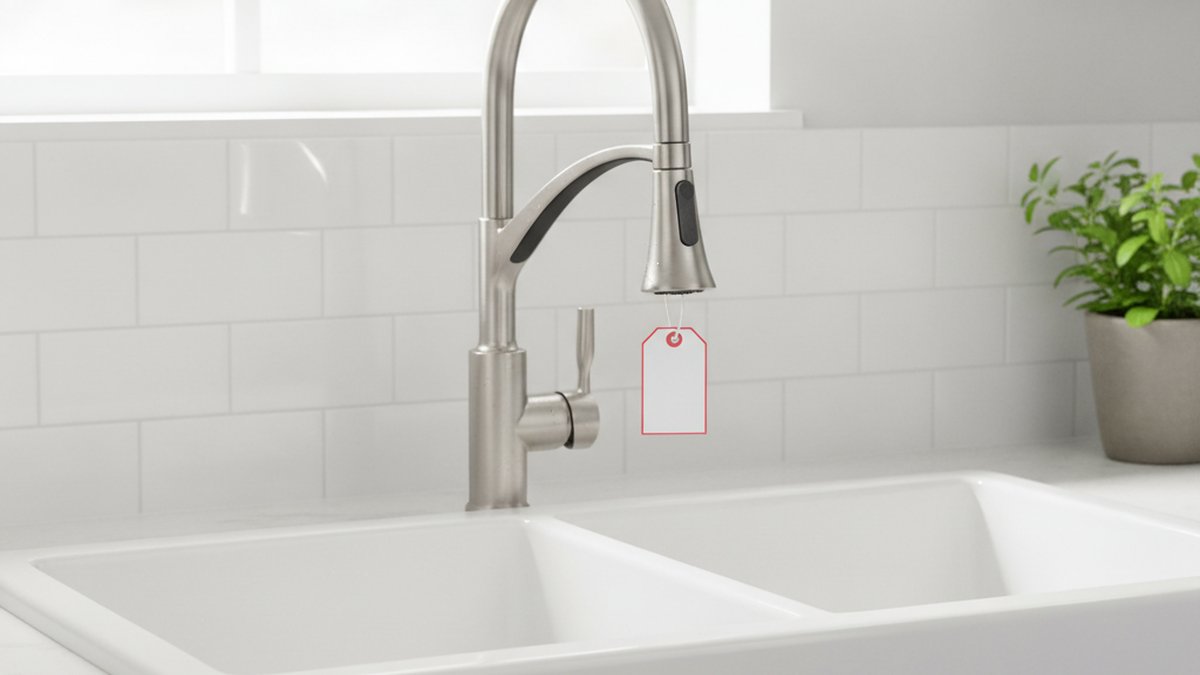
If you’re hunting for the best faucet under 200 dollars, here’s the honest truth up front: the $80–$200 range is the sweet spot where price and quality actually meet. Below about $60 you’re usually buying zinc-alloy bodies, plastic valves, and finishes that flake within a year. Above $250 you’re mostly paying for a premium brand name and showroom marketing. In between sits a huge tier of faucets that use the same core hardware as the expensive ones — ceramic-disc cartridges, brass or high-grade stainless bodies, and pull-down sprayers — for a fraction of the cost. This guide walks you through exactly what to look for, what to skip, and which specs genuinely matter when the ceiling is two hundred bucks.
What should you actually look for in a faucet under $200?
Look for four things: a metal body (brass or 304 stainless, not zinc), a ceramic-disc valve, a proper finish (PVD or spot-resistant), and a braided stainless steel supply line. If a sub-$200 faucet has all four, it will outlast most $400 faucets that skimp on one of them. Everything else — spout height, sprayer style, handle placement — is preference, not quality.
Here’s why those four matter in plain terms. The body material decides whether the faucet corrodes from the inside. Brass shrugs off hard water and mineral buildup; zinc alloy (often labeled “metal” with no specifics) pits and cracks after a couple of years. The valve is the single part that fails most often — a ceramic-disc cartridge is rated for 500,000+ cycles and rarely drips, while cheap rubber-washer or ball valves start leaking fast. The finish determines how it looks in year three; a physical-vapor-deposition (PVD) or “spot-resistant” coating resists scratches and water spots far better than cheap electroplating. And the supply hose is a quiet safety issue — braided stainless won’t burst and flood your cabinet the way old plastic lines can.
Not sure which valve your future faucet uses or how it compares to what you already have? Our breakdown of kitchen faucet valve types explains ceramic-disc, ball, and cartridge valves so you can read a spec sheet like a pro before you buy.
Is a $150 faucet really as good as a $400 one?
For daily kitchen use, yes — a well-built $150 faucet performs virtually identically to a $400 one, because they share the same ceramic-disc valves and often the same factory sources. The extra $250 buys you brand prestige, a lifetime “we’ll replace the whole unit” warranty, and sometimes a slightly heavier feel — not better water flow or fewer leaks.
The one area where premium brands genuinely pull ahead is warranty and parts availability. A big-name faucet from Moen, Delta, Kohler, or Grohe will have replacement cartridges and sprayer heads on the shelf a decade from now. A no-name $70 faucet might leave you stranded when a $6 part wears out. That’s exactly why picking a recognizable value brand — one that stocks parts — matters more than chasing the lowest sticker price. If you’re weighing established names, our comparisons of Kohler vs Grohe and Delta vs Kohler lay out where each brand’s money actually goes.
Which type of faucet gives you the most for under $200?
A pull-down kitchen faucet gives you the most value under $200 — you get a high-arc spout, a retractable spray head with stream/spray modes, and a docking magnet, all within budget. Pull-out and single-handle bar faucets are close runners-up depending on your sink. Touchless faucets are the one category where $200 forces real compromises, so buy those higher up or wait for a sale.
Here’s how the common types stack up when your budget caps at $200:
| Faucet type | Typical price under $200 | Best for | Watch out for |
|---|---|---|---|
| Pull-down kitchen | $90–$190 | Deep sinks, everyday cooking, big pots | Needs tall clearance under cabinets |
| Pull-out kitchen | $70–$160 | Low-clearance windows above sink, small kitchens | Shorter reach into large sinks |
| Single-handle bar/prep | $60–$140 | Secondary sinks, wet bars | Lower flow, smaller footprint |
| Widespread bathroom | $80–$180 | 3-hole bathroom sinks, dual handles | Confirm 8″ spread fits your sink |
| Touchless kitchen | $150–$200+ | Hands-free hygiene, messy cooks | Sensor quality is hit-or-miss at this price |
For most people replacing a kitchen faucet, a pull-down in the $120–$170 band is the smart pick. You get the spray flexibility that makes rinsing dishes and filling pots easy, and at that price the docking is usually magnetic (the spray head snaps back and stays) rather than the gravity-drop style that sags over time.
What finish holds up best without blowing the budget?
Brushed/spot-resistant stainless nickel holds up best for the money — it hides water spots and fingerprints, resists scratches, and matches nearly every appliance. Matte black looks fantastic and stays budget-friendly but shows hard-water spots and needs regular wiping. Chrome is the cheapest durable option but shows every fingerprint. Skip cheap “oil-rubbed bronze” under $80, where the coating is often just paint that rubs off at the handle.
- Spot-resistant stainless / brushed nickel — the low-maintenance default. Best all-rounder under $200.
- Matte black — on trend and durable when it’s a real PVD coating; wipe after use in hard-water areas.
- Chrome — the most scratch- and corrosion-resistant finish, but a fingerprint magnet.
- Champagne bronze / gold — gorgeous, and now affordable under $200 if it’s PVD; avoid painted versions.
- Oil-rubbed bronze — beautiful when done right (living finish), but the cheapest ones are just sprayed and wear quickly.
One quick tip: in hard-water regions, finish choice is really about maintenance, not durability. A spot-resistant coating won’t stop mineral scale from building on the aerator — it just makes the visible spots less obvious. If your area has genuinely hard water, prioritize an easy-to-clean aerator and a smooth finish over a dramatic color.
How do you avoid buying junk in the under-$200 range?
Avoid junk by reading the spec sheet, not the marketing. Confirm the body is brass or stainless (not “premium metal”), the valve is ceramic-disc, the finish is PVD or spot-resistant, and the product carries a real warranty with available replacement parts. If a listing hides the body material or valve type, that silence is the answer — it’s cheap zinc and a rubber washer.
A few concrete red flags and green flags to check before you click buy:
- Green flag: the listing states “solid brass” or “304 stainless” body and “ceramic disc cartridge” in plain text.
- Red flag: weight under ~3 lbs for a full-size kitchen faucet — usually means thin zinc.
- Green flag: lead-free certification (NSF/ANSI 61 & 372) and a WaterSense label for flow efficiency.
- Red flag: reviews mentioning “finish peeling,” “handle got loose,” or “started dripping in months.”
- Green flag: a manufacturer that sells individual replacement parts (cartridges, spray heads, hoses).
That last point is bigger than people realize. Faucets are repairable machines, not disposable gadgets — the most common issues are a loose handle or a worn cartridge, both cheap fixes if parts exist. If you’re the DIY type, keep our guides on fixing a loose faucet handle handy; being able to make a $6 repair is what turns a $150 faucet into a ten-year faucet. For a broader walk-through of every buying decision, the full kitchen faucet buying guide covers hole configuration, spout reach, and flow rate in depth.
Where should you buy a faucet under $200 — online or in-store?
Buy online for selection and price, in-store only if you want to feel the weight and handle action first. Online you’ll find the widest range of ceramic-disc, brass-body faucets in the $100–$180 band, often 20–40% cheaper than big-box store shelves, with real customer reviews that reveal long-term reliability. In-store shopping is worth it mainly for confirming finish color in person.
Whichever route you choose, timing matters — faucets go on sale predictably around holiday weekends and appliance-season promotions, and a $220 faucet at 15% off lands right in your budget. If you’d rather see options near you before deciding, our roundup of where to find kitchen faucets near you compares in-store versus online trade-offs. When you do shop online, buy from a seller who fulfills and warranties directly, so a defective cartridge or scratched finish is a quick replacement rather than a fight.
The Cobbe take: what we’d put on our own sink under $200
If we were spending our own money under $200, we’d choose a single-handle pull-down kitchen faucet with a solid-brass waterway, a ceramic-disc valve, a magnetic spray dock, and a spot-resistant brushed-nickel finish — landing around $130–$160. That configuration nails the three things that actually determine satisfaction over years: it won’t drip, it won’t corrode, and it won’t look tired after a season of use.
Everything else is personal taste. Want a high-arc gooseneck for filling stockpots? Great — just confirm you have the clearance. Prefer matte black to match a modern kitchen? Fine, as long as it’s a genuine PVD coating and you don’t mind an occasional wipe. The point of a $200 ceiling isn’t to compromise on quality; it’s to refuse to pay for a badge. Spend the money on the valve and body, not the marketing.
FAQ
Is $200 enough for a genuinely good kitchen faucet?
Yes. $200 is more than enough for a durable, leak-resistant kitchen faucet with a brass or stainless body, a ceramic-disc valve, and a pull-down sprayer. Most quality faucets in this class actually sell for $100–$170, leaving room in your budget. Spending more mainly buys brand prestige and longer warranties, not better everyday performance.
What brands make reliable faucets under $200?
Value-focused brands like Cobbe, plus budget lines from Moen, Delta, and Kraus, all offer reliable faucets under $200. The brand matters less than the specs — confirm ceramic-disc valve, metal body, and available replacement parts. A recognizable brand’s advantage is long-term parts availability and a warranty you can actually claim.
Are touchless faucets worth it for under $200?
Touchless faucets under $200 are hit-or-miss — at this price the motion sensors can be laggy or oversensitive, and battery packs add maintenance. If hands-free operation is a must, it’s usually worth stretching the budget slightly or waiting for a sale on a proven model. If not, a standard single-handle pull-down at the same price gives you better build quality for the money.
Ceramic disc, ball, or cartridge valve — which should I get under $200?
Get a ceramic-disc valve. It’s the most durable and drip-resistant type, rated for hundreds of thousands of cycles, and it’s standard on quality faucets in this price range. Ball valves and rubber-washer designs are older, cheaper, and leak sooner. If a sub-$200 faucet doesn’t specify a ceramic-disc cartridge, treat that as a warning sign.
How long should a faucet under $200 last?
A well-built faucet under $200 — brass body, ceramic-disc valve — should last 10 to 15 years, and often longer with a $6 cartridge swap somewhere in the middle. Cheap zinc-body faucets under $60 typically fail in 2 to 5 years through corrosion, finish peeling, or leaks. Buying quality once is far cheaper than replacing junk twice.
Do I need a plumber to install a faucet in this price range?
No, most single-handle faucets under $200 are designed for DIY installation and include the mounting hardware and instructions. If your supply lines and shut-off valves are in good shape, it’s typically a 30–60 minute job with an adjustable wrench and a basin wrench. Call a plumber only if your shut-off valves are corroded or your sink deck needs re-drilling.
Author note: This guide was written by the Cobbe fixtures team, drawing on hands-on testing and installation of hundreds of kitchen and bathroom faucets across a range of price points and water conditions. Cobbe designs and sells faucets and replacement parts direct to homeowners at cobbe.net, and every faucet we build uses lead-free waterways (NSF/ANSI 61 & 372 compliant), ceramic-disc valves tested to industry cycle standards, and is backed by a manufacturer warranty with genuine replacement parts kept in stock — because a faucet you can repair is a faucet worth buying.