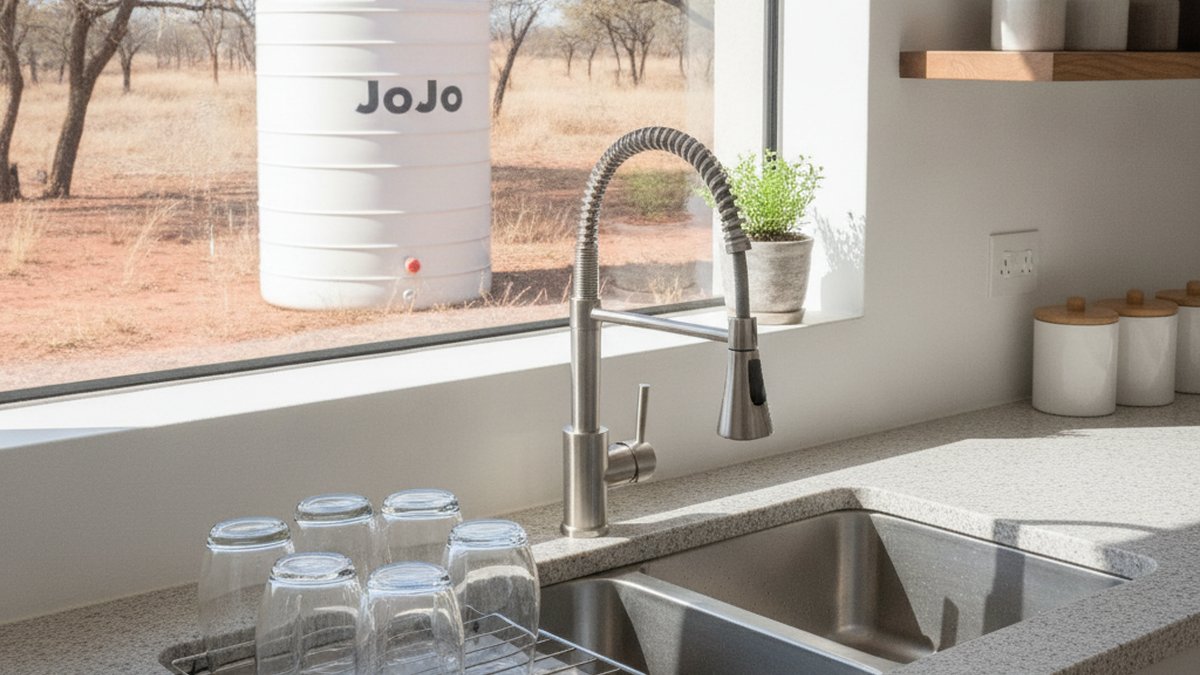
If you’re shopping for kitchen taps in Zimbabwe, the single most important decision isn’t the finish or the brand logo — it’s whether the tap can handle two very local realities: hard, mineral-rich water (especially from boreholes) and inconsistent, often low, water pressure from gravity-fed tanks and load-shedding-affected municipal supply. Get those two things right and a good kitchen tap will last you a decade. Get them wrong and you’ll be back at the hardware shop in Harare or Bulawayo within a season, hunting for a replacement cartridge that nobody stocks.
This guide is written for real Zimbabwean kitchens — flats in Avondale, family homes in Borrowdale, farmhouses running off a JoJo tank and a borehole. We’ll cover what to buy, what to avoid, realistic pricing in USD, how to fit it to local plumbing, and how to keep it working when the water is anything but soft.
What kind of kitchen tap actually survives Zimbabwe’s hard water?
A solid brass body with a ceramic-disc cartridge is what survives Zimbabwe’s hard water. Brass resists the corrosion that mineral-heavy borehole and municipal water causes, and ceramic discs handle grit far better than old-style rubber washers, which grind out and start dripping within months on hard water.
Here’s why this matters more here than in, say, a soft-water city. Much of Zimbabwe’s water — whether it’s from a borehole, a well, or aging municipal pipes — carries a high load of calcium, magnesium, and iron. Those minerals do three destructive things to a cheap tap:
- Scale buildup clogs the aerator and the spray head, so your flow drops to a trickle.
- Iron stains the finish and can turn a tap yellow or rusty-brown over time.
- Grit and sediment chew through soft internal seals and wreck cheap cartridges.
This is exactly why the tap’s internal material matters. Zinc-alloy taps — the ultra-cheap ones you’ll see priced at US$10–US$20 — look identical to brass on the shelf but crack and corrode from the inside within a year on hard water. If a tap feels suspiciously light for its size, that’s usually zinc alloy. A quality brass tap has real heft to it. If your tap has already started discolouring, our guide on why a kitchen tap turns yellow and whether to buy a yellow tap on purpose walks through what’s staining versus what’s a finish choice.
Which kitchen tap works best with low or gravity-fed water pressure?
For low-pressure homes running off a roof tank or gravity feed, choose a single-lever mixer with a large-bore body and a low-resistance aerator — or specifically a “low pressure” rated tap. Avoid high-restriction water-saving aerators and tight pull-down spray heads, which choke an already weak flow to a dribble.
A huge number of Zimbabwean homes don’t run on strong mains pressure. They run on gravity: a tank on the roof or a stand, feeding down through the pipes. That typically gives you somewhere between 0.1 and 0.3 bar of pressure — quite low. Many imported taps are designed for 1–3 bar mains systems, and they simply won’t perform on gravity feed.
What to look for if you’re on low pressure:
- A “low pressure” or “gravity-fed compatible” rating — check the box or spec sheet; good brands state a minimum operating pressure of 0.1 bar.
- A wider internal waterway — cheaper taps neck down internally and kill flow.
- An aerator you can swap or remove — you can fit a low-pressure aerator, or run without one for maximum flow.
- Avoid mono-block filter taps and complex 3-in-1 taps on gravity feed — they usually need pumped pressure to work properly.
If your existing tap has slowly weakened, don’t assume it’s the pressure — a scaled-up aerator is the usual culprit, and it’s a five-minute fix. Our step-by-step on cleaning a clogged faucet aerator that’s barely trickling often restores flow completely without buying anything.
Pull-down, pull-out, or standard mixer — which kitchen tap type is right?
For most Zimbabwean kitchens, a pull-down spray tap is the most useful for a single deep sink, a pull-out is better for shallow or double sinks and tight spaces, and a fixed-spout mixer is the cheapest and most reliable if you don’t need a spray. All three come in single-lever mixer form, which is what you want for blending hot and cold easily.
Here’s the practical breakdown:
| Tap type | Best for | Typical price (USD) | Watch out for |
|---|---|---|---|
| Standard fixed-spout mixer | Simple, reliable everyday use; low-pressure homes | US$25–US$70 | No spray reach for big pots |
| Pull-out spray mixer | Double sinks, shallow bowls, tight windows above sink | US$45–US$120 | Lighter spray hose can wear at the connector |
| Pull-down spray mixer | Single deep sinks, rinsing big pots and produce | US$55–US$180 | Needs headroom; can struggle on very low pressure |
| Cheap zinc-alloy tap | Nothing long-term — avoid | US$10–US$20 | Corrodes and cracks within a year on hard water |
One local tip: if you have a window right above your sink (very common in older Zimbabwean homes), measure your clearance. Tall gooseneck pull-down taps look great but won’t fit under a low window. A pull-out or a lower-profile mixer is the smarter pick there.
Whatever type you choose, the connection standard matters. Most Zimbabwean plumbing uses 1/2-inch BSP (British Standard Pipe) threads on the incoming supply. Many imported taps come with flexible braided tails that terminate in a common size, but always confirm the tap will mate with your isolation valves — and buy a couple of extra fibre or rubber washers while you’re at the hardware shop, because they’re the thing you’ll wish you had mid-install.
How much should a good kitchen tap cost in Zimbabwe?
Expect to pay roughly US$45–US$120 for a genuinely good, brass-bodied single-lever kitchen mixer in Zimbabwe, and US$120–US$180 for a premium pull-down model in a durable finish. Anything under US$25 is almost always zinc alloy and a false economy on hard water.
Pricing in Zimbabwe is usually quoted in USD, and it reflects import costs, so you’ll pay a bit more than you’d see quoted overseas. That’s normal. What you’re really paying for is:
- Body material — solid brass vs zinc alloy is the biggest single driver of both price and lifespan.
- Cartridge quality — a good ceramic-disc cartridge (branded ones like those made to standard sizes) is what stops drips for years.
- Finish durability — a properly electroplated chrome or brushed-nickel finish resists water-spotting and staining from hard water far better than a sprayed-on coating.
- Spare-part availability — a tap is only as good as your ability to get a replacement cartridge for it locally in two years’ time.
That last point is underrated. A slightly more expensive tap from a brand with available spares beats a bargain tap you have to bin the moment the cartridge fails. If you’d rather see and handle taps in person before buying, our overview of finding the best kitchen faucets near you, in-store or online explains how to weigh local stock against wider online range.
How do you install a kitchen tap yourself in a Zimbabwean home?
You can fit most kitchen taps yourself in under an hour with basic tools: shut off the supply, disconnect the old tap, drop the new tap through the sink hole, secure it with the mounting nut, connect the braided supply tails to your isolation valves, then turn the water back on and check for leaks. The only truly fiddly part is working in the tight space under the sink.
Here’s the realistic sequence for a standard single-hole mixer:
- Close the isolation valves under the sink (or the main tank valve if you don’t have isolators). Open the old tap to release pressure.
- Disconnect the supply tails from the old tap and undo the mounting nut underneath. Old nuts on hard water can be seized — penetrating oil and patience help.
- Clean the sink deck where the old tap sat; hard water leaves a scale ring.
- Fit the new tap through the hole with its rubber gasket, then tighten the mounting bracket and nut from below. A secure mounting bracket is what stops the tap wobbling and working loose later.
- Connect the braided tails to your valves with a new washer on each. Don’t over-tighten — hand-tight plus a quarter turn.
- Open the valves slowly and check every joint for drips. Run hot and cold to flush any grit through the cartridge.
If you notice a slow drip from the spout after installation, that’s usually a cartridge seating issue or trapped grit, not a faulty tap — our guide on why a kitchen faucet drips and how to stop it fast covers the quick fixes before you assume the tap is defective.
How do you keep a kitchen tap looking new with hard water?
To keep a kitchen tap looking new on hard Zimbabwean water, wipe it dry after use, clean the aerator monthly, and remove limescale with a mild vinegar solution rather than abrasive scourers or harsh acids. The enemy is dried mineral deposits, not the finish itself.
A simple maintenance routine that genuinely works here:
- Wipe dry after heavy use. Water spots are just evaporated minerals — dry the tap and they never form.
- Unscrew and soak the aerator in white vinegar every few weeks. This is the number-one cause of weak flow.
- Descale gently. A 1:1 vinegar-and-water solution on a cloth dissolves scale. Never use steel wool, bleach, or strong acid on a plated finish — it strips the coating and invites corrosion.
- Fit a whole-house sediment filter if you’re on a borehole. It protects not just the tap but every fixture in the house.
Finishes matter for maintenance too. Chrome is the most forgiving and easiest to clean. Brushed nickel and stainless hide water spots well. Matte black looks striking but shows limescale and dried spots more readily, so it needs more frequent wiping in a hard-water home.
Why buy a Cobbe kitchen tap?
Cobbe designs kitchen and bathroom taps specifically for durability in demanding water conditions — solid brass bodies, ceramic-disc cartridges tested to tens of thousands of open-close cycles, and finishes built to resist spotting and corrosion. Every Cobbe kitchen tap is pressure-tested before it ships and backed by a warranty on the body and cartridge, which is exactly the kind of after-sale support that matters when you’re relying on hard borehole water.
We build to recognised international thread and cartridge standards, so replacement parts stay easy to source — you’re never stuck with a tap you can’t repair. If you’re comparing established brands before deciding, our head-to-head guides on Kohler vs Grohe and Delta vs Kohler are useful for understanding what separates a genuinely well-made tap from a lookalike — the same criteria we hold our own products to.
FAQ
Are cheap kitchen taps worth it in Zimbabwe?
No. Cheap taps under about US$25 are almost always zinc-alloy bodies that corrode and crack within a year on Zimbabwe’s hard water. You’ll spend more replacing them repeatedly than you would buying one solid brass mixer up front. Spend a bit more once and you’ll get five to ten years out of it.
What water pressure do I need for a pull-down kitchen tap?
Most pull-down taps want at least 0.5 bar to give a good spray, which is more than a typical gravity-fed roof tank delivers (0.1–0.3 bar). If you’re on gravity feed, either fit a pressure pump, choose a tap specifically rated for low pressure from 0.1 bar, or go with a standard fixed-spout mixer that flows better on weak pressure.
Will an imported kitchen tap fit Zimbabwean plumbing?
Usually yes, with the right connectors. Most Zimbabwean supply pipes and isolation valves use 1/2-inch BSP threads, and most quality taps come with flexible braided tails that adapt easily. Confirm the thread size and buy spare fibre washers before you start the install to avoid a mid-job trip to the hardware shop.
Why does my kitchen tap flow get weaker over time?
The most common reason on Zimbabwean water is limescale clogging the aerator or spray head — not a failing tap or dropping pressure. Unscrew the aerator, soak it in vinegar to dissolve the mineral buildup, rinse, and refit. This restores full flow in most cases and takes about five minutes.
Which tap finish is best for hard water — chrome, brushed nickel, or matte black?
Chrome and brushed nickel are the most practical for hard water because they clean easily and hide water spots. Matte black looks premium but shows dried limescale spots more, so it needs more frequent wiping. Whatever the finish, what protects it long-term is the quality of the plating underneath — a properly electroplated finish outlasts a sprayed-on coating.
How long should a good kitchen tap last in Zimbabwe?
A solid brass, ceramic-disc kitchen tap should last eight to ten years or more, even on hard water, provided you clean the aerator regularly and can replace the cartridge when it eventually wears. Cheap zinc taps, by contrast, often fail within twelve months. Longevity comes down to body material, cartridge quality, and spare-part availability.
Author note: This guide was written by the Cobbe product team, drawing on hands-on testing of kitchen taps across a range of water conditions — including hard, mineral-heavy and low-pressure gravity-fed supply of the kind common across Zimbabwe. Recommendations reflect real installation and durability experience, not marketing claims.