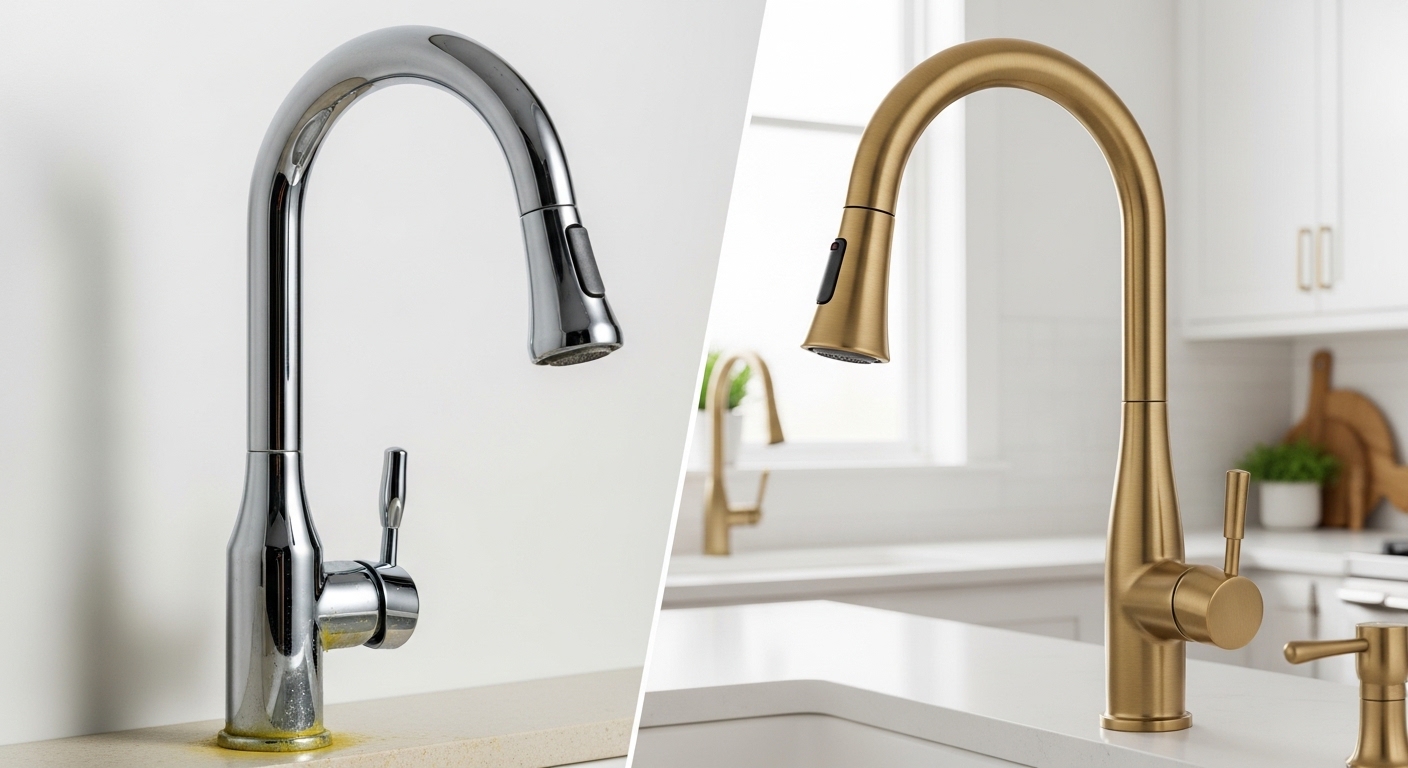
A yellow kitchen tap confuses a lot of people because “kitchen tap yellow” is really two searches in one. Half of shoppers are typing it because their once-shiny chrome or nickel faucet has developed a dingy yellow tint and they want it gone. The other half genuinely want a warm, golden, statement tap and are shopping for one. This guide answers both — first how to diagnose and reverse an accidental yellow, then how to buy a yellow (gold/brass) kitchen tap that stays beautiful for years instead of peeling in six months.
Why has my kitchen tap turned yellow when it used to be silver?
If a silver-toned tap has gone yellow, it’s almost never the metal itself changing color — it’s a thin layer of something sitting on top of the finish. The three usual culprits are hard-water mineral scale, a dried film of dish soap and grease, or a failing cheap coating that’s letting the raw brass underneath show through. You diagnose it by how the yellow behaves: wipe-off-able film is buildup, patchy yellow that won’t budge is coating failure.
Here’s the quick logic. Chrome and brushed nickel are just thin platings over a brass body. That brass is naturally yellow-gold. So when the top layer thins, wears, or gets covered, warmth bleeds through and you read it as “yellow.” Nine times out of ten on a tap that’s only a year or two old, it’s surface gunk — not the plating giving up.
- Hard-water scale: Leaves a cloudy, slightly yellow-brown crust, worst near the aerator and spout tip where water evaporates.
- Soap and grease film: Feels faintly sticky, sits around the base and handle, and smears when you wipe with a dry cloth.
- Coating failure: A patchy, dull yellow that stays after cleaning — common on very cheap faucets with lacquer or thin PVD.
- Sunlight on plastic parts: White or clear plastic sprayer heads and hoses can yellow permanently from UV — that part just needs replacing.
How do I get the yellow film off a chrome or nickel kitchen tap?
For most yellowing, plain white vinegar dissolves it in 10–15 minutes. Soak a paper towel in undiluted white vinegar, wrap it around the yellowed spout and base, leave it 10 minutes, then scrub gently with a soft toothbrush and rinse. For the aerator, unscrew it and soak the whole piece in a cup of vinegar. This handles both mineral scale and most soap film in one pass — no harsh chemicals needed.
A few rules keep you from making it worse. Never use a scouring pad, steel wool, or an abrasive powder like Comet on chrome or brushed finishes — they scratch microscopic grooves that trap even more grime and dull the shine permanently. Skip bleach too; it can attack the finish and does nothing for minerals. If vinegar alone doesn’t fully clear it, a paste of baking soda and water worked in with a soft cloth adds gentle lift without scratching. We walk through the full method — including badly caked spouts — in our guide on how to clean hard water stains from a faucet.
Why does my kitchen tap keep turning yellow again after I clean it?
If the yellow comes back within days or weeks, the cause is ongoing — you’re cleaning the symptom, not the source. The two biggest repeat offenders are hard water (mineral deposits reform every time water dries on the metal) and a worn-through finish that no longer resists staining. Fix the source and the yellow stops returning.
For hard water, the cheapest durable fix is habit plus hardware: wipe the tap dry after heavy use, and clean the aerator monthly so scale doesn’t build a foothold. If your water is genuinely hard (spots on glasses, crust on the kettle), a whole-home or under-sink softener slows it dramatically. But if the finish itself has failed — the yellow is in the metal, not on it — no amount of cleaning brings back the silver, and it’s time to either reface or replace the tap. That’s often the moment people decide to stop fighting it and lean into a warm finish on purpose.
We go even deeper on the accidental-yellowing diagnosis and repair path in our companion article, why does my kitchen faucet turn yellow — worth a read if your tap is more than a couple of years old and the color won’t wipe away.
Should you buy a yellow (gold or brass) kitchen tap on purpose?
Yes — a deliberate yellow-gold kitchen tap is one of the warmest, most on-trend finishes right now, and a good one holds up as well as chrome. The key is knowing you’re buying a designed gold finish (brushed gold, champagne bronze, or living/unlacquered brass) rather than accepting a tap that yellowed by accident. A real gold finish is engineered to be that color permanently; an accidental yellow is a defect.
People choose a gold or brass “kitchen tap yellow” finish because warm metals pair beautifully with white, cream, navy, forest green, and wood-tone kitchens, and they hide water spots and fingerprints far better than polished chrome. The trade-off is price and the need to match your other fixtures. Below is how the common warm finishes actually differ.
| Finish | Look | Maintenance | Best for | Typical price |
|---|---|---|---|---|
| Brushed / satin gold | Soft matte warm gold, low shine | Low — hides spots & prints | Modern & transitional kitchens | $120–$300 |
| Champagne bronze | Muted rosy-gold, understated | Low | Warm neutral kitchens | $150–$350 |
| Polished brass (PVD) | Bright shiny yellow-gold | Low–medium (shows prints) | Bold, glam, traditional | $150–$400 |
| Unlacquered “living” brass | Bright now, patinas over time | High — evolves & needs care | Character / heritage kitchens | $200–$500 |
What’s the difference between brushed gold, champagne bronze, and real brass?
The short version: brushed gold and champagne bronze are stable, sealed color finishes that never change, while unlacquered “living” brass intentionally darkens and patinas over years. Champagne bronze is essentially a softer, more muted cousin of brushed gold with a faint rosy undertone. All three read as “warm/yellow,” but only living brass actively evolves.
Which you want depends on how much change you’re comfortable with. If you want the tap to look identical in year five as on day one, choose a PVD brushed gold or champagne bronze. If you love the idea of a finish that ages into a lived-in warmth — and you don’t mind occasional polishing or letting it go naturally — unlacquered brass is genuinely special. If you’re weighing champagne bronze specifically, our deep dive on whether a champagne bronze kitchen faucet is worth it covers upkeep and pairing in detail.
Will a gold kitchen tap look dated in a few years?
A well-chosen brushed or satin gold is unlikely to look dated fast, because muted warm metals have moved from “trend” to “staple” — they now sit alongside chrome and matte black as a standard finish option, not a fad. What dates quickly is high-shine builder’s brass from the 1980s, not today’s soft brushed gold. The muted, low-luster versions age the most gracefully.
If longevity worries you, hedge two ways: pick a brushed (not mirror-polished) gold so it stays quiet in the room, and keep your cabinet hardware and lighting in a coordinating warm tone so the tap looks intentional rather than orphaned. A cohesive warm-metal story reads as “designed,” and designed rarely looks dated.
Does a yellow-gold finish wear off or peel over time?
A quality PVD gold finish will not peel or wear off in normal kitchen use — that’s the whole point of PVD. Cheap electroplated or spray-lacquered “gold” faucets, on the other hand, absolutely can chip, flake, and go blotchy within a year. The single most important buying decision for a yellow kitchen tap is the coating technology, not the shade.
PVD stands for Physical Vapor Deposition: the color is bonded to the metal at a molecular level in a vacuum chamber, producing a layer that’s harder than the brass underneath and highly resistant to scratching, corrosion, and cleaning chemicals. A lacquer or standard electroplate just sits on top like paint and eventually gives up. When you shop, look for the words “PVD” or a finish warranty measured in years — its presence is the clearest signal you’re getting the durable kind.
- PVD gold/brass: Bonded, scratch- and tarnish-resistant, typically backed by a lifetime finish warranty. Buy this.
- Electroplated gold: Cheaper, thinner, more prone to dulling and uneven wear over time.
- Lacquered/painted gold: A clear or tinted topcoat that can yellow, cloud, chip, or peel — the finish most likely to fail.
How do you keep a gold kitchen tap looking new?
Wipe it down with a soft damp cloth and dry it — that’s genuinely 90% of gold-faucet care. Warm finishes hide fingerprints and spots better than chrome, so daily maintenance is easier, not harder. Once a week, use a drop of mild dish soap on a microfiber cloth, rinse, and dry. That’s it for a sealed PVD finish.
What to avoid matters more than what to do. Never use abrasive pads, scouring powders, ammonia-based glass cleaners, or bleach on a gold finish — even on durable PVD they can dull the luster over time, and on lacquered finishes they’ll ruin it fast. For stubborn water spots, the same gentle white-vinegar trick works: a short soak, soft cloth, rinse, dry. Unlacquered living brass is the exception — it’s meant to patina, so you either leave it alone or polish it back to bright with a dedicated brass polish, your choice.
How do I match a yellow kitchen tap to the rest of my kitchen?
Match warm metals to warm metals and pick one dominant metal per room. A gold or brass tap looks best when your cabinet pulls, pendant lights, and any visible hardware share the same warm family — they don’t have to be an exact match, but they should all lean warm rather than fighting a cold chrome or bright-silver element right next to the sink.
Two practical guidelines make this foolproof. First, it’s fine to mix two metals in a kitchen (say warm gold at the sink and matte black on the range), but keep it deliberate and repeat each metal at least twice so it looks planned. Second, buy your sink, tap, and soap dispenser in the same finish and ideally the same brand line, because “gold” varies between manufacturers — one brand’s champagne differs from another’s brushed gold. If warm metals aren’t clicking for your space, our comparison of whether brushed nickel faucets are worth it lays out the cooler, more neutral alternative.
Which kitchen tap should you actually buy — quick decision guide
If your existing tap yellowed by accident, clean it first before spending anything — buildup is free to fix. If cleaning fails and the finish has worn through, replace it, and this is the perfect moment to decide between going back to a low-warmth finish or embracing a proper gold. If you want a yellow tap on purpose, buy a PVD brushed gold or champagne bronze with a finish warranty and match it to your hardware. Avoid any “gold” faucet that doesn’t state its coating type — that silence usually means lacquer or thin plating.
Cobbe builds its warm-finish kitchen taps on solid brass bodies with PVD color layers and ceramic-disc cartridges, so the finish resists the yellowing-by-accident problem entirely while giving you the intentional gold look. It’s the difference between a tap that turns yellow on you and a tap that’s beautifully, permanently golden by design.
FAQ
Is a yellow kitchen tap the same as a gold faucet?
Usually, yes — when people search “kitchen tap yellow” as a style, they mean a warm gold or brass finish (brushed gold, champagne bronze, or polished/living brass). The exception is an accidental yellow, where a chrome or nickel tap has discolored from buildup or a failing finish. A true gold faucet is engineered to be that color; an accidental yellow is a defect you can usually clean off.
Can I fix a yellowed chrome tap without replacing it?
In most cases, yes. If the yellow is surface film from hard water or soap, a 10-minute white-vinegar soak and a soft-brush scrub will clear it and restore the silver look. You only need to replace the tap if the yellow is coming from the plating itself wearing through — in that case cleaning won’t help, and the discoloration stays after scrubbing.
Does a gold kitchen tap show water spots and fingerprints?
Less than chrome, actually. Brushed and satin gold finishes have a soft matte texture that scatters light and hides prints and water spots far better than polished chrome or stainless. Polished (high-shine) gold shows more than brushed, but even it’s more forgiving than mirror chrome. A quick daily dry-off keeps any warm finish looking spotless.
Are gold kitchen taps more expensive than chrome?
Slightly, yes — expect to pay a modest premium over the identical model in chrome, because a quality gold finish requires PVD coating. Realistically that’s often $20–$60 more for a comparable tap. It’s worth it for the durability: cheap gold that costs the same as chrome is usually lacquered or plated and far more likely to peel, so paying for genuine PVD is money well spent.
Why did my white plastic sprayer head turn yellow but the metal didn’t?
That’s UV yellowing of the plastic, not a finish problem. White and clear plastics slowly yellow from sunlight and heat exposure, which is a chemical change in the plastic itself — cleaning won’t reverse it. The fix is simply to swap that component; a replacement spray head or hose in the correct fit restores the clean look without replacing the whole faucet.
How do I know if a gold faucet is real PVD or just painted?
Check the product spec for the words “PVD” and look for a finish warranty — reputable warm-finish taps are backed by a limited lifetime finish guarantee. Painted or lacquered gold rarely advertises its coating and often carries only a short warranty or none. If a listing is vague about how the color is applied, treat that as a warning sign that it’s the type prone to yellowing and peeling.
A note on expertise, testing, and warranty
This guide was written by the Cobbe product team, drawing on hands-on testing of kitchen faucet finishes across chrome, brushed nickel, matte black, and warm gold variants. Cobbe designs and manufactures kitchen and bathroom fixtures built on solid-brass bodies with PVD finishes and ceramic-disc cartridges rated for over 500,000 open-close cycles, and our faucets are tested to meet North American standards for lead-free wetted surfaces (NSF/ANSI 61 & 372) and cUPC certification. Our warm-finish kitchen taps carry a limited lifetime warranty on both the finish and the drip-free cartridge, which is the practical assurance that a deliberately gold tap won’t become an accidentally yellow one. Always confirm certification marks and warranty terms before you buy any faucet — from us or anyone else.
Pingback: Kitchen Taps in Zimbabwe: What Should You Actually Buy for Hard Water and Low Pressure? - Cobbe
Pingback: Is a Copper Faucet Worth It, and How Do You Keep One Looking Good? - Cobbe