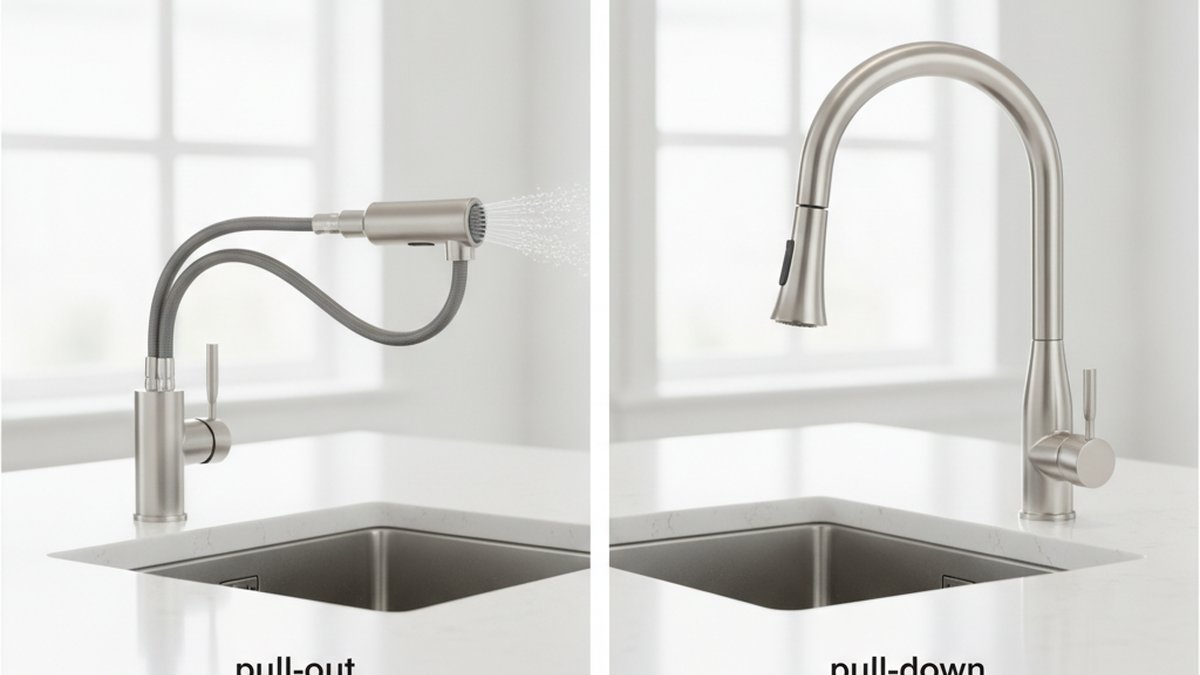
A kitchen faucet with sprayer pull-out spray is a faucet whose entire spray head detaches from the spout and extends on a flexible hose, so you can pull it straight out toward you — ideal for rinsing dishes, filling pots on the counter, and cleaning the sink basin. It’s different from a pull-down faucet (tall gooseneck, sprayer drops down), and that one difference changes which one fits your sink. This guide walks through the real questions people ask before buying one, with concrete specs, prices, and a comparison table you can act on.
What’s the difference between a pull-out and a pull-down sprayer — and which do I need?
Pull-out faucets have a lower, more compact spout and the spray head pulls out toward you, horizontally. Pull-down faucets have a tall arc and the head pulls straight down into the sink. If you have a window behind your sink, open shelving above it, or low cabinets, a pull-out wins because it doesn’t need the vertical clearance. If you have a deep single-bowl sink and plenty of headroom, a pull-down gives you more reach into the basin.
Here’s the practical rule most people miss: measure from your countertop to the bottom of any obstruction (window sill, shelf, upper cabinet). If you have less than about 10 inches of clearance, skip the tall gooseneck and go pull-out. The compact spout also makes pull-out faucets the better pick for prep sinks, bar sinks, and RVs or tiny homes where a 16-inch arc would look absurd.
- Pick pull-out if: you have a window or shelf behind the sink, a shallow sink, a small/prep sink, or you want maximum hose reach to fill pots on the counter.
- Pick pull-down if: you have a deep single bowl, plenty of overhead clearance, and you want that “restaurant” gooseneck look.
- Either works if: you have a standard double-bowl sink with open space above — then choose on style and budget.
How much should I spend on a pull-out spray faucet in 2026?
Plan on $90–$220 for a solid one that lasts. Below about $70 you start seeing plastic spray heads that crack, thin hoses that kink, and docks that won’t hold the head up. Above $250 you’re mostly paying for finish, brand name, and designer styling — not longevity. The sweet spot for durability-per-dollar sits right in the $110–$180 range.
Where your money actually goes matters more than the sticker price. A ceramic-disc valve, a braided stainless or nylon hose, and a metal (not plastic) spray head are the three things that determine whether the faucet still works perfectly in five years. If you want to see how a pull-out stacks up against other faucet types at a given budget, our breakdown of the best faucet under $200 is a good reality check before you spend a dime, and the broader kitchen faucet buying guide covers mounting, hole count, and reach in more depth.
| Price tier | Typical build | Hose | Spray head | Who it’s for |
|---|---|---|---|---|
| $40–$70 (budget) | Plastic internals, light finish | Thin PVC, kinks | Plastic, often non-replaceable | Rentals, short-term use |
| $90–$180 (sweet spot) | Ceramic-disc valve, solid brass or stainless body | Braided nylon/stainless, weighted or magnetic dock | Metal or reinforced, usually replaceable | Most home kitchens |
| $220–$400+ (premium) | Heavy brass, designer finishes, smart/touch options | Braided, long reach, smooth retract | Metal, multi-mode, easy-clean nozzles | Remodels, heavy daily cooking |
What features actually matter on a pull-out sprayer (and which are hype)?
The features that matter are the hose, the valve, the dock, and the number of spray modes. Touchless sensors, LED temperature lights, and voice control are nice-to-haves that rarely justify a $150 premium for most households. Focus your money on the parts that fail.
Breaking down what to prioritize:
- Hose material: braided nylon or stainless resists kinks and lasts years. Bare PVC is the #1 cause of early leaks and drooping heads.
- Valve type: a ceramic-disc cartridge is the standard for drip-free, smooth operation. If you want to understand why this matters, our guide to kitchen faucet valve types explains the difference between ceramic, ball, and compression valves.
- Dock mechanism: magnetic docks (like a strong magnet that grabs the head) snap back cleanly; weighted docks use a counterweight on the hose. Cheap friction docks sag within a year.
- Spray modes: at minimum you want an aerated stream (for filling and everyday use) and a strong spray (for rinsing). A pause button is genuinely useful. A “sweep” or power-clean mode helps with stuck-on food.
- Spray head material: metal or reinforced polymer heads survive drops onto the sink; brittle plastic ones chip and leak.
Will a pull-out sprayer work with low water pressure or hard water?
Yes — but you need to pick the right spray mode and clean the aerator. Pull-out heads concentrate flow, so the “spray” mode can feel strong even on modest pressure, while the aerated stream feels weaker. Hard water is the bigger enemy: mineral scale clogs the tiny nozzle holes and the aerator, cutting flow and causing uneven, spitting spray within months.
If you’re on a well or in a hard-water region, buy a head with rubber “nubbin” nozzles you can wipe scale off with your thumb — that one feature saves hours of maintenance. Soak the removable head in a 50/50 white-vinegar-and-water solution monthly. For readers dealing with genuinely tough supply conditions, our piece on kitchen taps for hard water and low pressure goes deeper on flow rates and scale management.
Can I replace just the sprayer head instead of the whole faucet?
Often, yes — and it’s the cheapest fix if your faucet body is fine but the spray is weak, dripping, or the modes stopped switching. Most pull-out heads unscrew from the hose at a standard connection, so a $15–$30 replacement head can bring an old faucet back to life. The catch is matching the thread and connector type to your brand.
Before you buy a new faucet, check whether a kitchen faucet sprayer head replacement solves your problem — we walk through how to do it without replacing the whole unit. If you’re not sure which head fits, our guide to the right replacement head covers measuring threads and matching your model. And if the issue is actually a dripping or sagging hose rather than the head, the fix for a leaking pull-out faucet hose is usually a $10 washer or quick-connect, not a new faucet.
Why does my pull-out sprayer droop, leak, or not retract?
Nine times out of ten it’s the hose weight, the quick-connect, or a worn O-ring — not a dead faucet. A sprayer that won’t retract has usually lost its counterweight (it slid up the hose) or the hose is catching on the shut-off valves and supply lines under the sink. A sprayer that drips at the head after you turn it off is a worn diverter or a scaled-up valve. A leak under the sink is almost always the quick-connect fitting or a cracked hose.
Quick diagnostic checklist:
- Won’t retract fully: reposition or reattach the counterweight ~8–10 inches down the hose; clear anything the hose snags on.
- Drips from the head: remove and descale the head; if that fails, replace the head or diverter.
- Leaks under the sink when spraying: inspect the quick-connect and hose; re-seat or replace the O-ring.
- Low or spitting flow: unscrew and soak the aerator/nozzle in vinegar.
How hard is it to install a pull-out spray faucet yourself?
Most people can do it in 45–90 minutes with a basin wrench, an adjustable wrench, and plumber’s tape. A pull-out faucet installs in a single mounting hole (sometimes with an optional deck plate to cover extra holes), and the hose threads down through the spout before you connect supply lines. No soldering, no special skills — just patience in a tight cabinet.
Here’s the basic sequence:
- Turn off both hot and cold shut-off valves under the sink and open the old faucet to release pressure.
- Disconnect the supply lines and remove the old faucet’s mounting nuts with a basin wrench.
- Drop the new faucet through the hole, feed the pull-out hose down, and secure the mounting nut from below.
- Attach the hose to the faucet body, clip on the counterweight, and connect the supply lines (wrap threads with plumber’s tape).
- Turn the water back on slowly, check every connection for drips, and run both temperatures for a minute to flush the line.
If your supply lines use a quick connector, installation is even faster — the hose clicks into place with no threading. That’s increasingly common on mid-range Cobbe and comparable faucets.
Pull-out vs. pull-down vs. side-sprayer: quick comparison
If you’re still torn between styles, here’s the short version: pull-out for clearance and reach, pull-down for deep sinks and looks, separate side-sprayer only if you specifically want the sprayer apart from the spout. The integrated pull-out is the most popular because it combines the sprayer and spout in one clean unit.
| Type | Best for | Clearance needed | Reach | Downside |
|---|---|---|---|---|
| Pull-out | Windows/shelves above sink, small or prep sinks | Low | Excellent (long hose) | Shorter spout, less basin coverage |
| Pull-down | Deep single-bowl sinks, open kitchens | High | Good (drops into basin) | Needs overhead room; can splash |
| Separate side-sprayer | Traditional 3–4 hole sinks, retro looks | Low | Limited | Extra part to leak; dated |
Why Cobbe for a pull-out spray faucet?
Cobbe builds pull-out kitchen faucets around the parts that actually fail on cheap models: braided hoses, ceramic-disc cartridges rated for 500,000+ open/close cycles, and metal-reinforced spray heads with wipe-clean nozzles for hard-water homes. Finishes are tested against standard corrosion and abrasion checks, and faucets ship with a limited lifetime warranty on the valve and finish, plus readily available replacement parts — so a worn head or hose is a cheap swap, not a reason to toss the whole faucet.
That last point matters more than most buyers realize. A faucet is only as good as your ability to keep it running, which is why we publish detailed replacement and repair guides rather than hoping you buy new. A good pull-out faucet should be a 10-year purchase, not a 2-year one.
FAQ
Is a pull-out faucet better than a pull-down faucet?
Neither is universally better — it depends on your sink. Pull-out is better for kitchens with a window or shelf above the sink, shallow or small sinks, and maximum hose reach. Pull-down is better for deep single-bowl sinks with lots of overhead clearance. For a standard setup, choose on style and budget.
How long does a pull-out sprayer hose last?
A quality braided nylon or stainless hose typically lasts 7–12 years. Cheap PVC hoses often kink or crack within 1–3 years. When a hose fails it’s usually a $10–$20 replacement part, not a reason to replace the whole faucet — check the connector type first so you buy the right one.
Can I use a pull-out faucet with a water filter or RO system?
Yes. Pull-out faucets connect to your standard hot and cold supply lines, so an under-sink filter that feeds those lines works normally. If you have a dedicated reverse-osmosis faucet, that’s a separate fixture — the pull-out handles your regular tap water while the RO faucet handles filtered drinking water.
Why is my pull-out sprayer weak or spitting?
Almost always mineral scale clogging the aerator or nozzle. Unscrew the spray head, soak it in a 50/50 white vinegar and water mix for 30–60 minutes, and wipe the rubber nozzles. If flow is weak in every mode, also check that the supply shut-off valves under the sink are fully open.
Do pull-out faucets fit any kitchen sink?
Most fit standard single-hole or 3-hole sinks (use the included deck plate to cover extra holes). Confirm your sink’s hole count and spacing, and check that the faucet’s spout reach clears the center of your basin. For very small bar or prep sinks, pick a compact pull-out rather than a full-size one.
What’s the difference between a spray head and a sprayer, exactly?
On a pull-out faucet they’re the same component — the detachable nozzle at the end of the hose that switches between stream and spray. If yours is damaged, you can often replace just that part; see our guide on the kitchen faucet spray head for how to pick or swap one.
Author note: This guide was written by the Cobbe product team, drawing on hands-on testing of pull-out and pull-down kitchen faucets across hard-water and low-pressure conditions, plus common installation and repair questions from real customers. We update it as mounting standards, valve technology, and pricing change.