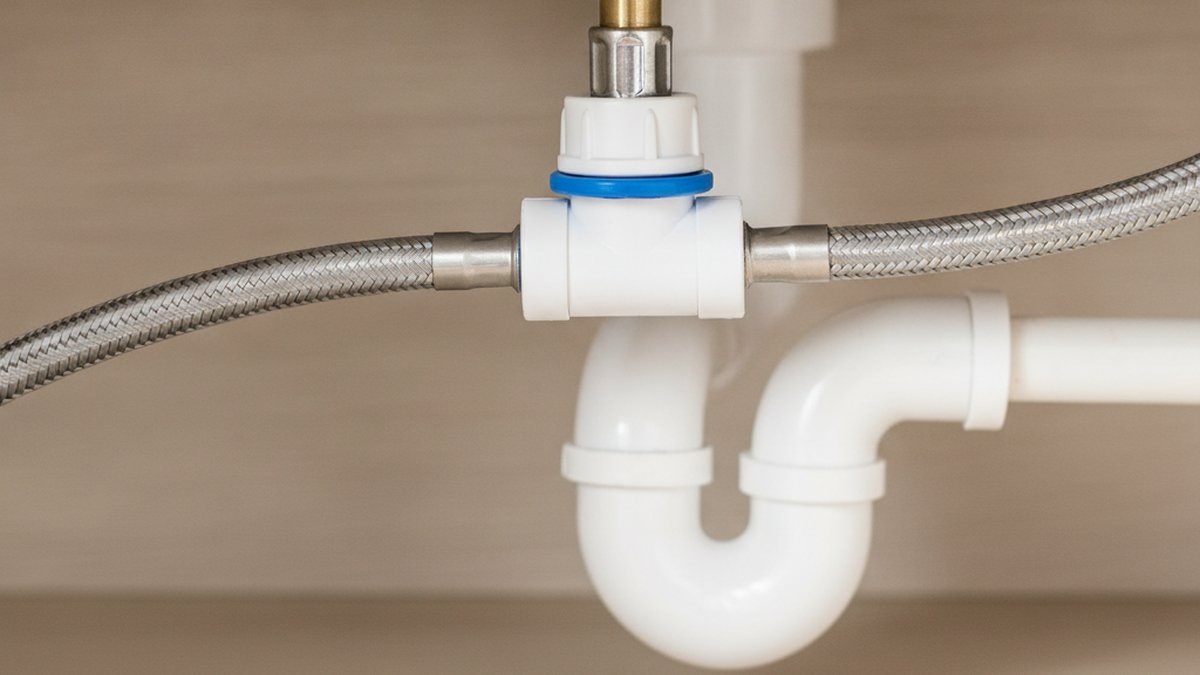
If you’ve ever crawled under the sink to swap a hose and found a little plastic collar instead of a nut, you’ve already met a kitchen faucet quick connector. It’s the small coupling that lets modern faucets snap together in seconds — no thread tape, no basin wrench, no cross-threading a fitting you can barely see. The catch is that “quick connector” isn’t one universal part. There are several designs, several sizes, and a handful of brand-specific systems that look almost identical but absolutely will not mate with each other. This guide walks through exactly what these connectors are, how to identify the one on your faucet, and how to buy or replace the right one the first time.
What exactly is a kitchen faucet quick connector, and what does it do?
A quick connector is a self-sealing coupling that locks two water lines together with a push, a clip, or a quarter-turn twist — instead of the traditional threaded nut. Inside, an O-ring or gasket makes the watertight seal, and a spring-loaded collet or metal clip grabs a groove on the hose end so it can’t blow apart under pressure. You push the parts together, they click, and you’re done.
These couplings do a few specific jobs on a kitchen faucet:
- Connect the supply hoses to the faucet shanks (the hot and cold lines running up from your shutoff valves).
- Join the pull-down or pull-out spray hose to the faucet body, usually with a snap collar so the hose can retract freely.
- Attach the spray head to the end of the hose so you can pop it off to clean or replace it.
- Adapt a hose to a different outlet — for example, connecting a sprayer line to a garden hose thread or a quick-fill adapter.
The whole point is speed and repeatability. A traditional threaded connection needs a wrench, thread sealant, and a steady hand in a cramped cabinet. A quick connector turns that into a five-second job you can do by feel, which is why nearly every pull-down faucet built in the last decade ships with at least one.
How do I know which quick connector type my faucet uses?
Look at the coupling itself — the shape tells you the type. There are three families you’ll run into, and identifying yours takes about ten seconds once you know what to look for.
Push-fit collet (the “John Guest” style): a round plastic collar you push the tube into; to release, you push the collar in toward the fitting and pull the hose out. Common on braided supply lines and some spray hoses.
Snap clip / bracket: a horseshoe-shaped metal or plastic clip that slides into a slot to lock two halves together. You pull the clip out with your fingers or a flat screwdriver to separate them. Very common where the spray hose meets the faucet outlet tube on pull-downs.
Bayonet / twist-lock quick-coupler: the two ends push together and twist a quarter turn to lock. This is the style you feel “click and seat.” Widely used on spray heads and on some brand supply systems.
| Connector type | How it locks | Where you’ll find it | Tools to release |
|---|---|---|---|
| Push-fit collet | Push tube in, collet grips a groove | Supply lines, some spray hoses | None — push collar and pull |
| Snap clip / bracket | Horseshoe clip in a slot | Spray hose to faucet body | Fingers or flat screwdriver |
| Bayonet twist-lock | Push and quarter-turn | Spray head, brand supply kits | None — twist to release |
| Threaded quick-coupler | Hand-tight threaded ring over a gasket | Hose adapters, weight attach points | Hand or light wrench |
Why won’t a quick connector from one brand fit another faucet?
Because most faucet makers use their own coupling geometry on purpose. The outside diameter of the hose end, the groove position the clip grabs, and the seal size are all brand-specific — so a Moen spray-head connector won’t lock onto a Delta hose even though both are “quick connectors.” This is the single most common reason a replacement part shows up and doesn’t fit.
There are practical reasons for it. Brands want you to buy their exact replacement hose or spray head, and they tune the connector to their own hose diameter and water pressure rating. Delta’s spray heads use a keyed quick-connect that mates only with Delta hoses. Moen has its own snap system. Grohe uses metric fittings that don’t share threads with American 3/8″ or 1/2″ standards. Generic Amazon pull-downs often copy one of these patterns but with tolerances that are just off enough to leak.
So the safe rule is: identify your faucet brand and model first, then buy the connector that matches that model. If it’s a no-name faucet with no model number, measure the hose outside diameter with calipers and match the connector to the physical size, accepting that you may need to try one or two. When people fight a leaking pull-out hose, a mismatched or worn connector is very often the culprit — our guide on why a pull-out kitchen faucet hose leaks and how to fix it fast walks through diagnosing exactly that.
What size quick connector do I need — 3/8″, 1/2″, or something proprietary?
For standard supply-line quick connectors, the two common sizes are 3/8″ and 1/2″, measured by the tube outside diameter, and you can confirm yours in under a minute with calipers or by reading the fitting. For spray-head and spray-hose connectors, sizing is usually proprietary to the brand rather than a plain inch measurement, so you match the model instead of a number.
Here’s how to nail the size without guessing:
- Measure the hose outside diameter. Slide calipers over the smooth part of the tube (not over a fitting). Most kitchen supply tubes read close to 3/8″ or 1/2″. Compression and quick-connect fittings are sized by this OD.
- Check the shutoff-valve outlet. Standard US angle stops are 3/8″ compression. Your quick connector’s other end must match whatever the valve or faucet shank presents.
- Read any printing on the old connector. Many stamp a size, a brand, or a part number right on the plastic.
- For spray hoses and heads, find the faucet model number. It’s often on a sticker under the sink, on the original box, or on the spec sheet. Buy that model’s replacement rather than a generic size.
If your project is really about adapting one hose thread to another — say, connecting your sprayer to a garden hose or an odd outlet — that’s a hose-adapter question more than a pure connector question. Our breakdown of which kitchen faucet hose adapter you actually need covers the thread sizes (GHT, 3/8″, 1/2″, metric) so you don’t buy three wrong parts before the right one.
How do I install or replace a kitchen faucet quick connector?
Turn off the water, relieve the pressure, disconnect the old coupling by its designed release method, and push or clip the new connector into place until it clicks — the whole swap usually takes under fifteen minutes. Quick connectors are engineered to be tool-light, so most of the job is prep and cleanup, not force.
Step by step:
- Shut off both angle-stop valves under the sink and open the faucet to release residual pressure. Put a towel and a small pan under the work area.
- Release the old connector by its type. Push-fit: press the collar in and pull the tube. Clip: slide the horseshoe clip out, then separate. Bayonet: twist a quarter turn and pull. Never yank a clip-style connector without removing the clip first — you’ll crack the housing.
- Inspect the O-ring or gasket. A hard, flattened, or torn seal is the usual reason a quick connector drips. Replace the seal or the whole connector.
- Clean the tube end. Wipe off mineral scale so the new collet or clip seats on a smooth surface. A rough or scaled tube is why a fresh connector still weeps.
- Push the new connector fully home until it clicks or the clip snaps in. On push-fit fittings, then gently tug to confirm the collet has grabbed. A partial insertion is the number-one cause of a “brand-new” leak.
- Turn the water back on slowly and watch the joint for 60 seconds. A dry joint under full pressure means you’re done.
One thing worth saying plainly: if you’re replacing the spray head rather than the hose connector, the head itself often just twists off its own quick-connect. That’s a separate, even simpler swap — our guides on doing a sprayer head replacement without replacing the whole faucet and choosing a kitchen faucet replacement head cover which heads pop off with a quick connector and which are threaded.
Are quick connectors reliable, or should I be worried about leaks?
Quality quick connectors are very reliable — a properly seated push-fit or bayonet coupling holds normal household water pressure (typically 40–80 psi) for years without weeping. The failures people blame on “quick connectors” almost always trace back to three fixable causes, not the design itself.
- Partial insertion. If the collet or clip didn’t fully engage, the joint holds until pressure or a bump nudges it loose. Push until it clicks and tug-test it.
- A tired O-ring. Rubber seals harden with age, heat, and mineral buildup. A cheap replacement O-ring often fixes a “failing” connector completely.
- Mismatched or counterfeit parts. A connector that’s a hair off-size seats but never seals well. Buy the connector matched to your faucet, not the cheapest lookalike.
For peace of mind, look for connectors rated to a recognized standard. Reputable kitchen faucets and their couplings are tested against ASME A112.18.1 / CSA B125.1 (the plumbing fixture fittings standard) and, in the US, certified to NSF/ANSI 61 and 372 for drinking-water safety and lead-free content. If a replacement part lists those certifications, it has been pressure- and material-tested rather than just molded and shipped.
When should I just replace the whole faucet instead of the connector?
Replace the connector when the faucet body and hoses are sound and only the coupling or its seal has failed; replace the whole faucet when the leak is inside the faucet body, the finish is failing, or replacement parts for your model are discontinued. A connector costs a few dollars; a full faucet is a bigger commitment, so it’s worth being honest about which problem you actually have.
Signs it’s a connector-only fix: the drip is right at a visible coupling, the faucet spouts and sprays fine, and the model still has parts available. Signs it’s time for a new faucet: water seeps from the base or handle, the cartridge is also worn, the finish is pitting, or the maker no longer sells parts. If you’re already shopping, it’s worth checking availability locally versus online — our roundup on finding the best kitchen faucets near you, in-store or online helps you weigh a quick part swap against a clean upgrade.
FAQ
Are all kitchen faucet quick connectors universal?
No. Some supply-line quick connectors are near-universal at standard 3/8″ or 1/2″ sizes, but spray-head and spray-hose connectors are usually proprietary to the brand and model. A Delta connector will not lock onto a Moen or Grohe hose. Always match your faucet’s brand and model, or measure the hose OD with calipers before buying.
Can I install a quick connector without any tools?
Most of the time, yes. Push-fit and bayonet connectors are designed to be hand-installed with a click. You may need a flat screwdriver to pry out a stubborn snap clip, and pliers to loosen an old threaded coupler that’s stuck. But the core connection is tool-free, which is the whole point of the design.
Why does my quick connector still leak after I replaced it?
The three usual reasons are partial insertion (push until it clicks and tug-test it), a worn or missing O-ring (inspect and replace the seal), or a size mismatch (the connector seats but doesn’t fully seal). Also clean any mineral scale off the tube end — a rough surface prevents a good seal even on a brand-new part.
What’s the difference between a quick connector and a hose adapter?
A quick connector joins two matching water lines with a push or clip and is designed to come apart easily. A hose adapter converts one thread or size to another — for example, faucet thread to garden-hose thread — and is usually threaded. If your goal is to connect two things that don’t naturally fit, you likely need an adapter, not just a connector.
How long do faucet quick connectors last?
The connector body typically lasts the life of the faucet, but the internal O-ring or gasket is the wear item and may need replacing every several years depending on water hardness, temperature, and use. Hard water shortens seal life the most, since mineral buildup stiffens the rubber and scores the sealing surface.
Do quick connectors reduce water pressure or flow?
A correctly sized quick connector adds essentially no measurable restriction — its internal bore matches the hose. If you notice weak flow after installing one, the more likely culprits are a clogged aerator, a kinked spray hose, or a partially closed shutoff valve, not the connector itself.
Author note: This guide was written by the Cobbe product team, who spend their days sizing, testing, and installing kitchen faucet couplings and spray systems. We’ve handled the Delta, Moen, Grohe, and generic pull-down connector standards firsthand, so the sizing and fitment advice here comes from real installs, not spec-sheet copy.
About Cobbe: Cobbe designs and sells kitchen and bathroom fixtures at cobbe.net, with a focus on pull-down faucets, spray heads, and the hoses and connectors that keep them working. Our replacement parts are built to recognized plumbing fitting standards (ASME A112.18.1 / CSA B125.1) and lead-free drinking-water certifications (NSF/ANSI 61 & 372), and our faucets are backed by a manufacturer’s warranty. When you match a connector to your Cobbe faucet model, it’s engineered and pressure-tested to seat and seal on the first click.