If you’ve ever tried to hook a garden hose, a portable dishwasher, or a replacement pull-down sprayer to your sink and found nothing lines up, a kitchen faucet hose adapter is the little brass or plastic fitting that bridges the gap. It sounds trivial until you’re standing at the hardware store holding a threaded ring you can’t identify. This guide walks you through exactly how to identify your thread type, which adapter matches which job, and how to get a leak-free connection on the first try — the same questions our team at Cobbe answers by email a dozen times a week.
How do I know which hose adapter fits my kitchen faucet?
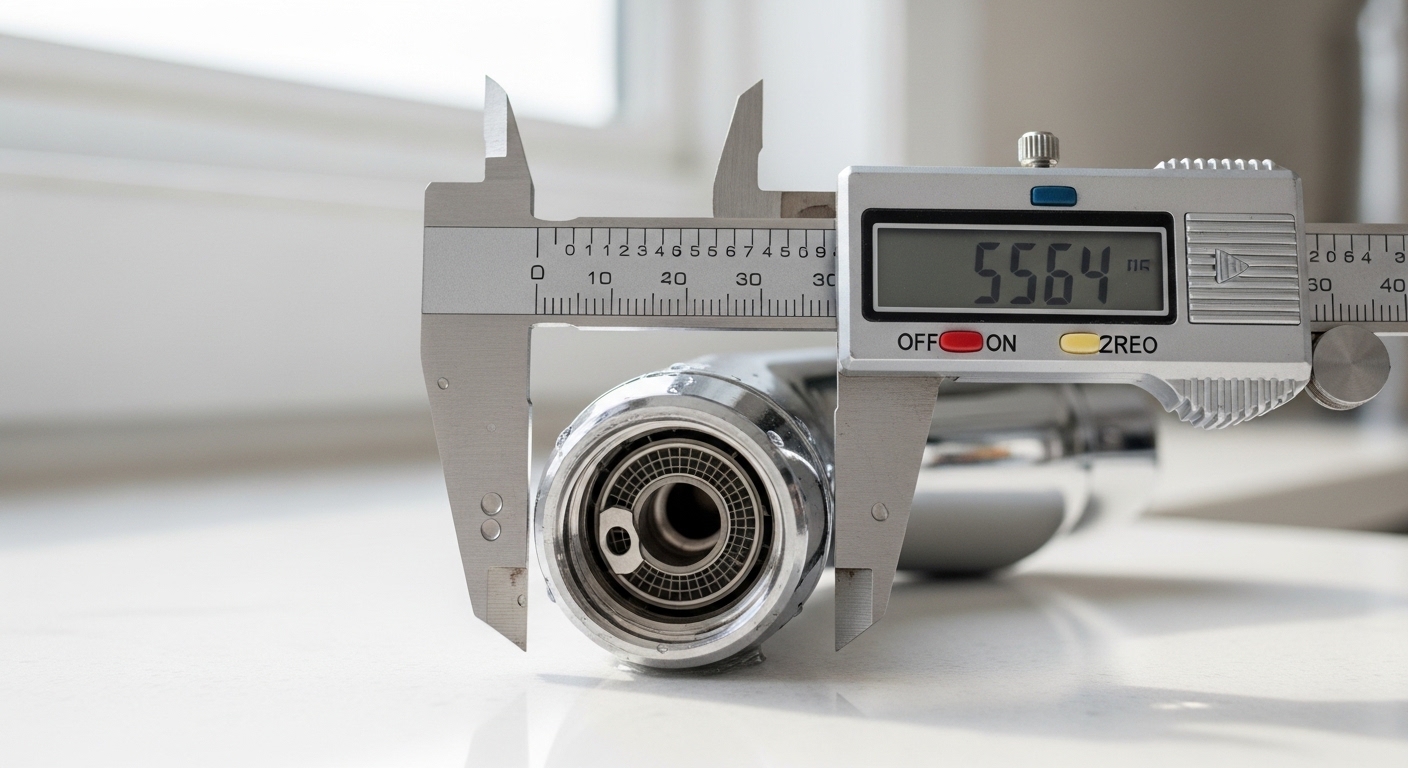
Look at the tip of your spout: unscrew the aerator, and the thread you expose tells you everything. If the threads are on the outside of the spout tip, you have “male” threads (usually 15/16″-27). If they’re on the inside, you have “female” threads (usually 55/64″-27). Those two — 15/16″-27 male and 55/64″-27 female — cover the overwhelming majority of American kitchen and bathroom faucets.
Here’s the part that trips people up: the number describes the faucet side, and a good adapter is reversible, with male threads on one end and female on the other, so a single “dual-thread” aerator adapter fits most standard spouts. The opposite end of the adapter is what connects to your hose. For garden hoses, that’s 3/4″-11.5 GHT (garden hose thread). They are not interchangeable — GHT is coarse and wide; aerator thread is fine and narrow — which is exactly why a garden hose will never thread straight onto a bare faucet.
To measure at home without a caliper: standard male aerator thread is a hair under 1 inch across (about 24mm), female is a bit smaller (about 22mm). If your spout tip is unusually small — around 18–20mm — you likely have a “junior” or Tom Thumb thread, common on European or bar faucets, and you’ll need a specialty adapter.
What if my faucet has no threads at all (a pull-down sprayer)?
If your faucet is a pull-down or pull-out model with a spray head, there are usually no external aerator threads to grab — the aerator is molded into the sprayer face. In that case you need a slip-on rubber adapter or a quick-connect coupler, not a threaded one. The rubber cone slides over the smooth spout tip and clamps down; the quick-connect snaps into the hose fitting on the underside where the sprayer hose meets the faucet body.
This is the single most common mistake we see: someone buys a threaded 15/16″ adapter, gets home, and there’s nothing to screw it onto because their sprayer face is smooth plastic. Before you buy, confirm whether your spout ends in threads or ends in a smooth sprayer. If you’re replacing the whole sprayer hose or wand, that’s a different repair — our step-by-step guide to installing a kitchen faucet covers disconnecting and reconnecting the sprayer hose under the sink.
Which kitchen faucet hose adapter should I buy for my specific job?
Match the adapter to the task, not just the thread. A garden-hose adapter, a dishwasher hookup, and a sprayer replacement all “connect to the faucet” but use different fittings and seals. Here’s a quick decision table.
| Your goal | Adapter type | Faucet-side fitting | Other-side fitting | Typical price |
|---|---|---|---|---|
| Connect a garden hose (fill buckets, wash pets) | Faucet-to-garden-hose aerator adapter | Dual 15/16″-27 M & 55/64″-27 F | 3/4″ GHT | $6–$12 |
| Hook up a portable/countertop dishwasher | Quick-connect faucet coupler (unified adapter) | 55/64″-27 female aerator | Push-button quick disconnect | $10–$18 |
| Replace a worn pull-down sprayer hose | Sprayer hose with quick-connect end | 1/4-turn or clip quick-connect under sink | Sprayer wand socket | $14–$30 |
| Smooth spout, no threads | Slip-on rubber multi-thread adapter | Rubber cone clamp | 3/4″ GHT | $5–$9 |
| Small “junior” bar/European spout | Specialty junior-thread adapter | 13/16″-27 or M18 | 3/4″ GHT or aerator | $8–$15 |
Notice that a portable dishwasher hookup almost always wants a female aerator thread on your faucet, because the unified coupler is designed to screw onto exposed male-threaded spouts after you remove the aerator. If your faucet only offers female threads, you may need a short male-to-male nipple first. Read the dishwasher’s manual — it usually specifies the exact adapter model.
Brass vs. plastic hose adapters — which lasts longer and is it worth the money?
Buy solid brass for anything you’ll leave connected or pressurize regularly; plastic is fine for occasional, low-stress use. A $10 brass adapter and a $4 plastic one look similar in the package, but the differences show up fast under real conditions.
- Brass (chrome-plated or raw): Won’t crack under pressure spikes, threads stay true after dozens of connect/disconnect cycles, and it tolerates hot water (dishwasher hookups run hot). Best for permanent or semi-permanent connections.
- Plastic (ABS/nylon): Lighter, cheaper, won’t corrode or seize, and won’t scratch a finished faucet. But threads can strip if you over-tighten, and it can crack in freezing garages or under a pressure surge. Fine for a garden hose you attach for ten minutes.
- Stainless quick-connects: The push-button couplers on modern sprayers — durable, but the O-ring inside is the real wear part. Keep a spare O-ring; that’s usually what leaks, not the metal.
One thing brass buyers should know: cheap “brass” imports can contain higher lead content. For anything touching drinking water, look for adapters certified to NSF/ANSI 61 and compliant with the U.S. lead-free law (≤0.25% weighted average lead). Cobbe adapters and faucet components are tested to those standards — more on that below.
How do I install a kitchen faucet hose adapter without leaks?
A leak-free install comes down to three things: clean threads, the right seal, and hand-tight plus a quarter turn — never crank it. Here’s the reliable sequence for a standard threaded aerator adapter.
- Remove the existing aerator. Wrap the spout tip in a cloth and turn counterclockwise (as you look up at it). If it’s stuck from mineral buildup, soak it — our advice on removing hard water stains from a faucet works to free a seized aerator too.
- Check the washer. Most aerator adapters include a rubber or fiber washer. Make sure it’s seated flat inside the female fitting — a cocked washer is the #1 cause of a slow drip.
- Thread on by hand. Start it straight and turn slowly. If it resists in the first turn, back off — you’ve cross-threaded. Fine aerator threads strip easily.
- Snug it up. Hand-tight, then about a quarter turn with pliers over a cloth. Do not force it.
- Test. Run water at low pressure first, watch the joint, then turn up. A bead of water at the seam means re-seat the washer or add a wrap of PTFE (plumber’s) tape on the threads — but only on threaded metal-to-metal joints, never on a washer-sealed one.
If water sprays sideways or the adapter won’t stop dripping even after re-seating, the problem may be the faucet itself rather than the adapter. A worn cartridge or O-ring inside the spout can leak past any fitting — see why a kitchen faucet drips and how to stop it fast to rule that out before you blame the adapter.
Will one adapter fit any brand — Moen, Delta, Kohler, or Cobbe?
Mostly yes, because the big American brands standardized on 15/16″-27 male and 55/64″-27 female aerator threads decades ago, so a dual-thread adapter fits Moen, Delta, Kohler, Cobbe, and most others. The exceptions are proprietary sprayer quick-connects and a few designer or imported spouts with hidden or metric threads.
Where brands genuinely differ is the sprayer quick-connect under the faucet — Moen, Delta, and others each use slightly different clip or 1/4-turn couplers, so a replacement sprayer hose should match your faucet’s system. If you’re weighing a whole new faucet rather than just an adapter, our breakdown of Moen vs. Delta compares how each brand handles hoses, sprayers, and long-term parts availability.
Finish matters cosmetically, not functionally — an adapter threads the same onto chrome, brushed nickel, matte black, or a warm metal spout. If you care about a visible adapter matching your faucet (say, an exposed garden-hose connector on a bar sink), match the finish; the fit is identical. For finish questions in general, our guide to a champagne bronze kitchen faucet covers how coatings hold up to repeated handling.
Can I leave a garden hose adapter on my kitchen faucet permanently?
You can, but you shouldn’t for two reasons: aeration and backflow. The moment you remove the aerator to fit a hose adapter, you lose the aerator’s job — mixing air into the stream to reduce splash and save water. Water use jumps and the stream gets harsh. Second, a hose sitting in a bucket, a pet tub, or a garden creates a backflow risk: if house pressure drops, contaminated water can be siphoned back toward your drinking supply.
The safe approach is a vacuum-breaker adapter (an anti-siphon fitting) if the hose will stay connected, and to re-install the aerator when you’re done. For occasional use, just swap the aerator back after the job. It takes ten seconds and keeps your faucet performing the way it was designed to.
FAQ
What size is a standard kitchen faucet hose adapter thread?
The two American standards are 15/16″-27 male and 55/64″-27 female on the faucet (aerator) side. The garden-hose side is 3/4″-11.5 GHT. A “dual-thread” adapter includes both faucet-side threads on one end so it fits either type of spout.
Can I connect a garden hose directly to my kitchen faucet?
No — garden hose thread (GHT) is coarser and wider than the fine aerator thread on a faucet, so they won’t mate. You need a faucet-to-hose adapter that converts the aerator thread to 3/4″ GHT. For smooth, threadless sprayer spouts, use a slip-on rubber adapter instead.
Why does my faucet hose adapter keep leaking?
Nine times out of ten it’s the washer — either missing, cocked, or hardened. Re-seat a fresh rubber washer, thread the adapter on straight, and tighten only hand-tight plus a quarter turn. If it still leaks, the faucet’s internal cartridge may be the culprit rather than the adapter.
Do I need a special adapter for a portable dishwasher?
Usually yes — most portable dishwashers include a unified quick-connect coupler that screws onto a male-threaded faucet spout after you remove the aerator. If your faucet has female threads or a pull-down sprayer, check the dishwasher manual for the specific adapter, as a standard aerator won’t accept the coupler.
Is a brass or plastic hose adapter better?
Brass lasts longer, handles hot water and pressure, and survives repeated connect/disconnect cycles — choose it for permanent or dishwasher use. Plastic is cheaper and won’t corrode or scratch the faucet, which is fine for occasional garden-hose use. For anything on your drinking-water line, pick a lead-free, NSF/ANSI 61-certified fitting.
Will a hose adapter reduce my water pressure?
A properly sized adapter has negligible effect on flow. What changes pressure feel is removing the aerator: without it the stream is unrestricted and can seem stronger but splashes more, using more water. Re-install the aerator after use to restore the balanced, air-mixed stream.
Author’s note: This guide was written by the Cobbe product team, which has fitted, tested, and shipped kitchen and bathroom faucet components for more than a decade. We test every adapter and faucet on real US plumbing at 40–80 psi, and our drinking-water components are certified to NSF/ANSI 61 and the U.S. lead-free standard, backed by Cobbe’s limited lifetime warranty on faucet bodies and finishes. When in doubt about your thread type, measure twice — and reach out to our support team before you buy.
Pingback: What Is a Kitchen Faucet Quick Connector, and How Do You Know Which One Fits Your Faucet? - Cobbe