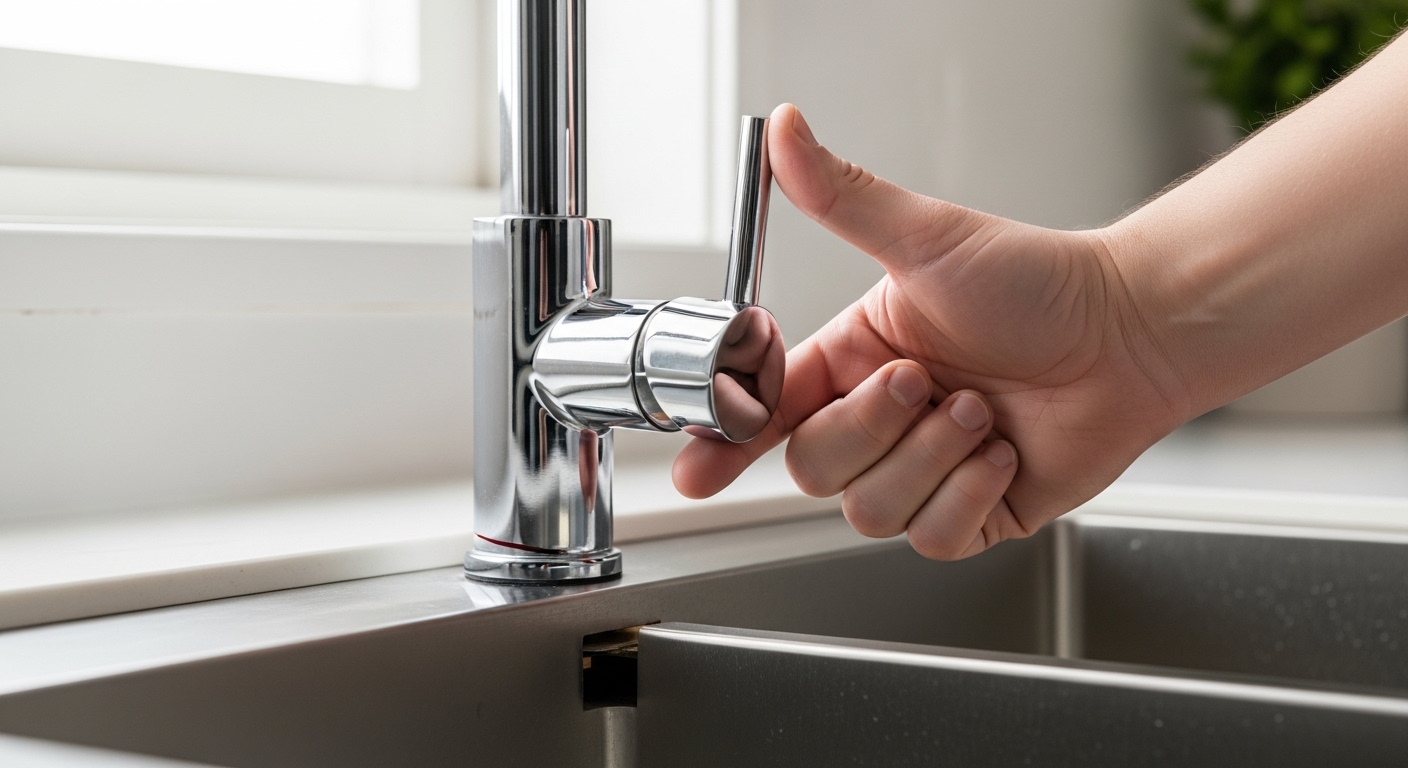
If your kitchen faucet keeps coming loose, you’re not doing anything wrong and your faucet isn’t defective — it’s physics. Every time you swing the spout, push the sprayer, or lean on the faucet to fill a big pot, you’re applying leverage to a fixture held down by a single nut under the sink. Over months of use that nut backs off, the base starts to rock, and the whole thing feels like it’s about to come off in your hand. Below I’ll walk you through exactly why it happens, the fastest permanent fix, and how to tell a quick tighten from a “you need a new mounting kit” situation.
Why does my kitchen faucet keep coming loose in the first place?
The number one reason is a loosened mounting nut under the sink. Modern faucets are held to the counter or sink deck by one or two plastic or brass nuts threaded onto a shank. Constant vibration, temperature swings from hot water, and the leverage of daily use slowly unscrew that nut — and once it’s even slightly loose, the faucet rocks, which loosens it faster. It’s a snowball effect.
That said, “loose” can mean a few different things, and the fix depends on which one you have:
- The whole faucet body rocks or spins on the sink — the mounting nut under the deck is loose. Most common by far.
- Only the handle wiggles — that’s a set screw or handle screw, not the mount. Different repair (more on that below).
- The spout tightens but slowly works loose again within days — a missing or crushed rubber base gasket, or a nut that’s stripped and no longer holds torque.
- The faucet was never tight from day one — an installation problem: wrong mounting bracket, an uneven or too-thick deck, or the nut was only hand-snugged.
Figuring out which bucket you’re in takes about ten seconds: wiggle the spout, then wiggle just the handle. If the base moves, it’s the mount. If only the handle moves, jump to the handle section.
How do I tighten a kitchen faucet that keeps coming loose — step by step?
Clear out the cabinet, put a flashlight or headlamp on, and tighten the mounting nut on the faucet shank until the base sits rock-solid. That’s the core fix, and here’s how to do it without stripping anything or making a mess.
- Shut off the water. Turn the two supply valves under the sink clockwise. Not strictly required for a tightening, but if you bump a supply line you’ll be glad they’re closed.
- Clear the cabinet and get light. Empty everything out so you can lie on your back and see straight up at the underside of the sink.
- Find the mounting nut. Follow the faucet body down through the deck. You’ll see a threaded shank with a large nut (often plastic wing-style you can turn by hand, sometimes brass needing a wrench). There may be a mounting bracket/plate above it.
- Have someone hold the faucet straight. Center the spout and hold it steady from above while you tighten below, so the faucet ends up aligned — not tightened crooked.
- Tighten the nut clockwise. By hand for wing nuts; with a basin wrench or the little plastic wrench that shipped with the faucet for the rest. Snug it firmly, then give it another quarter turn — but don’t gorilla it, especially on plastic nuts, which crack.
- Re-check from above. Wiggle the spout. It should feel like part of the counter. Turn the water back on and check for drips.
If you have a hard time reaching the nut, a basin wrench (about $12) is the tool designed exactly for this — its swiveling jaw grabs nuts in the cramped space behind the sink where a normal wrench can’t fit. It’s the single best $12 you can spend if your faucet loosens more than once. For a deeper look at the parts that hold everything down, our guide on the kitchen faucet mounting bracket shows how the plate and nut work together.
What if it comes loose again a week later — why won’t it stay tight?
If you tighten it and it’s wobbly again within days, the nut is no longer holding torque — usually because the base gasket is missing or crushed, the nut threads are stripped, or the mounting surface is uneven. Re-tightening a stripped nut just buys you another week. Here’s how to actually stop the cycle:
- Add or replace the rubber base gasket/washer. The gasket between the faucet base and the sink is what creates friction so the nut doesn’t back off. If it’s flattened, torn, or was never installed, the faucet will always creep loose. A new one costs a couple of dollars.
- Use a lock washer or a dab of thread locker. A plumber-friendly (blue, removable) thread locker on the shank threads keeps the nut from vibrating loose. Blue, not red — red is permanent and you’ll never get it off again.
- Replace a stripped nut or mounting kit. Most faucet makers sell a replacement mounting kit for a few dollars. On a plastic nut that’s cross-threaded, this is the real fix.
- Check the deck thickness. If you have a thick counter plus a mounting plate, the shank may be too short for the nut to bite fully. Some kits include an extension.
Nine times out of ten, adding a fresh rubber gasket plus a touch of blue thread locker ends the problem permanently. If the underside is corroded or the shank threads are chewed up, it’s worth reading up on the kitchen faucet valve size and internal parts before ordering replacements so you buy the right hardware the first time.
My kitchen faucet handle is loose, not the base — is that the same fix?
No — a loose handle is a totally different repair from a loose base, and it’s even quicker. A wobbly handle is almost always a loose set screw (the tiny screw under or behind the handle) or the handle adapter, not the mounting nut. Tighten the set screw with a hex/Allen key and the handle firms right up.
Here’s the quick version: pop off the decorative cap or index button on the handle, find the small set screw underneath (usually needs a 7/64″ or 3/32″ hex key), hold the handle in the correct position, and snug the screw. Don’t over-tighten — you can strip the soft brass. If the screw won’t hold, the handle’s internal splines may be worn and need a new handle. We cover this exact repair in detail in our guides on a loose handle on a faucet and, for a specific brand, the American Standard kitchen faucet handle, both of which apply to most single-handle designs.
Loose base vs. loose handle: which fix do I need?
Use this table to match your symptom to the right repair so you don’t take apart the wrong thing.
| What’s moving | Most likely cause | The fix | Tools & time |
|---|---|---|---|
| Entire faucet body rocks/spins | Loose mounting nut under sink | Tighten mounting nut clockwise | Basin wrench, ~15 min |
| Loosens again within days | Crushed/missing base gasket or stripped nut | New gasket + blue thread locker, or new mounting kit | Wrench + $2–$8 parts, ~30 min |
| Only the handle wiggles | Loose set screw | Tighten set screw with hex key | Allen key, ~5 min |
| Spout swings loosely / droops | Worn spout O-rings or retaining nut | Replace O-rings or tighten spout collar | O-ring kit, ~20 min |
| Never tight from install day | Wrong bracket, too-short shank, uneven deck | Correct mounting kit / add spacer | Correct kit, ~45 min |
Should I fix a faucet that keeps coming loose or just replace it?
Fix it if the faucet is under about 7–8 years old, isn’t leaking internally, and the finish still looks good — the loosening is a hardware issue, not a sign the faucet is dying. Replace it if the shank threads are corroded through, the body itself is cracked, or you’re already fighting drips and low flow on top of the wobble. At that point you’re pouring repairs into a fixture that’s near the end of its life.
A quick honest math check: a mounting kit and gasket run a few dollars and fifteen minutes. A quality replacement faucet is a bigger commitment but comes with a fresh warranty and, on a solid design, a mounting system engineered not to loosen. If you decide to upgrade, pay attention to how the faucet mounts — a single-bolt “quick install” system with a wide friction washer holds far better over time than an old two-nut design. When you’re comparing, our breakdown of Moen vs. Delta and our guide on how to install a kitchen faucet step by step will help you choose one that installs tight and stays tight.
How do I stop a kitchen faucet from ever coming loose again?
Install it right once and it won’t come back. The faucets that never loosen all share the same install habits: a good gasket, correctly torqued hardware, and something to fight vibration. Here’s the prevention checklist I give everyone:
- Always use the base gasket. Never skip it to “save room” on a thick counter — it’s what stops the creep.
- Add blue (removable) thread locker to the shank threads before threading on the nut.
- Torque, then re-check after a week. New installs settle; a quick re-snug after seven days locks it in.
- Don’t lean on the faucet. Using the spout as a handle to pull yourself up or hang a heavy sprayer stresses the mount.
- Re-inspect twice a year. A ten-second wiggle-test every six months catches loosening before it becomes a wobble.
Do those five things and “my faucet keeps coming loose” becomes a problem you never think about again.
FAQ
Can I tighten a loose kitchen faucet without a basin wrench?
Often yes — many modern faucets use a hand-turn plastic wing nut you can tighten with just your fingers. But if the nut is a brass hex type set deep behind the basin, a basin wrench (about $12) is the only tool that reaches it comfortably. A pair of channel-lock pliers can work in a pinch if you have room.
Why does my faucet get loose again every few weeks?
Because the nut isn’t holding torque. That happens when the rubber base gasket is missing or crushed, or the nut threads are stripped. Re-tightening alone won’t last — add a fresh gasket and a dab of blue thread locker, or replace the mounting kit, and it’ll stay put.
Is a wobbly kitchen faucet dangerous or just annoying?
Mostly annoying, but don’t ignore it. A faucet that rocks can eventually stress the water supply line connections underneath, and constant movement can crack the base seal and let water seep under the sink, which leads to hidden cabinet damage. It’s worth a 15-minute fix sooner rather than later.
Does tightening the faucet fix a leak too?
Only if the leak is at the base where the faucet meets the counter — tightening the mount and refreshing the base gasket can stop that. A drip from the spout or handle is a different issue (usually a worn cartridge or O-ring). See our guide on a dripping kitchen faucet for that repair.
How long should a properly mounted kitchen faucet stay tight?
Years — indefinitely, really. A faucet installed with an intact gasket and correctly torqued hardware shouldn’t need re-tightening more than a quick annual check. If yours loosens within months, the install or the mounting hardware is the problem, not normal wear.
A quick note on who wrote this — and why you can trust the fix
This guide was written by the Cobbe product and installation team, drawing on years of hands-on faucet installs, warranty service, and customer repair questions. Cobbe designs and sells kitchen and bathroom faucets built around a single-bolt quick-mount system specifically engineered to resist the loosening described here, and every faucet is pressure- and durability-tested to standards aligned with ASME A112.18.1/NSF 61 for drinking-water safety and cartridge cycle life. Our faucets are backed by a limited lifetime warranty on the finish and function — including the mounting hardware — so if a mount ever fails on a Cobbe faucet, the replacement kit is on us. Always follow your specific faucet’s included instructions and, if you’re unsure about your supply lines, consult a licensed plumber.
Pingback: Why Is My Moen Gooseneck Faucet Handle Loose, and How Do I Tighten It? - Cobbe