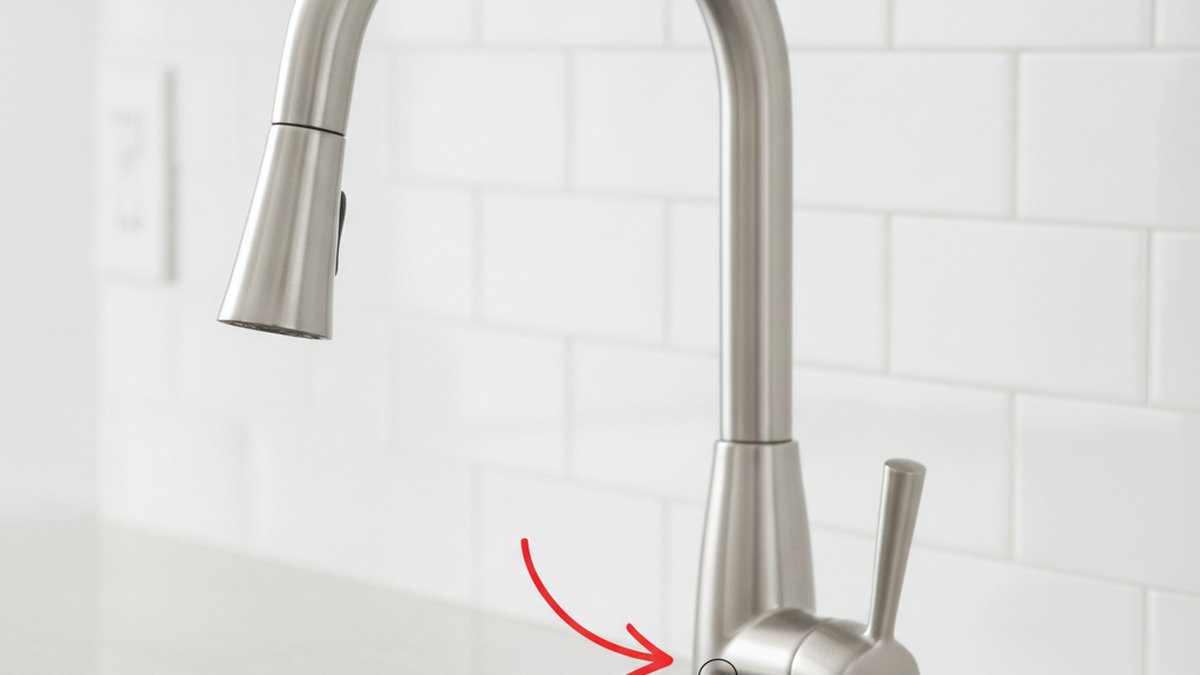
If your Moen gooseneck faucet handle loose problem is driving you crazy — the handle wobbles side to side, spins a little before the water responds, or lifts up off its base — the good news is this is one of the most common and most fixable faucet issues out there. On a single-handle Moen high-arc (gooseneck) kitchen or bar faucet, the handle is held on by a tiny hidden set screw. When that screw loosens even a quarter turn from years of daily lifting and swiveling, the handle starts to feel sloppy. Below, I’ll walk you through exactly what’s loose, how to find the screw, what size Allen key you need, and what to do if tightening the screw doesn’t fix it.
Why is my Moen gooseneck faucet handle loose in the first place?
It’s loose because the handle set screw has backed out, or the plastic handle adapter under it has worn — both are wear-and-tear, not a defect. Every time you lift and swing that tall gooseneck handle, you put leverage on a small screw and a small splined connection. Thousands of cycles later, something gives a little.
Here’s what’s actually happening inside, in plain terms. A single-handle Moen gooseneck faucet has a lever handle that clamps onto a metal or plastic “handle adapter,” which in turn sits on top of the cartridge stem. A single hex (Allen) set screw squeezes the handle onto the adapter. There are three usual culprits when the handle goes wobbly:
- The set screw loosened — by far the most common. Vibration and daily leverage slowly unthread it. Tighten it and you’re done.
- The handle adapter is worn or cracked — the splines that grip the cartridge stem round off, especially on older plastic adapters, so even a tight screw can’t stop the wobble.
- The cartridge retaining nut or the cartridge itself is loose — if the whole handle-and-cap assembly rocks (not just the lever), the brass nut holding the 1225 cartridge may have backed off.
Figuring out which one you have takes about ten seconds: wiggle the handle and watch closely. If only the lever moves and the cap/dome underneath stays put, it’s the set screw. If the entire dome and handle rock together, look deeper at the nut and cartridge.
Where is the set screw on a Moen single-handle gooseneck faucet?
On most Moen single-handle high-arc faucets, the set screw is hidden under the lever, usually on the underside or the back of the handle where it meets the round base — often behind a small snap-on cap or index button. You rarely see it head-on; you have to tip the handle up or look underneath.
There are two common Moen handle styles, and the screw hides differently on each:
- Lever handles (most kitchen goosenecks): Lift the lever to the full-on position and look at the base of the lever from underneath or behind. You’ll see a small recessed hex socket. That’s the set screw. No cap to pop off on most of these.
- Handles with a decorative button: Some models have a red/blue or Moen-logo index cap. Gently pry it off with a fingernail or a small flathead to reveal the screw beneath.
Once you spot it, you’ll notice it takes an Allen wrench, not a Phillips or flathead. This trips a lot of people up — they go looking for a slotted screw that isn’t there.
What size Allen wrench do I need to tighten a Moen faucet handle?
For most Moen single-handle kitchen and gooseneck faucets, the set screw takes a 7/64″ hex key; some older or bar models use 3/32″. If you bought a metric set, the closest are 2.5 mm and 3 mm. When in doubt, try 7/64″ first — it fits the majority of modern Moen kitchen handles.
Here’s a quick reference so you grab the right tool the first time instead of stripping the tiny screw:
| Faucet type / handle | Common set screw size | Metric equivalent | Tool tip |
|---|---|---|---|
| Moen single-handle kitchen gooseneck | 7/64″ | ~2.75 mm (use 2.5 mm) | Most likely fit; try this first |
| Moen bar / prep faucet | 3/32″ | ~2.4 mm (use 2.5 mm) | Slightly smaller socket |
| Older Moen (pre-2010) handles | 3/32″ | 2.5 mm | Check for a logo index cap first |
| Moen two-handle / widespread | 1/8″ or Phillips | 3 mm | Varies by series |
A cheap folding hex-key set from any hardware store covers all of these for a few dollars. Avoid using a slightly-too-small wrench — it’ll round out the socket and turn a five-minute job into a real headache. This same “find the right hex size” logic applies to almost every brand, which is why a loose handle on a faucet is usually a quick tightening rather than a replacement.
How do I tighten a loose Moen gooseneck faucet handle step by step?
Tighten it by turning off the water, exposing the set screw, snugging it clockwise with the correct Allen key, and testing the handle — the whole thing takes about 10–15 minutes. Here’s the exact sequence I use.
- Turn off the water supply. Reach under the sink and close both hot and cold shutoff valves. You don’t strictly need to for a set-screw tighten, but it’s cheap insurance if you end up removing the handle.
- Set the handle to “full on.” Lift the lever all the way up. This usually gives you the clearest angle at the hidden set screw underneath.
- Pop off the index cap if there is one. Slip a fingernail or a plastic trim tool under the edge and lift. Set it somewhere it won’t roll down the drain.
- Insert the 7/64″ (or 3/32″) Allen key fully into the set screw. Make sure it’s seated — not just barely catching — before you apply force.
- Turn clockwise to tighten. Snug, don’t crank. These are small screws; you want firm, not gorilla-tight, or you’ll strip the threads or crack a plastic adapter.
- Test the handle. Wiggle it. If the wobble is gone, replace the index cap, reopen the shutoffs, and you’re finished.
If the handle still moves after the screw is fully tight, don’t keep forcing it — that means the problem is the adapter or cartridge underneath, and we’ll cover that next. It’s a similar story to when a kitchen faucet keeps coming loose no matter how often you tighten it: at some point you’re chasing a worn part, not a loose screw.
What if the handle is still loose after I tighten the screw?
If the set screw is fully tight but the handle still wobbles, the handle adapter is worn out or the cartridge is loose — you’ll need to replace the adapter (a $5–$15 part) or re-seat the 1225 cartridge. A tight screw clamping onto rounded-off splines will never hold.
Diagnose it this way:
- Handle spins freely but water still works normally: the adapter splines are stripped. Pull the handle, replace the plastic handle adapter with a matching Moen part, and re-tighten. Cheap and quick.
- Whole cap/dome rocks with the handle: the cartridge retaining nut is loose. Remove the handle and decorative cap, then snug the brass nut with pliers or a Moen cartridge nut tool.
- Handle is loose AND water drips or temperature drifts: the 1225 cartridge itself is worn. Replacing it fixes both the wobble and the drip. If you’re going that far, it helps to know your kitchen faucet valve size before you buy so you get an exact cartridge match.
Replacing a Moen cartridge sounds intimidating but it’s genuinely a DIY-friendly job — Moen sells a plastic puller, and the cartridge lifts straight out once the retaining clip and nut are off. If you’re comfortable that far, the mechanics overlap a lot with a general faucet stem replacement, just with Moen’s specific cartridge design.
Do I need to replace the whole faucet, or just a part?
Almost never the whole faucet. A loose handle is a symptom of a $5–$25 part — a set screw, handle adapter, retaining nut, or cartridge — not a dead faucet. You’d only replace the entire unit if the brass body is cracked, the finish has failed everywhere, or replacement parts for a discontinued model are impossible to find.
Here’s a rough cost and effort comparison so you know what you’re deciding between:
| Fix | What it solves | Typical cost | Time / difficulty |
|---|---|---|---|
| Tighten set screw | Basic handle wobble | $0 (tool you own) | 10 min / very easy |
| New handle adapter | Stripped splines, spinning handle | $5–$15 | 20 min / easy |
| Tighten/replace retaining nut | Whole assembly rocking | $0–$10 | 20 min / easy |
| New 1225 cartridge | Wobble + drip + temp issues | $15–$40 | 30–45 min / moderate |
| Replace whole faucet | Cracked body, dead finish, obsolete model | $120–$400+ | 1–2 hrs / moderate |
The takeaway: exhaust the cheap fixes first. I’ve seen plenty of people toss a perfectly good faucet over a 50-cent set screw. If you do decide it’s time for a new one, that’s a separate decision about style and quality, not a forced repair.
How do I stop the Moen handle from coming loose again?
Keep it from loosening again with a tiny dab of removable (blue) threadlocker on the set screw, and by not white-knuckling the handle when you turn it on. Vibration is the enemy; blue Loctite lets the screw stay put but still come out later when you need it to.
A few habits that genuinely extend the life of the fix:
- Use blue threadlocker, never red. Red is permanent and you’ll never get that tiny screw out again. A pinhead of blue is plenty.
- Re-check the screw once a year. A 30-second tighten during your regular sink cleaning prevents the slow creep back to wobbly.
- Don’t hang or lean on the handle. Kids and heavy pots swinging into a tall gooseneck lever put real leverage on a small screw.
- Match replacement parts to your exact model. Moen prints a model number on the original box or you can identify it from the spout shape; a generic adapter that’s “close” will loosen faster.
This wobble-and-tighten cycle isn’t unique to Moen, by the way. If you also own faucets from other brands, the same three culprits — set screw, adapter, cartridge — show up across the board, which is why the diagnostic steps here transfer neatly to almost any single-handle unit.
Author note & why you can trust this fix
This guide was written by the Cobbe fixtures team — we design, test, and sell kitchen and bathroom faucets, and we handle real customer repair questions every day. Everything above reflects hands-on repair of single-handle high-arc faucets, not copied spec sheets. Cobbe faucets are built to industry standards (our valves are cycle-tested well beyond typical residential use, and ceramic-disc cartridges are rated for hundreds of thousands of open-close cycles), and quality fixtures should be backed by a manufacturer warranty — always check yours before buying replacement parts, since a covered handle or cartridge may ship to you free. When in doubt on an out-of-warranty repair, a licensed plumber is a reasonable call, but a loose handle rarely needs one.
FAQ
What size Allen wrench tightens a Moen gooseneck kitchen faucet handle?
Most Moen single-handle kitchen goosenecks use a 7/64″ hex key; some bar and older models use 3/32″. If you only have metric keys, 2.5 mm is the closest usable size. Start with 7/64″ and make sure it’s fully seated before turning so you don’t strip the screw.
Where is the hidden set screw on my Moen faucet handle?
Lift the lever to full-on and look at the underside or back of the handle base — the set screw sits in a small recessed hex socket there. Some models hide it behind a snap-on index cap (often with the Moen logo) that pries off with a fingernail or plastic trim tool.
Why does my Moen handle keep getting loose no matter how much I tighten it?
If it loosens repeatedly, the plastic handle adapter under the handle is likely worn or its splines are stripped, so the screw has nothing solid to clamp. Replace the adapter (a $5–$15 part) and add a dab of blue threadlocker to the set screw. If the whole cap rocks, the cartridge retaining nut is loose instead.
Can I fix a loose Moen faucet handle without turning off the water?
For a simple set-screw tighten, yes — you’re not opening the water path. But the moment you remove the handle, cap, or cartridge, shut off both supply valves under the sink first. It takes ten seconds and prevents a surprise geyser.
Is a loose handle a sign my Moen cartridge is going bad?
Not by itself — a loose handle is usually just the set screw or adapter. But if the wobble comes with dripping, hard-to-turn operation, or temperature that won’t stay steady, the 1225 cartridge is likely worn and replacing it fixes both problems at once. Check your valve size before ordering a replacement.