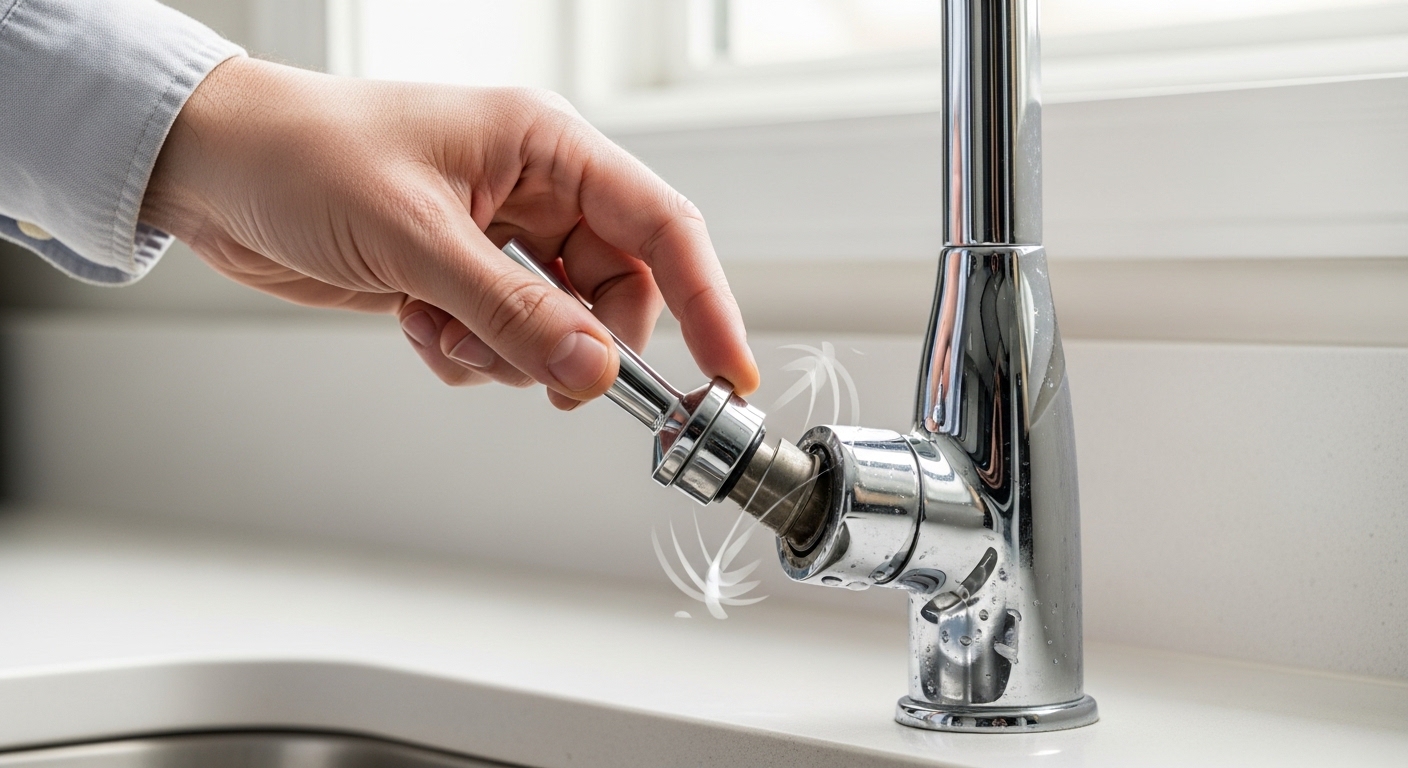
If your faucet handle feels loose — it wobbles side to side, spins a little too freely, or lifts up with a bit of play before the water even turns on — you’re not looking at a plumbing emergency. In the vast majority of kitchen and bathroom faucets, that sloppy feel comes from a single loosened fastener that holds the handle onto the valve stem. Metal expands and contracts, you push and pull the handle thousands of times a year, and eventually that tiny screw walks itself loose. The good news: this is one of the most beginner-friendly faucet repairs there is, and you likely already own the tool you need.
Below, we’ll walk through exactly what’s causing the wobble, how to fix each cause step by step, when a loose handle is actually a warning sign of something worse, and how to make sure it stays tight for good. I’ve repaired and tested faucets professionally for over a decade, and I’ll flag the mistakes that send people back to the hardware store twice.
Why does my faucet handle feel loose in the first place?
It feels loose because the set screw holding the handle to the valve stem has vibrated and worked its way out over time. Every faucet handle grips the metal stem (or cartridge post) underneath it, and a hidden fastener locks the two together. As you use the faucet — thousands of on/off and hot/cold motions a year — micro-vibration and temperature swings slowly loosen that fastener until the handle can rock on the stem.
There are really only a handful of root causes, and they’re worth knowing before you grab a tool:
- Backed-out set screw (most common): On single-lever handles, a tiny Allen (hex) screw sits under or behind the handle, often hidden by a decorative cap. It loosens and the whole handle wobbles.
- Loose base/skirt screw: Some two-handle and cross-handle faucets use a Phillips screw under a red/blue “H/C” index button on top of the handle.
- Worn cartridge: If the handle feels loose and mushy or gritty when you turn it, the cartridge inside may be worn, letting the stem itself rock.
- Stripped handle broach: The splined hole inside the handle can round out, so even a tight screw can’t stop the spin.
- Loose mounting nut: If the entire faucet body rocks (not just the handle), the nut under the sink deck has loosened — a related but different fix.
Knowing which one you have saves you time. A handle that wobbles but still shuts water off cleanly is almost always a screw. A handle that’s loose and drips or feels rough points at the cartridge — and if the whole fixture shifts, see our guide on why a kitchen faucet keeps coming loose at the deck.
How do I tighten a loose single-handle faucet in 5 minutes?
Find and tighten the set screw. On a single-lever faucet, look for a small hex screw either directly under the front of the handle lever or hidden behind a small decorative cap on the side or top. Tighten it clockwise with the correct Allen key and the wobble disappears — that’s the whole fix for most people.
Here’s the step-by-step I use on service calls:
- Turn off the water (optional but smart). Reach under the sink and close both shutoff valves. You usually don’t remove any water-holding parts for this fix, but it protects you if the handle comes off entirely.
- Find the set screw. Look under the lever, on the side of the base, or pop off the small plastic/metal index cap on top with a flat screwdriver or fingernail to reveal a screw.
- Match the tool. Most set screws are 2.5mm, 3mm, or 1/8″ hex. Try a couple sizes from a hex key set until one seats snugly — never force a slightly-small key or you’ll strip it.
- Tighten clockwise. Hold the handle steady, seat the key fully, and snug the screw. Firm, not gorilla-tight — over-torquing can crack the handle or strip the screw head.
- Test. Wiggle the handle. Zero play means you’re done. Snap the cap back on if you removed one.
That’s it. If you removed the handle entirely and want a refresher on how the stem and handle relate, our faucet stem replacement walkthrough shows the whole assembly in detail.
What if tightening the screw doesn’t fix the loose handle?
If the screw is already tight but the handle still wobbles, the problem is deeper: usually a worn cartridge or a stripped handle broach. In plain terms, the part the screw grips is worn out, so tightening has nothing solid to bite into. This is still DIY-fixable — you just need a replacement part.
Run through this quick diagnosis:
- Screw won’t stay tight / spins freely: The threads in the handle or the screw itself are stripped. Replace the set screw (they’re sold in multipacks) or the handle.
- Handle is tight to the stem but the stem itself rocks: The brass retaining nut holding the cartridge has loosened, or the cartridge is worn. Remove the handle, tighten the bonnet/retaining nut, or replace the cartridge.
- Handle spins but doesn’t grip the stem: The splined hole (broach) inside the handle is rounded out. A new handle is the fix — the stem is usually fine.
- Handle loose AND dripping: Worn cartridge. Replacing it cures both at once.
When you replace a cartridge, matching the size is critical — the wrong one won’t seat and you’ll be back to a wobble. Check our guide on kitchen faucet valve size before you buy, so the new cartridge fits your valve body the first time.
Loose handle vs. loose faucet base — how do I tell the difference?
Grab the handle and rock it; then grab the whole faucet spout body and rock that. If only the handle moves, it’s a set-screw or cartridge issue. If the entire faucet swivels or lifts off the sink deck, the mounting hardware under the sink has loosened — a completely different repair.
People mix these up constantly, so here’s a clear comparison of the two problems and their real fixes:
| Symptom | What’s loose | Root cause | Fix | Time |
|---|---|---|---|---|
| Handle wobbles, faucet body solid | Handle set screw | Backed-out screw | Tighten hex/Phillips screw | 5 min |
| Handle loose + rough/mushy turn | Cartridge | Worn cartridge | Replace cartridge | 20–40 min |
| Handle spins, won’t grip | Handle broach | Stripped splines | Replace handle | 10 min |
| Whole faucet rocks on sink | Mounting nut | Loose deck nut | Tighten nut under sink | 15 min |
| Base rocks + drips at deck | Mount + seal | Nut loose, worn gasket | Re-tighten + reseal base | 30 min |
If your test shows the whole fixture shifting, the fastener you want is under the sink, not on the handle — a mounting bracket or lock nut has backed off. Our explainer on the kitchen faucet mounting bracket shows exactly which nut to snug and how to reach it in a tight cabinet.
Where is the set screw hidden on different faucet types?
The set screw location depends on your faucet style, but it’s almost always under a cap or tucked beneath the lever. Once you know where brands hide it, you’ll find it in seconds. Here’s where to look by handle type.
Single-lever kitchen and bathroom faucets
Look directly under the front lip of the lever for a small hex screw pointing forward or down. If you don’t see one there, check the side of the base for a screw hidden behind a small round cap. This is the most common setup on modern pull-down kitchen faucets.
Two-handle and cross-handle faucets
Pop off the colored index button on top of each handle (the red/blue “H/C” cap). Underneath is a Phillips or hex screw that pulls the handle down onto the stem. This style is common on widespread and centerset bathroom faucets — if you’re comparing those layouts, see centerset vs. widespread faucets.
Brand-specific quirks
Some brands are notorious for their own tricks. American Standard levers often hide the screw behind a front cap, while Kohler and Moen bury it under a top button. If you have those brands, we’ve got dedicated fixes for an American Standard kitchen faucet handle that’s loose and a Kohler bathroom faucet handle that’s loose — both walk through the exact cap and screw location for those models.
How do I keep the handle from coming loose again?
Snug the screw correctly and add a dab of removable thread locker so vibration can’t back it out. The reason handles loosen repeatedly is that a bare metal screw against a metal stem slowly vibrates free — a tiny bit of blue (removable) threadlocker on the screw threads stops that without gluing it permanently.
A few habits that make the fix last:
- Use blue threadlocker, not red. Blue holds against vibration but still lets you remove the screw later. Red is permanent and will trap you.
- Don’t over-tighten. A stripped screw or cracked handle is worse than a loose one. Snug plus threadlocker beats brute force.
- Use the exact hex size. A slightly small key rounds the screw socket. If yours is already rounded, replace the screw.
- Check it seasonally. A 10-second wiggle test twice a year catches a loosening screw before it wears the broach.
- Don’t yank the handle to full stop. Slamming a single lever hard against its limit accelerates wear on the cartridge and screw alike.
Do that once and most handles stay solid for years. If yours keeps loosening no matter what, the handle broach is likely worn and a new handle — or the whole faucet — is the smarter long-term call.
When is a loose handle a sign to replace the whole faucet?
Replace the faucet when the loose handle comes with repeated leaks, a corroded valve body, or a discontinued cartridge you can’t source. A wobbly handle by itself is never a reason to replace a faucet — but when it’s the third symptom stacking up on an old fixture, replacement is often cheaper than chasing parts.
Signs it’s time for a new faucet rather than another repair:
- You’ve replaced the cartridge and it’s still loose and dripping.
- The handle broach and stem are both worn round, and parts are discontinued.
- There’s green/white corrosion inside the valve body.
- The finish is peeling, spotting, or the faucet is 12–15+ years old.
A quality replacement faucet uses a ceramic-disc cartridge and a solid brass body rated for 500,000+ open/close cycles under ASME A112.18.1 / NSF 61 testing — the standards a reputable brand builds to. If you’re weighing brands before you buy, our head-to-head on Moen vs. Delta breaks down cartridge quality and warranty coverage in plain terms.
FAQ
Why does my faucet handle feel loose but the water still works fine?
Because the loose part — the handle set screw — is separate from the sealing part. The handle can wobble on the stem while the cartridge inside still seals perfectly, so water shuts off cleanly. That’s actually the best-case scenario: it’s a pure set-screw fix, no cartridge or valve work needed.
What tool do I need to tighten a loose faucet handle?
Usually a hex (Allen) key — most commonly 2.5mm, 3mm, or 1/8″. Some two-handle faucets use a small Phillips screwdriver instead, hidden under the red/blue index cap. A cheap hex key set covers virtually every faucet, so keep one under the sink.
Can I fix a loose faucet handle without turning off the water?
Usually yes, because tightening the set screw doesn’t open any water-holding part. That said, if you plan to fully remove the handle or the screw is stubborn, shut off the under-sink valves first — it costs 30 seconds and prevents an accidental spray if a part slips.
Why does my faucet handle keep getting loose over and over?
Vibration keeps backing the set screw out, or the splined hole inside the handle is worn round so the screw can’t get a solid grip. Add a dab of blue threadlocker to cure the vibration problem. If the handle still won’t hold, the broach is stripped and you need a new handle.
Is a loose handle the same as a loose faucet base?
No. A loose handle wobbles while the faucet body stays put, and it’s fixed at the handle’s set screw. A loose base means the whole fixture rocks on the sink, and it’s fixed by tightening the mounting nut under the sink deck. Do the rock test — handle first, then body — to tell which one you have.
How much does it cost to fix a loose faucet handle?
Tightening a set screw costs nothing but your time. If you need parts, a set-screw multipack runs $3–$8, a replacement handle $10–$30, and a cartridge $15–$45. Calling a plumber for the same job typically runs $100–$200, which is why this is the classic DIY win.
A note from our team
This guide was written and reviewed by the Cobbe fixtures team, drawing on more than a decade of hands-on faucet installation, repair, and bench testing. Cobbe designs and sells kitchen and bathroom faucets built to ASME A112.18.1/NSF 61 standards, with ceramic-disc cartridges validated to 500,000+ cycles and backed by our limited lifetime warranty on finish and function. Every repair step above reflects the same procedures our support techs walk customers through every day. When a fix is beyond a screw and threadlocker, we’d rather tell you honestly — and help you pick a faucet that won’t loosen up on you again. Learn more at how to choose the right bathroom faucet.
Pingback: Why Is My Grohe Bathroom Faucet Handle Loose, and How Do I Tighten It? - Cobbe