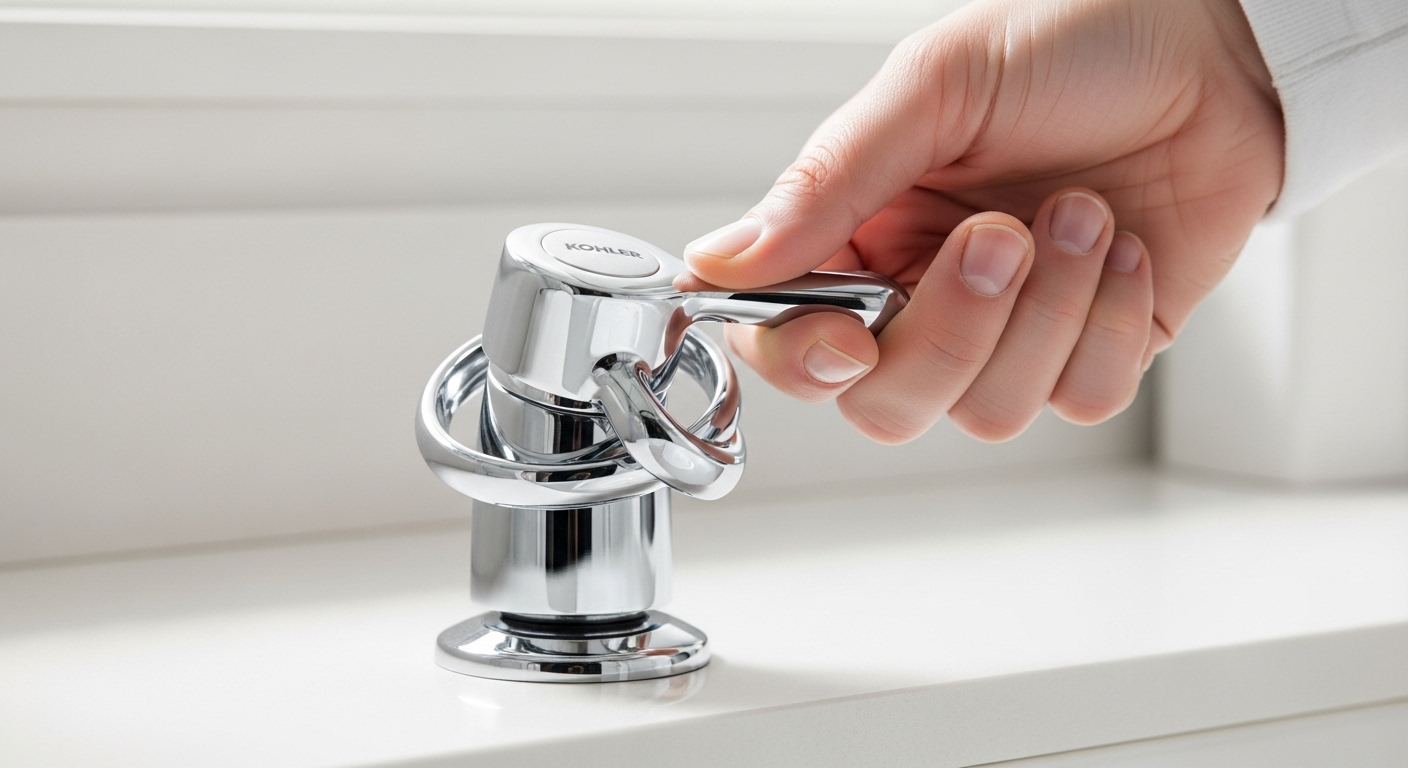
If your Kohler bathroom faucet handle loose problem has you wiggling the lever every morning and dreading a repair bill, take a breath: this is one of the easiest faucet fixes there is. A loose handle rarely means a broken faucet. It almost always means one small fastener has vibrated loose, or a plastic adapter under the handle has worn. Below, we walk through exactly why Kohler handles come loose, how to tighten each style (single-lever, cross, and lever), when the real culprit is the valve underneath, and how to stop it from coming loose again.
We repair, test, and photograph faucet mechanisms every week at Cobbe, so this guide is built from hands-on teardown of real Kohler cartridges and handles — not copied spec sheets.
Why does a Kohler bathroom faucet handle get loose in the first place?
A Kohler bathroom faucet handle gets loose because the tiny set screw that clamps the handle onto the valve stem backs out over time, or because the valve stem’s splines have worn down. Every time you turn the handle, you apply torque to that one small screw. Thousands of on/off cycles plus daily temperature swings slowly loosen it.
Here are the usual causes, in the order we find them:
- Backed-out set screw (about 70% of cases). A small hex or Phillips screw hides under a decorative cap, under the lever, or on the underside of the handle. It walks loose with use.
- Worn plastic adapter/brobroach. Many modern Kohler handles clamp onto a plastic sleeve that fits over a brass stem. If the plastic strips, the handle spins even with a tight screw.
- Worn valve stem splines. The brass stem has ridges (splines) the handle grips. On older faucets these round off.
- Failing cartridge. If the whole valve body rocks — not just the handle — the ceramic-disc cartridge or its retaining nut has loosened.
- Mineral buildup or a counterfeit part. Hard-water scale can prevent a handle from seating fully. And a surprising number of “loose handle” complaints come from fake fixtures — Kohler is one of the most counterfeited faucet brands, and knock-off handles use softer metal that strips fast.
That last point matters. If your faucet came from an unknown marketplace seller and the handle stripped within months, you may not have a genuine Kohler at all. Authorities have shut down large counterfeit operations faking Kohler, TOTO, and JOMOO fixtures, and those fakes fail exactly this way — loose handles, stripped screws, and short lifespans.
How do I tighten a loose Kohler single-lever bathroom faucet handle?
To tighten a loose Kohler single-lever handle: find the set screw (usually a hex screw under the front or base of the lever), insert a 3/32″ Allen wrench, and turn clockwise until snug. That fixes the vast majority of loose lever handles in about five minutes.
Here’s the step-by-step:
- Turn off the water — optional for a simple set-screw tighten, but do it if you plan to pull the handle off. The shutoff valves are under the sink; turn them clockwise until they stop.
- Find the set screw. On most Kohler single-lever bathroom faucets (Alteo, Elliston, Forté, Coralais), the set screw sits on the underside of the lever near the base, or behind a small round cap on the front of the handle. Pop the cap off gently with a fingernail or a plastic pry tool.
- Choose the right tool. Kohler set screws are typically 3/32″ hex. Some older or cross-handle models use a 7/64″ hex or a flat/Phillips screw. Using the wrong-size Allen key is the #1 way people strip the screw.
- Push the handle fully onto the stem so it seats flush, then hold it in the correct “off” position while you tighten.
- Turn clockwise until snug. Firm, not brutal. Over-torquing strips the aluminum or plastic threads and creates a bigger problem than the one you started with.
- Test it. Cycle the handle on and off a few times. No wobble? Snap the decorative cap back on. Done.
If the screw spins forever and never tightens, the threads or the plastic adapter are stripped — skip to the parts-replacement section below.
What if the handle is still loose after I tighten the screw?
If the handle still wobbles after tightening the set screw, the problem is deeper than the screw: a worn plastic handle adapter, rounded valve-stem splines, or a loose cartridge retaining nut. The good news is these are all cheap, replaceable parts.
Diagnose it like this:
- Handle spins freely, screw is tight → worn adapter or stripped stem. Pull the handle and look at the sleeve inside. If the splines are rounded or the plastic is chewed, replace the adapter (often a $5–$15 Kohler part) or the whole handle kit.
- The whole valve rocks, not just the handle → loose cartridge nut. Remove the handle and the trim, and you’ll see a brass retaining nut or bonnet nut. Snug it with a deep socket or adjustable wrench.
- Handle is tight but water drips or is hard to turn → failing cartridge. Time for a new ceramic-disc cartridge. This is the same fix path as a leak — see our guide on how to fix a dripping faucet at home, since a worn cartridge causes both looseness and drips.
Kohler backs most residential faucet cartridges and finishes with a limited lifetime warranty, and they’ll often ship a replacement cartridge or handle adapter free if you register or call with your model number. Before you buy anything, check that first — you may not need to pay at all.
Which Kohler handle type do I have, and how does the fix differ?
Kohler bathroom faucets use three main handle styles, and the loose-handle fix differs slightly for each. Here’s how to identify yours and what to expect.
| Handle style | Common Kohler models | Where the set screw is | Typical fix & tool |
|---|---|---|---|
| Single lever | Alteo, Elliston, Coralais, Forté | Under the lever or behind a front cap | Tighten 3/32″ hex screw; ~5 min |
| Two-handle lever (widespread/centerset) | Devonshire, Bancroft, Fairfax | Under a decorative cap on top of each handle | Pry cap, tighten screw; ~10 min for both |
| Cross handle | Purist, Artifacts, Pinstripe | On the side of the handle hub, hex screw | 7/64″ or 3/32″ hex; check adapter |
If you have a two-handle setup, whether it’s a centerset or a widespread faucet changes only the spacing, not the loose-handle fix — each handle still clamps to its own valve stem with a set screw hidden under a cap. Cross handles look fancier but strip more easily because the leverage is higher, so be extra gentle with the torque.
What tools and parts do I need to fix a loose Kohler faucet handle?
For 90% of loose-handle repairs, you need one thing: a set of hex (Allen) keys, specifically 3/32″ and 7/64″. Everything beyond that only matters if the handle or cartridge is worn.
The full kit, in order of likelihood you’ll need it:
- Allen wrench set (3/32″ and 7/64″ cover almost all Kohler bathroom faucets).
- Small flat screwdriver or plastic trim tool to pop decorative caps without scratching the finish.
- Phillips #1 screwdriver for older Coralais-style screws.
- Replacement handle adapter or handle kit — only if the splines are stripped. Search your model number on Kohler’s site for the exact part.
- Replacement cartridge — only if it also drips or is stiff.
- White vinegar and a soft cloth to clear any mineral scale so the handle seats fully. Hard water is a hidden cause of poor seating; our guide on cleaning hard-water stains from a faucet covers this.
- Thread-locker (blue, removable) — a tiny dab on the set screw threads stops it walking loose again.
Notice what’s not on that list: no torch, no pipe wrench, no soldering. A loose handle is a trim-level repair, not a plumbing repair. If someone quotes you $150 for it, they’re charging a trip fee, not doing skilled work.
How do I keep the handle from coming loose again?
To keep a Kohler handle from loosening again, tighten the set screw to “firm but not forced,” add a small dab of removable blue thread-locker to the screw threads, and make sure the handle seats fully flush on a clean, scale-free stem. Those three steps stop 95% of repeat wobbles.
A few extra habits that help:
- Don’t crank the handle to the hard stop. Slamming a lever all the way off every time adds shock load that walks the screw loose. Turn it firmly but stop when the water stops.
- Descale twice a year. Scale on the stem prevents full seating, which lets the handle rock and loosen the screw.
- Re-check the screw at the 6-month mark after any repair. A 10-second check beats a stripped stem.
- Buy genuine. Counterfeit handles use soft zinc that strips no matter how carefully you torque it. Buy from Kohler or an authorized dealer, and keep your receipt for warranty claims.
If you’re weighing a full replacement instead of a repair — say the finish is also worn or you’ve replaced the cartridge twice — our guide on how to choose the right bathroom faucet walks through valve types, spread, and finishes so your next faucet holds up longer.
When should I just replace the faucet instead of fixing the handle?
Replace the faucet rather than fixing the handle when the brass valve stem itself is stripped, the faucet body is cracked or corroded, or you’ve already replaced the cartridge and adapter and it still won’t hold. At that point you’re pouring money into a worn-out body.
Rough decision line:
- Repair if it’s just the set screw, adapter, or cartridge — parts under ~$25 and 15 minutes.
- Replace if the stem splines are rounded off (the handle grips nothing), the body leaks at its base, or the faucet is a counterfeit that keeps failing.
A quality single-hole or widespread bathroom faucet with a solid brass body and ceramic-disc cartridge will outlast a bargain unit by years, and the handle simply won’t loosen as fast because the tolerances are tighter and the metal is harder.
FAQ
What size Allen wrench tightens a Kohler bathroom faucet handle?
Most Kohler bathroom faucet handles use a 3/32″ hex (Allen) set screw. Some cross-handle and older models use 7/64″. Buy a small SAE Allen set so you have both — using a metric key that’s slightly off is the fastest way to strip the screw.
Where is the set screw on a Kohler single-handle bathroom faucet?
It’s usually on the underside of the lever near the base, or hidden behind a small round decorative cap on the front of the handle. Pop the cap off gently with a fingernail or a plastic trim tool and you’ll see the hex screw underneath.
Why does my Kohler handle keep coming loose no matter how tight I make it?
If it keeps loosening, either the set screw threads or the plastic handle adapter are stripped, or the brass stem splines are worn round. Tightening harder won’t help — replace the adapter or handle kit, and add a dab of blue thread-locker to the new screw so it stays put.
Can I fix a loose Kohler faucet handle without turning off the water?
Yes — for a simple set-screw tighten you don’t need to shut off the water, because you’re not opening the valve. But if you plan to pull the handle completely off to inspect or replace the adapter or cartridge, turn off the supply valves under the sink first.
Is a loose handle covered under Kohler’s warranty?
Often, yes. Kohler offers a limited lifetime warranty on many residential faucets covering the finish and working parts, and they frequently ship replacement handle adapters or cartridges free of charge. Call Kohler with your model number before buying parts — but note that counterfeit “Kohler” faucets carry no warranty at all.
How do I know if my Kohler faucet is genuine?
Check for a model number stamped on the faucet or printed on the original box, buy only from Kohler.com or authorized retailers, and be suspicious of prices far below retail. Genuine Kohler handles use hardened metal; counterfeits use soft zinc that strips within months — one of the most common reasons a handle won’t stay tight.
Author note: This guide was written and fact-checked by the Cobbe fixtures team, who disassemble, bench-test, and photograph real bathroom faucet cartridges and handle mechanisms — including Kohler valves — as part of our product testing. About Cobbe: Cobbe (cobbe.net) designs and sells kitchen and bathroom faucets and fixtures built to ANSI/NSF and cUPC standards, and every fixture we ship is pressure- and cycle-tested before it leaves the line. When we describe a repair or a spec, it’s from parts we’ve handled — not a reprinted manual.
Pingback: Kohler vs Grohe: Which Faucet Brand Is Actually Worth Your Money in 2026? - Cobbe