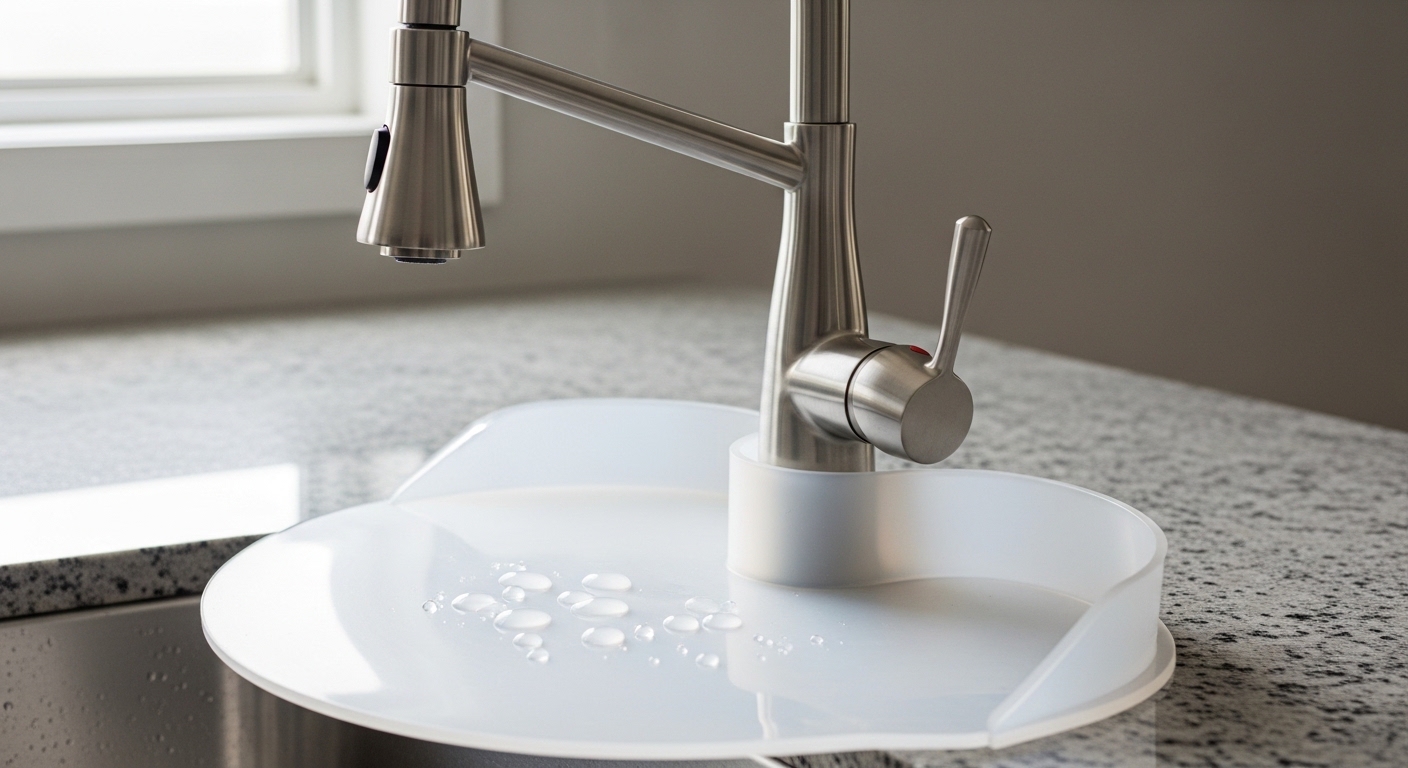
If you searched for a kitchen faucet cover, you’re probably staring at one of three annoyances: a puddle of water and grime that keeps collecting around the base of your faucet, a couple of extra sink holes you don’t know how to hide, or an outdoor kitchen/garden spigot you’re worried will freeze. The confusing part is that all three problems get called the same thing online, so shopping results are a mess. This guide sorts out exactly what each type of cover is, when you actually need one, and how to pick the right size — in plain language, from people who make faucets for a living.
What does “kitchen faucet cover” actually mean — which one do I need?
There are four distinct products people mean by “kitchen faucet cover,” and buying the wrong one is the #1 reason for returns. Here’s the quick sort: if water and grime pool at the base, you want a silicone splash guard. If you have empty holes in your sink, you want a deck plate. If your handle or spout looks scratched and dated, you might want a decorative wrap or escutcheon. If it’s outdoors and winter is coming, you want an insulated freeze cover.
Most home searches for a kitchen faucet cover land on the first two — the splash guard and the deck plate — because those solve the everyday indoor problems. Let’s break down each one so you know exactly which to add to cart.
| Cover type | What it solves | Typical price | Best for |
|---|---|---|---|
| Silicone splash guard / base mat | Water pooling, grime, mineral crust at the faucet base | $8–$20 | Everyday kitchens, hard-water homes |
| Deck plate (escutcheon) | Hiding 1–2 extra unused sink holes | $15–$40 | Switching a 3-hole faucet to a single-hole model |
| Decorative handle/spout wrap | Scratches, dated finish, cosmetic refresh | $6–$15 | Rentals and quick makeovers |
| Insulated outdoor freeze cover | Frozen/burst pipes on exposed spigots | $5–$15 | Outdoor kitchens, garden taps, cold climates |
Why does water keep pooling around my kitchen faucet base?
Water pools around your faucet base because the gap where the spout meets the deck is a natural low point where splashes, dish suds, and mineral-heavy tap water collect and sit. Over weeks that puddle turns into a chalky white crust or pink/black mildew ring — and that’s exactly what a silicone splash guard is designed to stop.
A splash guard is a soft, flexible silicone mat with a hole (or a slit) that hugs the base of the faucet. Water that lands on it either evaporates or gets wiped away in one swipe, instead of seeping into the seam around your mounting hardware. This matters more than it sounds: standing water at the base is what slowly corrodes the trim ring, loosens the mounting nut underneath, and — over a year or two — contributes to a wobbly faucet. If you’ve ever dealt with a loose handle on your faucet, chronic moisture at the base is often part of the story.
A splash guard is also the cheapest insurance against hard-water damage. In homes with hard water, that base puddle bakes into limescale that’s a pain to remove. If yours has already crusted over, our guide on cleaning hard water stains from a faucet walks through the vinegar-soak method before you add a guard to keep it from coming back.
How do I choose the right size splash guard?
Measure the diameter of your faucet base where it meets the sink deck, then pick a guard whose center hole matches within about ⅛ inch. Most kitchen faucet bases run 1.5 to 2.25 inches across; a guard that’s too tight won’t seat flat, and one that’s too loose lets water sneak underneath — defeating the point.
- Measure the base diameter — the round or oval plate the spout stands on, not the spout itself.
- Check the overall footprint — an 8–10 inch mat covers the whole splash zone behind the faucet; a small 4-inch ring only guards the base.
- Pick a slit-style guard for pull-down faucets — the slit lets you slide it on without removing the spray head or hose.
- Choose clear or color-matched silicone so it disappears against your counter instead of looking like an add-on.
How do I cover the extra holes in my sink after changing faucets?
Use a deck plate (also called an escutcheon or base plate) — a metal or plastic cover that spans the standard 4-inch or wider hole spacing and hides the one or two holes your new single-handle faucet no longer uses. It sits under the faucet base and gives a clean, finished look without you having to replace the entire sink.
This is the single most common “cover” need when people upgrade. Older kitchen sinks were often drilled for 3 or 4 holes (faucet, side sprayer, soap dispenser, air gap). Modern pull-down faucets usually need just one hole. Rather than leave two empty holes staring at you, a deck plate bridges them. Standard kitchen sink holes are drilled on 4-inch centers, and most deck plates are built to match — but always confirm your hole spacing before buying.
| Situation | Solution | Notes |
|---|---|---|
| 3 holes, installing a 1-hole faucet | 10-inch deck plate | Covers outer holes on either side of the spout |
| 1 leftover hole (old sprayer) | Single-hole cover cap or soap dispenser | Swap the empty hole for a useful accessory |
| Oversized/damaged hole | Faucet hole cover plate up to 2.5″ | Check the plate’s maximum hole diameter |
Match the deck plate finish to your faucet — brushed nickel to brushed nickel, matte black to matte black — or the mismatch will read as an afterthought. If you’re mid-upgrade and unsure how the plate seats on the studs, our step-by-step kitchen faucet install guide shows exactly where the deck plate and gasket stack goes before you tighten the mounting nut. And if you’re fighting the anchor hardware itself, the kitchen faucet mounting bracket guide covers how the plate, bracket, and nut work together under the sink.
Do I glue a deck plate down or does it screw on?
Neither — a deck plate is sandwiched in place by the faucet itself, not glued. The plate slides over the faucet’s threaded shank (with a rubber gasket underneath for a watertight seal), and when you tighten the mounting nut below the sink, the whole stack clamps down tight. That means installing or removing one is a two-minute job that doesn’t damage your counter.
Can I use a cover to hide scratches or refresh a dated faucet finish?
Yes — decorative silicone or vinyl handle wraps and slip-on escutcheon rings can hide scratches, chips, and a tired finish for well under $15, which makes them popular in rentals and quick sink makeovers. They won’t fix a functional problem, but for pure cosmetics they buy you time before a full faucet replacement.
Be realistic about the limits, though. A wrap covers a scratch; it doesn’t restore the underlying finish, and cheap ones can trap moisture against the metal. If your faucet is scratched because the finish itself is failing, you’re usually better off replacing it than masking it. This is where finish choice at purchase time pays off — durable finishes like brushed nickel and champagne bronze resist visible wear far longer. If you’re weighing a swap, see whether brushed nickel faucets are worth it or how a champagne bronze kitchen faucet holds up before you commit to a cover-up.
What kind of cover protects an outdoor kitchen faucet from freezing?
For an outdoor or exposed spigot, you want an insulated faucet freeze cover — a foam or hard-shell dome that slips over the tap and seals with a loop or strap to trap the pipe’s residual heat. It’s a completely different product from an indoor splash guard, and in cold climates it’s the difference between an intact line and a burst pipe repair that can run into the hundreds of dollars.
If your kitchen setup includes an outdoor bar sink, a garden tap tied to the kitchen line, or an exposed pipe in an unheated space, this is the cover that matters most for winter. A few practical rules:
- Disconnect any hose first — a connected hose holds water against the spigot and defeats the cover.
- Drain the line if you have an interior shutoff, then cap the exterior tap.
- Seal snugly so wind can’t lift the cover; the trapped air is what insulates.
- Combine with a drip in a hard freeze — a slow trickle keeps water moving so it can’t freeze solid.
One quick note: an insulated freeze cover is for outdoor exposed taps only. Never wrap an indoor kitchen faucet in an insulated cover — it traps moisture and does nothing useful indoors.
Does a kitchen faucet cover fix a drip or a leak?
No — a cover hides symptoms but never fixes the cause of a leak, and using one to mask a drip can actually make things worse by trapping moisture where you can’t see it. A dripping spout or a leak at the base is a worn cartridge, O-ring, or loose connection, and it needs an actual repair.
If water is appearing at the base, first rule out a genuine leak before you reach for a splash guard. A slow drip from the spout is usually a cartridge issue — our guide on why your kitchen faucet is dripping shows how to diagnose it. And if your water pressure has dropped along with the mess, a clogged aerator may be the culprit; here’s how to clean a clogged faucet aerator. Fix the plumbing first, then add a cover to keep the newly clean base dry.
How do I install and maintain a silicone splash guard?
Installing a silicone splash guard takes under a minute: clean and dry the faucet base, then stretch the guard’s center hole (or slide the slit) over the base so it sits flat against the deck. Maintenance is just as simple — lift it, rinse it, wipe the deck, and set it back.
- Clean the base first — remove any existing limescale so the guard seats flush and doesn’t trap old grime.
- Dry the deck so the silicone grips instead of sliding on a wet surface.
- Seat the guard flat — no lifted edges where water can pool underneath.
- Rinse it weekly — silicone is dishwasher-safe on the top rack for most brands.
- Inspect the base monthly — lifting the guard is a good moment to check for any new drip or corrosion.
That last step matters: a good cover doubles as a maintenance prompt. Every time you lift it to rinse, you get a look at the base of your faucet — which is exactly where early leaks and loosening hardware first show up.
FAQ
Are kitchen faucet covers universal, or do I need a specific size?
Splash guards and deck plates are not universal. Splash guards need to match your base diameter (typically 1.5–2.25 inches), and deck plates need to match your sink’s hole spacing (most commonly 4-inch centers, sometimes 8-inch widespread). Always measure before buying. Outdoor freeze covers are more forgiving and usually fit a range of standard spigots.
Will a silicone splash guard damage my faucet finish?
No. Food-grade silicone is inert and won’t scratch or react with brushed nickel, chrome, matte black, or bronze finishes. The one caution: don’t leave standing water trapped under a poorly fitted guard, since prolonged moisture — not the silicone itself — is what harms finishes and hardware over time.
Can I put a deck plate on any sink?
Only if the hole spacing matches. A deck plate spans your existing drilled holes, so measure center-to-center between them first. If your sink has non-standard spacing or a damaged oversized hole, look for a plate rated for your specific dimension. You can’t drill new holes into most stainless or granite composite sinks without special tools, so the plate has to work with the holes you have.
Do I need a cover for a brand-new faucet?
Not necessarily, but a splash guard is cheap preventive maintenance — especially in a hard-water home where mineral crust forms fast. Think of it like a phone case: your faucet works fine without one, but the guard keeps the base clean and dry and extends the life of the trim and mounting hardware. A deck plate, by contrast, is only needed if you have extra holes to cover.
What’s the difference between a deck plate and an escutcheon?
They’re essentially the same thing — both are cover plates that hide holes and give a finished look at the base. “Deck plate” is the common term for the wide plate under a kitchen faucet, while “escutcheon” is the more technical word used across kitchen and bathroom fixtures, including the round ring that covers a valve hole in a shower wall. For your kitchen sink, look for “deck plate” or “faucet base plate.”
Can a cover stop my outdoor kitchen tap from freezing on its own?
A freeze cover greatly reduces the risk but isn’t a guarantee in extreme cold. It traps the pipe’s residual heat, which is enough for typical freezes — but in a deep, prolonged freeze you should also disconnect hoses, drain the line if possible, and let the tap drip slowly. The cover plus those steps together is what reliably prevents a burst pipe.
A note from the Cobbe team: This guide was written by Cobbe’s product team, who design and pressure-test kitchen and bathroom faucets and their accessories. Every Cobbe faucet base component is tested against standard finish-durability and water-tightness benchmarks, and our faucets are backed by a limited lifetime warranty on finish and function. We build fixtures — and the covers, deck plates, and guards that go with them — so we see firsthand where water damage actually starts, which is why we recommend keeping the faucet base clean and dry above almost anything else. When you’re comparing accessories, match sizes and finishes carefully, and fix any real leak before you cover it up.