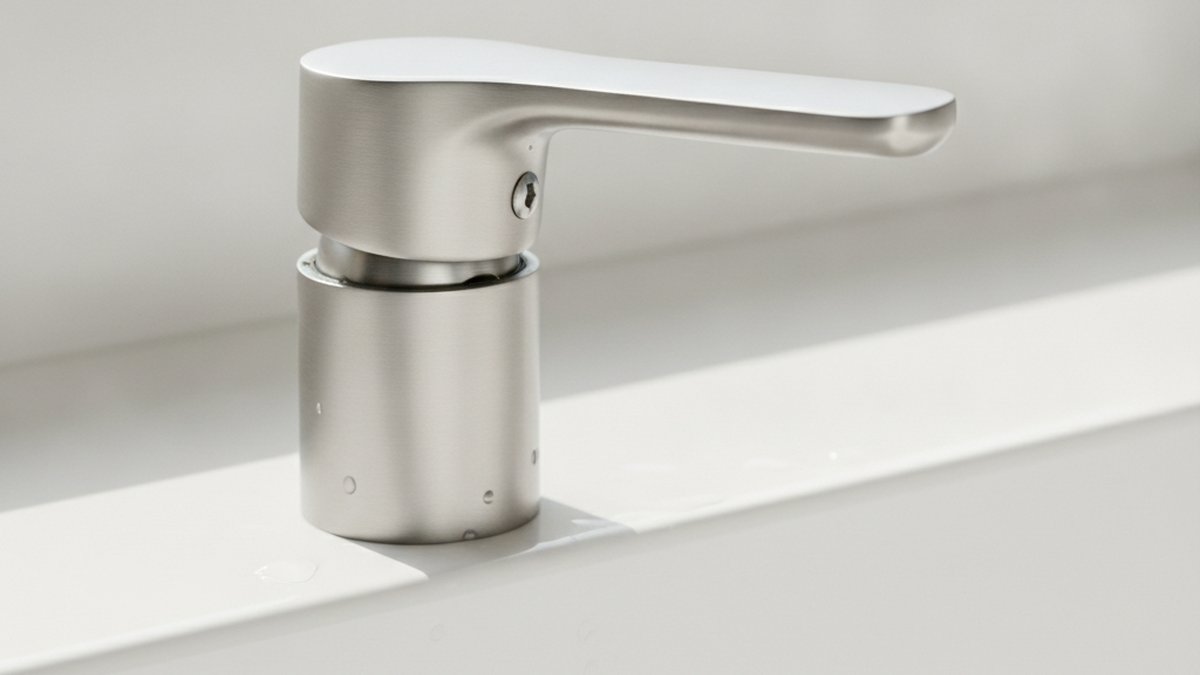
Learning how to fix a faucet handle that is loose is one of the most useful five-minute repairs you can do at home, and it almost never requires a plumber. A loose handle feels alarming — it flops, spins, or lifts off in your hand — but the cause is almost always a single loose screw hiding under a cap. Below, we’ll walk through the exact steps, the tools you need, and what to do when tightening the screw doesn’t hold, because that’s the part most quick-fix articles skip.
At Cobbe, we design and test kitchen and bathroom faucets, and the loose-handle complaint is far and away the most common thing our support team hears. The good news: it’s also the easiest thing to fix. Let’s get your handle solid again.
Why is my faucet handle loose in the first place?
A faucet handle goes loose because the small screw that clamps it onto the valve stem has vibrated free over months of daily use. Every time you turn the handle, you apply torque to that screw. Thousands of on/off cycles slowly back it out, and once it loosens even a fraction of a turn, the handle starts to wobble.
There are really only four causes, and they range from trivial to “replace a part”:
- A loose set screw or handle screw (most common). The clamp that holds the handle to the stem has backed out. Tightening it fixes the problem completely.
- A stripped or worn handle adapter/broach. The plastic or brass splined piece that grips the stem has rounded off, so the screw tightens but the handle still spins. This part is cheap to replace.
- A worn cartridge or valve stem. If the entire stem moves inside the faucet body, the cartridge itself is loose or worn. This is the fix behind many “handle tightens but keeps coming loose” cases.
- A loose mounting nut under the sink. Less common, but if the whole faucet rocks (not just the handle), the base nut under the counter has loosened.
Knowing which of these you’re dealing with saves you from buying parts you don’t need. In most homes, it’s simply cause #1. If you’ve already tightened the screw once and it came loose again, you’re likely looking at #2 or #3 — we cover that in detail in our guide on why a kitchen faucet keeps coming loose.
What tools do I need to tighten a loose faucet handle?
You need almost nothing — most loose handles are fixed with a single hex key that costs a few dollars or came free with the faucet. Here’s the short list:
- Allen (hex) key set — the 2.5 mm and 3 mm sizes handle the vast majority of set screws.
- Phillips and flat-head screwdrivers — for handles that use a standard screw under the cap.
- An adjustable wrench — only if you need to snug the base or a retaining nut.
- A small flat blade or your fingernail — to pry off the decorative index cap.
- A rag or masking tape — to protect the finish and plug the drain so no screws fall in.
That’s it. No plumber, no soldering, no shutting off the house main in most cases. If you can find a hex key, you can do this.
How do you tighten a loose faucet handle step by step?
To tighten a loose faucet handle, find and turn the set screw clockwise until the handle is snug — the whole job takes about five minutes. Here’s the exact sequence that works for single-lever kitchen and bathroom faucets, which is the most common design:
- Turn off the water and plug the drain. For a handle-only repair you usually don’t need to, but plugging the sink drain with a rag guarantees a dropped screw won’t disappear down the pipe. If you’ll be removing the cartridge, shut the two supply valves under the sink first.
- Find the set screw. On a lever handle, look for a small hole on the underside or back of the lever, or a round decorative cap (often marked with a red/blue index or a brand logo) on top. Pop the cap off gently with a fingernail or a small flat blade.
- Match your tool. Most set screws are hex (Allen) screws — try a 2.5 mm key first, then 3 mm. Some older or budget faucets use a Phillips screw. Don’t force the wrong size or you’ll strip it.
- Tighten clockwise. Hold the handle in its correct position, insert the key, and turn clockwise until firm. Snug is enough — you don’t need to crank on it. Overtightening can crack a plastic adapter or strip the threads.
- Test and re-cap. Wiggle the handle. If it’s solid, press the index cap back on and you’re done. Turn the supply valves back on if you closed them.
If your faucet is a two-handle bathroom or kitchen model, each handle has its own screw under its own cap — repeat the process on the loose side. For a deeper walkthrough with photos, our article on why your water faucet handle is loose and how to tighten it fast covers every handle style.
What if my faucet handle has no visible screws?
If there are no visible screws, the screw is hidden under a snap-on cap or the handle is held by a set screw at the base — you just have to find the access point. This is by far the most common source of confusion, because modern faucets deliberately hide the hardware for a clean look.
Check these spots in order:
- The top button/cap: a round disc showing hot/cold colors or a logo pops off to reveal a screw.
- The underside or rear of the lever: tilt the handle up and look underneath for a small hex hole.
- The base collar: some pull-down kitchen handles have a tiny set screw at the back of the base, facing away from you.
A handful of designs use a threaded handle with no screw at all — you tighten the whole handle by hand or with a strap wrench. If you’ve hunted and truly found nothing, walk through our dedicated guide on a sink faucet handle that’s loose with no screws, which maps out every hidden-fastener style by brand.
Why does my faucet handle keep getting loose even after I tighten it?
If the handle loosens again within days or weeks, tightening the screw isn’t enough because the underlying part — the handle adapter or the cartridge — is worn. This is where a lot of people give up and call a plumber, but the fix is still a simple DIY part swap.
Here’s how to tell what’s wrong: after tightening, grab the handle and gently rock it side to side.
- The handle moves but the stem underneath stays put → the handle’s plastic broach/adapter is stripped. Replace the adapter (a $5–$15 part specific to your model).
- The whole stem/cartridge moves inside the faucet body → the cartridge is worn or its retaining nut is loose. Tighten the retaining nut, or replace the cartridge (typically $15–$40).
- It loosens only after hot use → thermal expansion is backing out an already-worn screw; a drop of removable threadlocker (blue, never red) on the set screw stops this permanently.
A dab of blue threadlocker or plumber’s PTFE tape on the set-screw threads is the single most underrated trick for a handle that won’t stay tight. It lets you still remove the screw later, but it stops daily vibration from backing it out. If you’re replacing the cartridge or stem, our step-by-step on how to do a faucet stem replacement yourself shows the whole process without a plumber.
Loose handle fixes compared: which one do you actually need?
Not every loose handle needs the same fix. Use this table to match your symptom to the right repair, the cost, and the time it takes.
| Symptom | Most likely cause | The fix | Cost | Time |
|---|---|---|---|---|
| Handle wobbles slightly, screw visible | Loose set screw | Tighten clockwise with hex key | $0 | 5 min |
| Screw tightens but handle still spins | Stripped handle adapter/broach | Replace adapter | $5–$15 | 15 min |
| Whole stem moves in the body | Worn cartridge / loose retaining nut | Tighten nut or replace cartridge | $15–$40 | 30 min |
| Handle loosens again days later | Vibration backing out screw | Add blue threadlocker to screw | $6 | 10 min |
| Entire faucet rocks on the sink | Loose base mounting nut | Tighten nut under the counter | $0 | 15 min |
The takeaway: start with the cheapest, fastest fix (tighten the screw) and only move down the table if the wobble comes back. Nine times out of ten you’ll stop at row one.
Does the brand of faucet change how you fix a loose handle?
The basic method is identical across brands, but where the screw hides and what size tool you need varies. Moen, Delta, Kohler, Grohe, and American Standard all use slightly different handle designs and set-screw sizes. For example, many Moen single-handle kitchen faucets use a 3/32″ hex screw under a button on top, while Grohe often uses a small hex screw at the base of the lever.
The principle stays the same — find the screw, match the tool, tighten clockwise — but if you want the exact location and screw size for your specific faucet, we have brand-specific walkthroughs for the trickier ones, including a guide to a loose Moen gooseneck faucet handle. When in doubt, keep the model number (usually stamped under the spout or printed on the original box) handy so you can order the right adapter or cartridge the first time.
When should you replace the faucet instead of fixing the handle?
Replace the faucet only when the body itself is cracked, corroded, or the cartridge is discontinued — a loose handle almost never justifies a new faucet. A handle problem is cosmetic and mechanical, not structural, so repairing it is nearly always the right call.
Consider replacement when:
- The faucet is 15+ years old and parts are no longer manufactured.
- The base is corroded or leaking at the deck even after tightening.
- You’ve replaced the cartridge and it still drips or the handle won’t seat.
- You’re renovating anyway and want a matching finish.
Otherwise, a $10–$40 repair beats a $150+ replacement every time. A loose handle is a maintenance item, not a death sentence for your faucet.
How do you keep a faucet handle tight for good?
To keep a faucet handle from loosening again, apply a drop of blue (removable) threadlocker to the set-screw threads and avoid using the handle as a lever to pull yourself up or push down hard on. Most repeat-loosening comes from vibration plus rough use, and both are easy to prevent.
A few habits that keep handles solid for years:
- Check the set screw once a year — a 30-second snug-up during other cleaning prevents wobble from ever starting.
- Don’t over-torque the handle when shutting off; a firm turn is enough, and slamming it stresses the cartridge.
- Use blue threadlocker or PTFE tape on the screw threads if you’ve had to tighten twice.
- Replace worn adapters early — a slightly rounded broach only gets worse, and a fresh one costs a few dollars.
Do those and you’ll likely never think about the handle again.
FAQ
Can I fix a loose faucet handle without turning off the water?
Yes — if you’re only tightening the set screw, you don’t need to shut off the water, because you aren’t opening the valve. Just plug the drain so a dropped screw can’t fall in. You only need to close the supply valves under the sink if you’re going to remove the cartridge or stem.
What size Allen wrench tightens a faucet handle set screw?
Most faucet set screws use a 2.5 mm or 3 mm hex key (roughly 3/32″ in imperial). Try 2.5 mm first, then step up. Using the wrong size risks stripping the screw head, so match it snugly before applying force. A small hex-key set covers every common faucet.
Why does my handle tighten but still wobble?
If the screw is tight but the handle still wobbles, the plastic or brass adapter that grips the valve stem is stripped or the cartridge itself is worn. Tightening the screw can’t fix a rounded-out adapter — you’ll need to replace that small part, which is inexpensive and model-specific.
Is a loose faucet handle dangerous?
A loose handle isn’t dangerous on its own, but it can worsen. Left alone, the constant play accelerates wear on the cartridge and can eventually cause leaks or make the faucet hard to shut off fully. It’s a five-minute fix, so it’s worth doing before it becomes a bigger repair.
How much does a plumber charge to fix a loose faucet handle?
A plumber typically charges $75–$200 for a service call to tighten or rebuild a handle — mostly labor and the trip fee. Since the actual fix is usually a single screw or a $10–$40 part, this is one of the best DIY repairs to do yourself. You’ll spend minutes and a few dollars instead.
My whole faucet moves, not just the handle — what’s wrong?
If the entire faucet rocks on the sink, the mounting nut under the counter has loosened, not the handle. Reach under the sink, find the nut securing the faucet base to the deck, and tighten it by hand or with a basin wrench. That’s a separate issue from a loose handle and usually just as quick.
About the author & brand: This guide was written by the Cobbe product team, who design, pressure-test, and service kitchen and bathroom faucets sold at cobbe.net. Every Cobbe faucet cartridge is cycle-tested to industry durability standards (500,000+ open/close cycles) and backed by our warranty, and our support team fields real customer repair questions like this one daily. When we say a loose handle is usually a five-minute fix, it’s because we’ve walked thousands of customers through it.