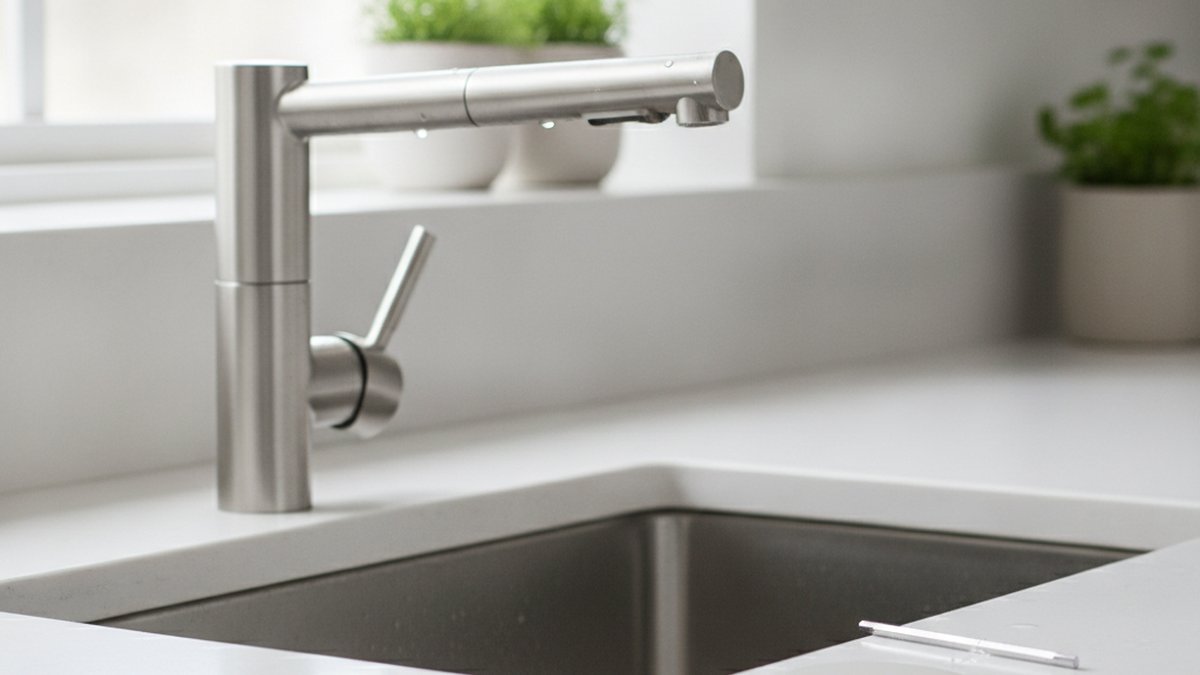
If your water faucet handle loose problem has you jiggling the lever every time you turn the water on, you’re dealing with one of the most common — and most fixable — faucet issues there is. A wobbly handle isn’t just annoying; left alone, it slowly rounds off the internal splines or wears the cartridge stem, turning a two-minute tightening job into a full cartridge replacement. The good news: in the vast majority of cases the handle is loose because a single screw has vibrated its way out, and you already own the tool to fix it.
Below, I’ll walk you through exactly why handles come loose, how to find the screw when there doesn’t appear to be one, and how to make the repair actually stay tight so you’re not back under the sink next month.
Why is my water faucet handle loose in the first place?
A faucet handle goes loose because the fastener holding it to the valve stem has worked itself free, or the parts it grips have worn down. Everyday use puts a surprising amount of torque on that one small connection — every push, pull, and twist slowly loosens things.
Here are the real culprits, roughly in order of how often I see them:
- A backed-out set screw. Most single-handle faucets are held on by one tiny hex (Allen) set screw, usually hidden under a decorative cap or tucked under the base of the lever. Thermal expansion and daily leverage back it out over months.
- A loose handle adapter or “broach.” Many modern faucets use a plastic or brass adapter that slips over the cartridge stem. When its splines wear, the handle spins or rocks even though the screw is tight.
- A loose cartridge retaining nut. If the whole valve rocks — not just the handle — the brass nut holding the cartridge in the faucet body has loosened.
- Mineral buildup and corrosion. Hard water deposits can wear plastic components and prevent the screw from seating fully.
- A stripped stem. The worst case: the splines on the cartridge stem are rounded off, so nothing grips. This means a new cartridge.
The key diagnostic question: does only the handle wobble, or does the entire valve body move when you push it? Handle-only wobble is a screw or adapter fix. Whole-valve movement points to the retaining nut or the faucet’s mounting hardware. If your issue is the faucet spinning at the base rather than the lever, that’s a mounting problem — see our guide on why a kitchen faucet keeps coming loose.
Where is the screw on a faucet handle when I can’t see one?
On most single-handle faucets the screw is hidden either under a snap-off cap on top of the handle (the red/blue hot-cold button) or behind the handle in a small recessed hole that faces the wall. You almost never see it head-on — that’s by design, to keep the faucet looking clean.
Here’s how to find it based on faucet style:
- Look on top first. Pull-down kitchen and many bath faucets have a small cap on the top or front of the lever. Pry it off gently with a fingernail or a flat plastic tool — a decorative cap pops off to reveal a Phillips or hex screw.
- Check the back/underside. Lever-style single handles usually have the set screw underneath, at the base of the lever, angled toward the back. You’ll need a 2.5mm or 3mm hex key.
- Twist the handle to expose it. Sometimes rotating the lever to the full-hot or full-cold position lines the hidden screw hole up with your line of sight.
If you genuinely have no visible screw anywhere and the handle just pulls or pops off, you likely have a push-fit or clip-retained design. We cover that exact scenario step by step in why a sink faucet handle is loose with no screws.
How do I tighten a loose water faucet handle myself?
To tighten a loose water faucet handle: shut off the water, remove the decorative cap, tighten the set screw with the correct hex key or screwdriver, and reseat the handle firmly. Most repairs take 10–15 minutes and need one tool.
Here’s the full process:
- Turn off the water supply. Reach under the sink and close both shutoff valves. This isn’t strictly required for a screw tightening, but it protects you if the handle comes fully off and the cartridge shifts.
- Set the handle to “off.” This relieves pressure on the internal parts.
- Locate and expose the screw using the steps above. Keep the tiny cap somewhere safe — they love to roll into the drain, so plug it first.
- Tighten the set screw. Turn clockwise firmly but don’t gorilla it — over-torquing a small brass or plastic screw strips the threads. Snug is enough.
- Test for wobble. Wiggle the handle. If it’s solid, replace the cap and you’re done.
- If it still wobbles, pull the handle off and inspect the adapter. A cracked or worn splined adapter is a cheap, common replacement part.
One pro tip that saves repeat visits: add a small drop of removable (blue) threadlocker to the set screw before you retighten it. It stops the vibration-driven loosening that caused the problem in the first place, while still letting you remove the screw later.
What if tightening the screw doesn’t fix the loose handle?
If the screw is tight but the handle still rocks or spins, the problem is downstream of the screw — usually a worn handle adapter, a loose cartridge nut, or a stripped stem. Each has a distinct feel that tells you which one it is.
Use this quick comparison to match your symptom to the real cause and fix:
| Symptom | Most likely cause | Fix | Difficulty |
|---|---|---|---|
| Handle wobbles side to side, screw won’t stay tight | Backed-out set screw / stripped screw threads | Retighten with threadlocker, or replace the set screw | Easy (10 min) |
| Handle spins freely or “clicks” without engaging | Worn or cracked handle adapter/broach | Replace the plastic/brass adapter | Easy (15 min) |
| Whole valve body rocks when you push the handle | Loose cartridge retaining nut | Tighten the brass nut under the trim/dome | Moderate (20 min) |
| Handle loose AND water drips or is hard to turn | Worn cartridge / stripped stem splines | Replace the cartridge | Moderate (30–45 min) |
| Handle loose at the base, faucet twists on the sink | Loose mounting nut under the deck | Tighten the mounting hardware from below | Moderate (30 min) |
If the diagnosis points to the cartridge or stem, don’t panic — it’s still a DIY job. Our walkthrough on how to do a faucet stem replacement without calling a plumber covers the disassembly step by step, and you’ll want to confirm sizing first with our guide to what kitchen faucet valve size you need.
Is a loose water faucet handle the same on kitchen, bathroom, and shower faucets?
The root causes are identical across kitchen, bathroom, and shower faucets — a loosened set screw, worn adapter, or loose cartridge nut — but the handle style and where the screw hides differ. The repair logic is the same; only the access point changes.
- Kitchen faucets: Usually a tall single lever with a rear or underside hex screw. High daily use means these loosen most often.
- Bathroom faucets: Often shorter levers or cross/knob handles; screws hide under the top cap. Two-handle configurations double your inspection points.
- Shower faucets: The handle sits on a longer stem and often has a decorative escutcheon; the set screw is typically at the base of the lever, facing down.
Brand matters for the exact part, not the method. Moen, Grohe, Kohler, Delta and American Standard each use slightly different adapters and screw sizes, but the same three-step logic — expose the screw, tighten it, check the adapter — applies to all of them. If you have a general single-handle unit and just want the fastest path, our overview of what’s really wrong when a faucet handle feels loose ties all of this together.
How do I stop my faucet handle from coming loose again?
To keep a faucet handle from loosening again: use blue removable threadlocker on the set screw, avoid using the handle as a leverage point to pull yourself up at the sink, and check the screw once or twice a year. Vibration and daily torque are what work it loose, so a threadlocker plus a periodic snug-up solves it permanently for most people.
A few habits that make a real difference:
- Don’t over-tighten during use. Slamming a single-handle lever all the way to its stop every time stresses the connection. Gentle operation extends the life of the cartridge and the handle attachment.
- Descale regularly if you have hard water. Mineral scale wears plastic adapters. If your aerator is also clogging, that’s a hard-water tell — see how to clean a clogged faucet aerator.
- Keep the right hex key handy. A $3 set of metric and SAE hex keys means the next tightening takes 90 seconds.
- Replace worn adapters early. A cracked adapter that still “kind of works” will strip the cartridge stem if you keep using it — a far pricier fix.
When should I just replace the faucet instead of fixing the handle?
Replace the whole faucet — rather than repairing the handle — when the cartridge stem is stripped and the model is discontinued, when the faucet is over 10–15 years old with multiple worn parts, or when replacement cartridges cost nearly as much as a new faucet. For a single loose handle on a newer faucet, repair almost always wins.
Do the math honestly: a set screw or adapter is a few dollars, a cartridge is usually $15–$40, but if you’re chasing leaks, corrosion, and a wobbly handle all at once on an aging unit, a modern faucet with a solid warranty is the smarter spend. A quality single-handle faucet is engineered so the handle attaches to a durable ceramic-disc cartridge with a metal adapter — exactly the parts that resist the loosening you’re fighting now.
If you do decide to upgrade, look for a faucet whose cartridge is tested to survive hundreds of thousands of on/off cycles and whose finish carries a lifetime warranty — those specs are the difference between a handle that stays put for a decade and one you’re tightening every season.
FAQ
Can I tighten a loose faucet handle without turning off the water?
Yes, for a simple set-screw tightening you can usually leave the water on, since you’re not opening the valve itself. But if you need to fully remove the handle to inspect the adapter or cartridge, shut off the supply valves under the sink first — it takes 30 seconds and prevents an accidental spray.
What size Allen key do I need for a faucet handle set screw?
Most single-handle faucet set screws take a 2.5mm, 3mm, or 1/8-inch hex key. Buy an inexpensive combined metric and SAE hex-key set so you’re covered regardless of brand — Grohe and other European faucets tend to be metric, while many U.S. brands use SAE sizes.
Why does my faucet handle keep coming loose even after I tighten it?
If it loosens repeatedly, the set screw is vibrating out or its threads (or the adapter splines) are worn. Add a drop of blue removable threadlocker when you retighten. If the handle still won’t stay firm, the plastic adapter or the cartridge stem is worn and needs replacement — a tight screw can’t grip a rounded-off stem.
Is a loose faucet handle dangerous or just annoying?
It’s mostly annoying, but ignoring it causes real damage: a wobbling handle grinds against the cartridge stem and gradually strips the splines, turning a cheap screw fix into a full cartridge replacement. It can also let the valve drift, causing drips. Fix it early and you save yourself the bigger repair.
How much does it cost to fix a loose water faucet handle?
A DIY fix costs almost nothing — the set screw is often reusable, a replacement adapter runs a few dollars, and a new cartridge is typically $15–$40. A plumber’s service call for the same job usually runs $75–$150, which is why this is one of the best beginner DIY plumbing repairs.
My faucet handle has no visible screw at all — how do I remove it?
Many modern handles use a hidden set screw under a snap-off cap, or a push-fit/clip design with no screw. Gently pry off the decorative cap on top or at the front of the lever to reveal the screw. If there truly is no screw, the handle typically pulls straight up or releases with a small retaining clip — pull firmly and evenly rather than twisting.
Author note: This guide was written by the Cobbe fixtures team, drawing on hands-on repair testing across single-lever kitchen, bathroom, and shower faucets from major brands. Cobbe designs and sells kitchen and bathroom faucets built around ceramic-disc cartridges tested for long-cycle durability, and our fixtures meet standard U.S. plumbing certifications with finish and function warranties. We’ve disassembled and reassembled hundreds of handles to document exactly where these screws hide and why they loosen — so the steps above reflect what actually works at the sink, not just theory.
Pingback: How to Fix a Faucet Handle That Is Loose: What Actually Works? - Cobbe