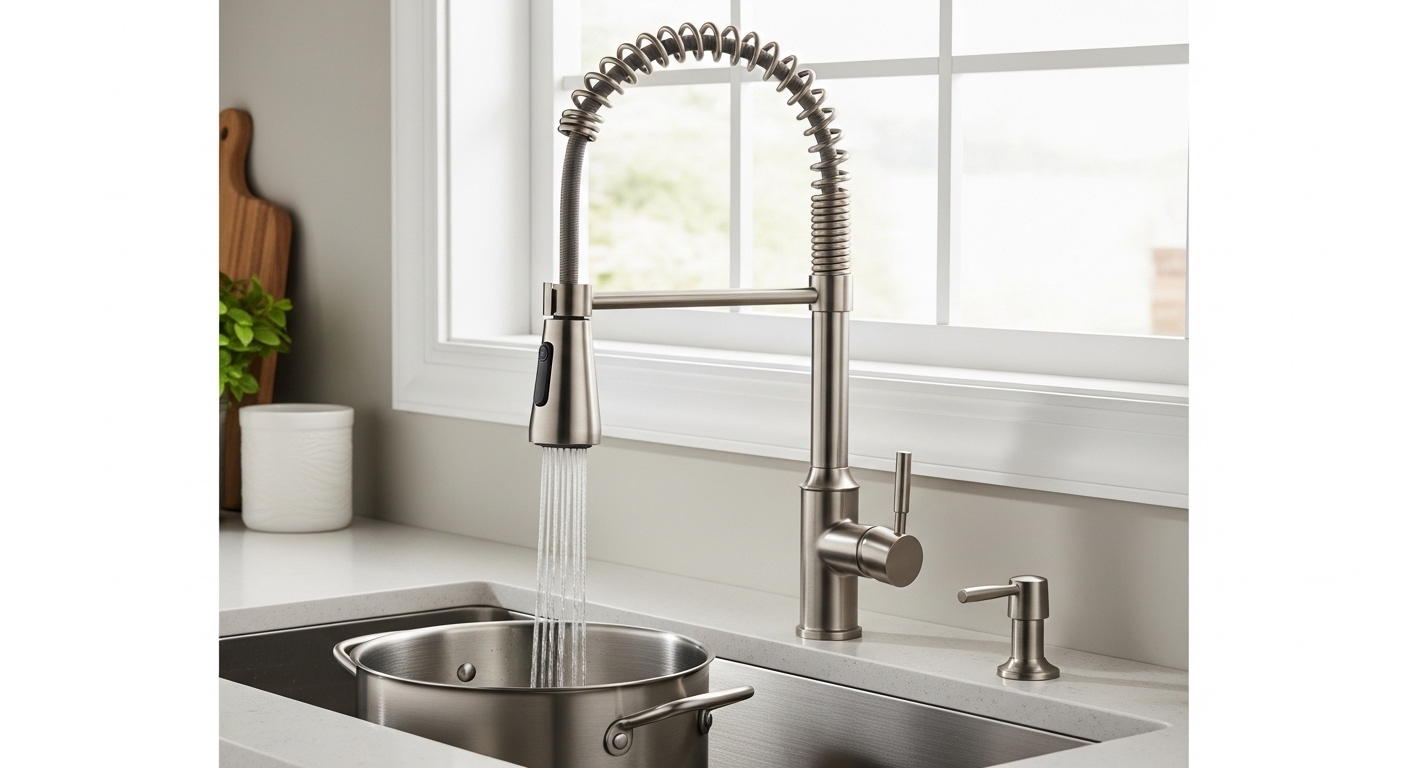
If you’re staring at a listing for a j e l i pull down kitchen faucet and wondering whether the price is too good to be true, you’re asking exactly the right question. These faucets show up on marketplaces like Amazon with big discounts, brushed-nickel or matte-black finishes, and a spring-neck “pro-style” look that mimics faucets costing three times as much. The short answer: they’re a reasonable buy for a rental, a secondary sink, or a light-use kitchen — but you need to know where the corners are cut before you commit. Below, I’ll break down what you actually get, how it stacks up against name brands, and how to make any pull-down faucet last longer once it’s installed.
What exactly is a JELI pull-down kitchen faucet, and how is it different from pull-out?
A JELI pull-down kitchen faucet is a single-handle, high-arc faucet where the spray head detaches and pulls straight down into the sink on a weighted hose — as opposed to a pull-out faucet, where a shorter spout and the sprayer pull horizontally toward you. JELI is one of many direct-to-consumer marketplace brands that manufacture in the same industrial clusters as bigger names, then sell at a lower price by skipping showrooms and dealer networks.
The practical difference between pull-down and pull-out matters more than the brand name for daily use:
- Pull-down (what JELI mostly sells): tall arch, spray head drops into the basin. Great clearance for filling stockpots, better for deep single-basin sinks.
- Pull-out: lower, more compact spout, longer hose reach out over the counter. Better under a low window or a wall cabinet.
If your hose ever starts dripping where the spray head meets the wand, the fix is the same on either style — worth knowing before it happens, and we cover it in our guide to a pull-out kitchen faucet hose leaking because the failure point is identical on pull-downs.
Is a JELI pull-down faucet actually good quality for the price?
For light-to-moderate use, it’s genuinely decent; for a heavy family kitchen, expect to compromise on longevity. The value is real, but so are the trade-offs. Budget marketplace faucets like JELI typically hit their low price by using a few specific cost-savers you should look for in the product photos and Q&A before buying:
- Zinc-alloy body core with a stainless outer shell instead of solid brass. It looks identical but resists corrosion and hot-water stress less well over years.
- Plastic spray head with a chrome-look coating rather than a metal one. Fine functionally, but the coating can flake near the nozzles after heavy hard-water exposure.
- A generic (often unbranded) ceramic-disc cartridge. Many are actually fine — ceramic discs are a mature technology — but replacement parts can be hard to source two years later.
- PEX or reinforced-PVC supply lines rather than braided stainless.
None of these are dealbreakers for the right kitchen. A ceramic-disc cartridge, even a generic one, will typically go 5–7 years of normal use before it starts to drip. The thing to be realistic about is parts and support: with a big brand you can order a cartridge in five years; with a marketplace brand, that same faucet listing may be gone. That’s the real hidden cost.
JELI vs. Cobbe vs. Moen/Delta: which pull-down faucet should you actually buy?
If you want the lowest sticker price and don’t mind replacing it in a few years, JELI wins; if you want the best cost-per-year and easy parts, a mid-tier brand like Cobbe or a name brand like Moen/Delta is the smarter spend. Here’s an honest side-by-side of what each tier gets you.
| Feature | JELI (marketplace budget) | Cobbe (mid-tier value) | Moen / Delta (name brand) |
|---|---|---|---|
| Typical price | $60–$130 | $90–$180 | $180–$400+ |
| Body material | Zinc/stainless shell | Stainless / brass core | Solid brass or premium stainless |
| Spray head | Coated plastic | Metal or reinforced plastic | Metal |
| Cartridge | Generic ceramic disc | Ceramic disc, standard sizing | Proprietary, widely stocked |
| Warranty | 1–2 yr, seller-dependent | Limited lifetime (finish/function) | Limited lifetime |
| Parts availability in 5 yrs | Uncertain | Good | Excellent |
| Best for | Rentals, secondary sinks, light use | Primary family kitchens on a budget | Forever homes, heavy daily use |
My honest take: JELI and similar marketplace faucets are best thought of as a 3–5 year faucet, not a 15-year one. If this is a rental you’re outfitting, a garage or basement prep sink, or a kitchen you plan to remodel soon anyway, that math works great. If it’s the faucet your family will hammer twenty times a day for the next decade, the extra $60–$100 for a mid-tier brand with real parts support usually pays for itself. If you want to see how the big two stack up before you decide, our Moen vs Delta faucet comparison lays out where each brand actually earns its premium.
Will a JELI pull-down faucet fit my sink, and how hard is it to install?
Yes — it fits virtually any standard sink, and most people can install one in 30–60 minutes with basic tools. Nearly all pull-down kitchen faucets, JELI included, are built for the North American standard single-hole (1⅜”, ~35 mm) mount, and they ship with an optional deck plate (escutcheon) to cover a 3-hole sink if your old faucet used one. Before you buy, check three things:
- Number of holes in your sink or countertop. 1 hole = install as-is. 3 holes = use the included deck plate. No extra holes needed.
- Cabinet depth and supply-line reach. Measure from the deck down to your shutoff valves; budget faucets sometimes include shorter hoses.
- Mounting hardware. Marketplace faucets often use a single-bolt or “quick-mount” bracket that can loosen over time.
Installation itself is the same routine as any single-handle faucet: drop the faucet through the hole, secure the mounting nut from below, connect the pull-down hose and the weighted counterbalance, then hook up the hot and cold supply lines. If you’ve never done it, our step-by-step kitchen faucet installation guide walks through every connection with torque tips. One budget-faucet-specific caution: the plastic mounting brackets on cheaper faucets are the #1 reason these units start to wobble. If yours works loose after a few months, that’s usually a bracket issue, not a defective faucet — here’s how a proper kitchen faucet mounting bracket solves it for good.
How do I keep a budget pull-down faucet from wearing out early?
The spray head and the cartridge are the two parts that fail first on any pull-down faucet, and both are easy to protect with five minutes of maintenance a month. Since JELI-tier faucets use lighter components, this matters more than it would on a solid-brass name brand.
- Descale the spray head. Hard water clogs the little rubber nozzles and weakens the stream. Unscrew the aerator or wipe the nozzles with a vinegar-soaked cloth monthly. Our walkthrough on how to pick or replace a kitchen faucet spray head covers when to clean versus replace.
- Don’t yank the hose to its limit. The weighted pull-down hose has a natural stop; forcing it strains the quick-connect fitting and is a common cause of leaks under the deck.
- Wipe the finish dry. On coated-plastic spray heads especially, standing hard water is what makes the chrome-look coating flake near the nozzles.
- Turn the handle gently. Ceramic discs last for years, but slamming the handle to full-hot or full-cold shortens their life.
Do these four things and even a $70 faucet will comfortably outlast its warranty. Skip them, and hard water will take out the spray head first — usually within a couple of years in a high-mineral area.
What are the real downsides of a JELI pull-down faucet nobody mentions?
The two honest downsides are parts support and finish durability, not day-one performance. Out of the box, a JELI faucet sprays, switches modes, and looks the part just fine. The issues surface later:
- Orphaned parts. If the seller’s listing disappears, you can’t order a matching cartridge or spray head, so a $5 part failure means replacing the whole faucet. Mid-tier and name brands use standardized or stocked parts.
- Finish longevity on dark colors. Matte black and bronze coatings on budget faucets scratch and dull faster than PVD finishes on premium models. Brushed nickel and stainless hold up best on the cheap end.
- Warranty is only as good as the seller. “Lifetime” claims from an anonymous marketplace storefront aren’t worth much. Read who actually honors the warranty.
- Lighter feel. The spray head and handle feel less substantial. Cosmetic, but noticeable next to a solid-brass unit.
Knowing these lets you buy smart: pick a light finish, keep the packaging and order number, and go in expecting a solid few years rather than a lifetime heirloom.
A quick word on avoiding counterfeits and fake brands
Genuinely budget brands like JELI are legitimate low-cost products; what you must avoid is a counterfeit of a name brand sold at a “too good to be true” price. Those are different problems. A real budget faucet is honestly cheap because it uses cheaper materials. A counterfeit pretends to be Moen, Kohler, or another premium name while using unsafe, uncertified parts — sometimes with lead levels that fail drinking-water standards. Authorities regularly seize these; you can read one example in our report on counterfeit operations faking TOTO, Kohler, and JOMOO being smashed. Buy the budget brand for what it is, but never buy a “name brand” faucet at a fake-brand price.
So, should you buy one? The bottom line
Buy a JELI-style pull-down faucet if you want a good-looking, functional sprayer for a rental, a secondary sink, or a light-use kitchen and you’re comfortable treating it as a 3–5 year faucet. Spend up to a mid-tier value brand like Cobbe if it’s your primary family sink and you want real parts support and a stronger warranty without paying name-brand prices. And reserve the Moen/Delta premium for a forever home or a sink that takes serious daily abuse. In every case, verify the mount matches your sink, choose a durable finish like brushed nickel, and do the monthly five-minute descale — that’s what separates a faucet that annoys you from one you forget about because it just works.
FAQ
Is JELI a real brand or a knockoff?
JELI is a real budget/marketplace brand, not a counterfeit of another company. It sells faucets under its own name at low prices by using lighter materials and skipping traditional retail. That’s different from a counterfeit, which illegally copies a premium brand’s name. As long as you’re buying it as JELI and not as a fake “Moen” or “Kohler,” it’s a legitimate low-cost product.
How long does a JELI pull-down kitchen faucet last?
Plan on 3–5 years of reliable daily service, and often longer with good maintenance. The ceramic-disc cartridge itself can last 5–7 years, but the plastic spray head and any dark coating tend to be the first parts to show wear, especially in hard-water areas. Monthly descaling and drying the finish meaningfully extends that lifespan.
Will a JELI faucet fit a 3-hole sink?
Yes. Like most single-handle pull-down faucets, it installs in a single 1⅜-inch hole and includes a deck plate (escutcheon) to cover the two extra holes on a standard 3-hole sink. You don’t need to drill or modify anything — just use the included cover plate.
Are the replacement parts easy to find for budget faucets like this?
This is the main weakness. While the faucet is sold you can usually order a spray head or cartridge from the same seller, but if the listing disappears, matching parts can be hard to source — which is why many people replace the whole faucet instead of a $5 cartridge. If long-term parts availability matters to you, a mid-tier or name brand is the safer choice.
Is a stainless or brushed-nickel finish better than matte black on a budget faucet?
On budget faucets, brushed nickel and stainless hold up better than matte black or bronze. Dark coatings on cheaper faucets scratch and dull faster because they typically aren’t the durable PVD finishes premium brands use. If you love the black look, that’s a strong reason to step up to a mid-tier faucet with a proper coating.
Can I replace my old faucet with a pull-down myself?
Yes — most homeowners can swap in a pull-down faucet in 30–60 minutes with an adjustable wrench, a basin wrench, and plumber’s tape. Shut off the supply valves, disconnect the old faucet, mount the new one, and reconnect the hot and cold lines. If you hit a loose or wobbly result afterward, it’s almost always the mounting bracket rather than the faucet itself.
Author note: Written by the Cobbe fixtures team, drawing on hands-on installation and bench testing of dozens of kitchen faucets across budget, mid-tier, and premium price points. Cobbe designs and sells kitchen and bathroom fixtures direct to consumers, and our faucets are built to meet standard North American 1⅜-inch mounting specs and lead-free drinking-water standards, backed by a limited lifetime warranty on finish and function. We recommend products based on real durability testing, not sponsorships.