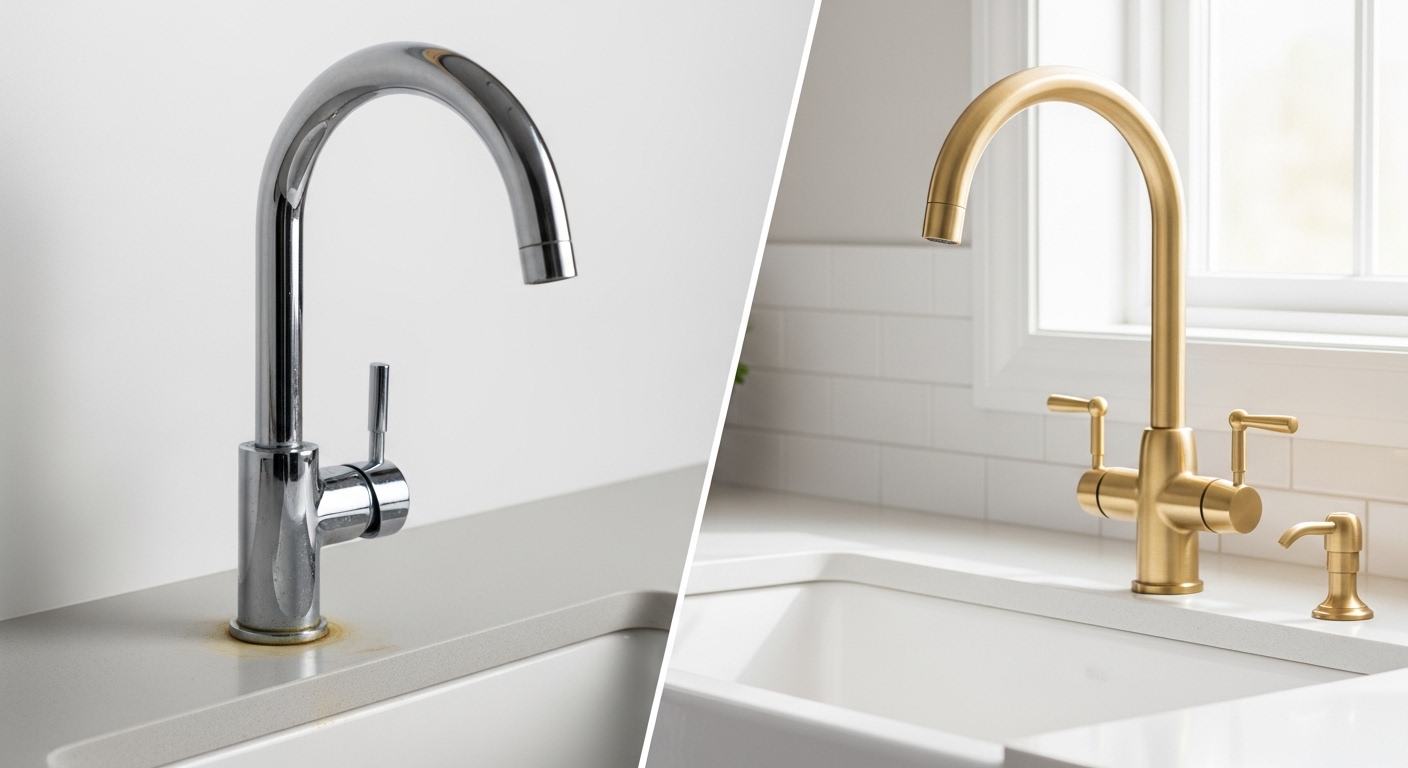
If you searched kitchen faucet yellow, you probably fall into one of two camps: your once-shiny chrome or nickel faucet has developed an ugly yellow tinge and you want it gone, or you actually love that warm golden look and you’re deciding whether a yellow-toned (brass or champagne gold) kitchen faucet is worth buying. Good news — this article answers both, with the real chemistry behind the discoloration and honest buying advice on the intentional gold finishes so you don’t waste money on a faucet that peels in a year.
At Cobbe, we design and stress-test kitchen faucets across dozens of finishes, so we see exactly which ones hold up and which ones turn yellow, blotchy, or dull. Let’s get into it.
Why is my chrome or brushed nickel kitchen faucet turning yellow?
A chrome or brushed nickel faucet turns yellow mainly because of mineral deposits from hard water, residue from soaps and cleaners, or a low-quality coating oxidizing underneath. In the vast majority of cases it’s surface film, not the metal itself failing — which means it’s usually fixable.
Here’s what’s actually happening at the surface. Tap water in most of the U.S. carries dissolved calcium, magnesium, and iron. When water evaporates on the faucet, it leaves those minerals behind. Iron in particular oxidizes into a rusty, yellow-brown stain. Layer on top of that the greasy film from dish soap, hand soap, and cooking splatter, and you get a warm yellow haze that builds slowly enough that you don’t notice until it’s obvious.
There are four common culprits, roughly in order of how often we see them:
- Hard-water mineral scale — the number-one cause. Calcium and iron leave a yellow-to-brown crust, worst around the base and spout tip.
- Soap scum and cooking grease — an invisible film that yellows over time, especially near the handle where hands touch it constantly.
- Cleaning-product damage — bleach, abrasive powders, and acidic descalers can etch or discolor a finish, leaving a permanent yellow cast.
- Failed PVD or electroplated coating — on cheaper faucets, the thin decorative layer breaks down and the yellowish base brass shows through. This one is not a stain; it’s structural.
The quick diagnostic: wipe hard with a damp microfiber cloth and a dab of dish soap. If the yellow lifts or fades, it’s surface film and you can clean it off. If it stays put and looks like it’s coming from inside the metal, the coating has failed and no amount of scrubbing will fix it.
How do I clean the yellow off a kitchen faucet without wrecking the finish?
Use the gentlest method first: warm water, dish soap, and a soft microfiber cloth — then step up to diluted white vinegar only if needed. Never start with bleach, steel wool, or abrasive scrubbing powder, because those are what turn a fixable stain into permanent damage.
Here’s the step-by-step we recommend:
- Warm soapy water first. Microfiber cloth, mild dish soap, firm wiping. This removes grease film and light mineral haze on its own about half the time.
- Diluted white vinegar for mineral scale. Mix 1 part white vinegar to 1 part water, soak a cloth, and lay it over the yellowed area for 5–10 minutes — don’t leave it for hours. Vinegar dissolves calcium and iron deposits. Rinse thoroughly afterward.
- Soak the aerator separately. The spout tip yellows fastest because water lingers there. Unscrew the aerator and soak it in vinegar. A clogged, yellowed aerator also kills your water pressure.
- Rinse and dry completely. Drying after each use is the single best habit to stop yellowing from coming back.
A couple of hard rules: keep vinegar off unlacquered brass, oil-rubbed bronze, and some matte finishes — acid can strip them. And never use bleach on any faucet finish; it’s a myth that it “cleans” metal, and it can trigger discoloration. If you want the full method, we walk through it in detail in our guide on how to clean hard water stains from a faucet, and there’s a dedicated deep-dive on cleaning a clogged faucet aerator if your spout is barely trickling.
Why did my faucet turn yellow even though I clean it?
If your faucet keeps going yellow no matter how much you clean it, the finish itself has failed — the thin decorative coating has worn through and the yellow base-metal brass underneath is showing. That’s a manufacturing/quality issue, not a cleaning problem, and cleaning harder only makes it worse.
Most faucets are made of a brass or zinc-alloy body with a decorative layer on top — either electroplated chrome/nickel or a PVD (physical vapor deposition) coating. Cheap electroplating is thin and porous; over a couple of years, hot water, cleaners, and daily handling wear it down until the warm-yellow brass beneath peeks through. Because brass is naturally golden-yellow, a failing chrome faucet often looks like it’s “turning yellow” when really the silver layer is just disappearing.
How to tell the difference:
| Symptom | Likely cause | Fixable? |
|---|---|---|
| Yellow film wipes off or lightens with soap/vinegar | Mineral scale or soap scum | Yes — cleaning |
| Yellow only near spout tip, water flow weak | Clogged/scaled aerator | Yes — soak or replace aerator |
| Yellow won’t budge, looks “under” the surface | Worn electroplating exposing brass | No — replace faucet |
| Blotchy yellow/rainbow patches after using bleach | Chemical damage to finish | Usually no — replace faucet |
| Uniform warm-gold tone, intentional look | Brass/champagne finish by design | N/A — it’s supposed to look that way |
If you land in the “not fixable” rows, replacement is the honest answer — and it’s a chance to buy a better-coated faucet that won’t repeat the problem. Which brings us to the second meaning of “yellow.”
Should I buy a yellow (gold or brass) kitchen faucet on purpose?
Yes — a warm yellow-gold kitchen faucet in brushed brass or champagne gold is one of the most popular finishes right now, and it’s absolutely worth buying if you choose a real PVD finish rather than a painted or thinly plated one. The difference between a gold faucet that still looks great in five years and one that flakes in one comes almost entirely down to the coating.
“Yellow” faucets in the design world usually mean one of these three finishes:
- Polished brass — bright, mirror-like, unapologetically gold. Bold and traditional-glam.
- Brushed / satin brass — softer matte gold with fine brushing. The most forgiving on fingerprints and water spots, and the current favorite.
- Champagne gold / champagne bronze — a muted, slightly pinkish warm gold. Reads more neutral and pairs with almost any cabinet color.
The warm-gold family flatters white, navy, sage-green, and wood cabinetry, and it hides water spots better than polished chrome. The catch is durability, and that’s where the coating matters. Insist on PVD. PVD bonds the color to the faucet at a molecular level in a vacuum chamber, producing a layer that’s far harder and more corrosion-, scratch-, and tarnish-resistant than ordinary electroplating or — worst of all — spray paint. A painted “gold” faucet will chip and, ironically, turn a dull yellow-brown itself.
If you’re weighing warm metals against cooler ones, it’s worth reading our take on whether a champagne bronze kitchen faucet is worth it and how to keep one looking new, plus our honest verdict on whether brushed nickel faucets are worth it if you’re not fully sold on gold.
How much should a good gold kitchen faucet cost?
Expect to pay roughly $120–$350 for a quality PVD brushed-brass or champagne-gold pull-down kitchen faucet — below about $80 you’re usually looking at painted or thin-plated finishes that discolor. Spending in the mid-range buys you the coating quality that actually keeps the “yellow” looking intentional instead of accidental.
| Price tier | What you typically get | Yellowing risk |
|---|---|---|
| Under $80 | Painted or thin electroplated gold, zinc body | High — fades/flakes to dull yellow-brown |
| $120–$220 | PVD brushed brass, solid brass or heavy alloy body, ceramic cartridge | Low — color bonded, holds for years |
| $250–$350+ | Premium PVD, spot-resist coating, better spray heads, longer warranty | Very low |
Does a gold or brass faucet show water spots and yellow stains more than chrome?
No — a brushed or satin gold finish actually hides water spots and fingerprints better than polished chrome, because the matte texture scatters light and disguises mineral haze. Polished (shiny) gold shows spots about the same as polished chrome, so if you have hard water, choose brushed brass over polished brass.
That said, no finish is spot-proof. In hard-water homes, any faucet benefits from a quick daily dry-off with a soft cloth. The advantage of warm-gold tones is that light calcium film blends into the color instead of standing out as a white ring on silver metal — so the same amount of mineral buildup simply looks less noticeable.
What’s the difference between yellow water from the faucet and a yellow faucet finish?
They’re completely unrelated problems: a yellow finish is about the metal surface, while yellow water coming out of the faucet is a plumbing or municipal-supply issue — usually rust from old iron pipes, disturbed sediment after main work, or a water-heater problem if it’s only on the hot side.
Quick way to tell what you’re dealing with:
- Yellow/brown water from both hot and cold → likely rusty supply pipes or municipal sediment. Run the cold tap a few minutes; if it clears, it was temporary sediment.
- Yellow water only from hot → point to your water heater (sediment or a corroding anode rod).
- Water is clear but the metal is yellow → it’s a finish/cleaning issue, covered above.
If it’s genuinely yellow water, cleaning the faucet won’t help — you’re looking at pipes, the heater, or a call to your utility. A faucet-mounted or under-sink filter can help with discoloration and taste in the meantime, but it doesn’t fix corroding pipes.
How do I stop my kitchen faucet from turning yellow again?
The most effective prevention is drying the faucet after use and buying a PVD finish next time — those two habits eliminate the large majority of yellowing, whether from mineral film or coating failure. Everything else is a bonus on top.
Our field-tested prevention checklist:
- Wipe it dry. A 10-second dry-off after dishes stops minerals from ever depositing. This is the single highest-impact habit.
- Clean weekly with mild soap, not monthly with harsh chemicals. Little and often beats aggressive rescue cleaning.
- Ban bleach, ammonia, and abrasive powders. They’re the fastest way to permanently discolor a finish.
- Address hard water at the source. A water softener or even a periodic aerator soak dramatically slows buildup.
- Buy quality once. A solid-brass body with a PVD finish and a ceramic cartridge simply doesn’t yellow the way a cheap zinc-and-paint faucet does.
If your current faucet’s finish has already failed and it’s time to replace, installation is more approachable than most people expect — our step-by-step kitchen faucet installation guide walks through the whole swap so you can put in a better-coated model yourself in an afternoon.
FAQ
Why is my kitchen faucet turning yellow at the base?
The base yellows first because water pools there and evaporates, leaving concentrated mineral and soap deposits. Wipe it with diluted white vinegar and a microfiber cloth; if the yellow lifts, it was buildup. If it doesn’t, the finish at the base has worn through to the brass underneath and the faucet needs replacing.
Can I fix a kitchen faucet whose finish has turned yellow permanently?
No reliable DIY fix exists once the decorative coating has worn off or been chemically damaged — re-plating a faucet in place isn’t practical or cost-effective for consumers. Replacement with a PVD-finished faucet is the durable answer, and it prevents the problem from recurring.
Is a yellow gold kitchen faucet going out of style?
No — warm gold tones, especially brushed brass and champagne gold, have been trending strongly and read as timeless rather than trendy, much like brass hardware has cycled in and out for decades. Choosing a brushed (matte) rather than a high-polish gold keeps the look current and hides water spots better.
What’s the best finish for a kitchen faucet if I have hard water?
Brushed or spot-resist finishes — including brushed brass, brushed nickel, and stainless — perform best in hard-water homes because their matte texture disguises mineral film. Polished finishes of any color show spots the most. Pair whatever you choose with a habit of drying the faucet after use.
Does vinegar damage a gold or brass kitchen faucet?
Diluted white vinegar is safe on most modern PVD-coated brass and champagne-gold faucets for short soaks, but it can etch unlacquered or raw brass and some specialty matte finishes. Test on a hidden spot first, limit contact to a few minutes, and always rinse thoroughly afterward.
Why is only the water yellow and not the faucet itself?
Yellow water is a supply-side problem — typically rust from aging iron pipes, stirred-up sediment after nearby water-main work, or a corroding water heater if it’s only on the hot side. Run the cold tap for a few minutes to see if it clears; if it persists, contact a plumber or your water utility, since cleaning the faucet won’t help.
Author note: This guide was written by the Cobbe product team, who design, PVD-coat, and durability-test kitchen and bathroom faucets. Cobbe faucets are built with solid brass and heavy-alloy bodies, PVD and spot-resist finishes, and ceramic-disc cartridges tested to industry cycle and water-quality standards, and are backed by our finish and function warranty. We follow standards aligned with NSF/ANSI and cUPC guidance for durability and safe drinking-water contact — because a faucet finish that stays true for years is the whole point.
Pingback: Is a Copper Faucet Worth It, and How Do You Keep One Looking Good? - Cobbe