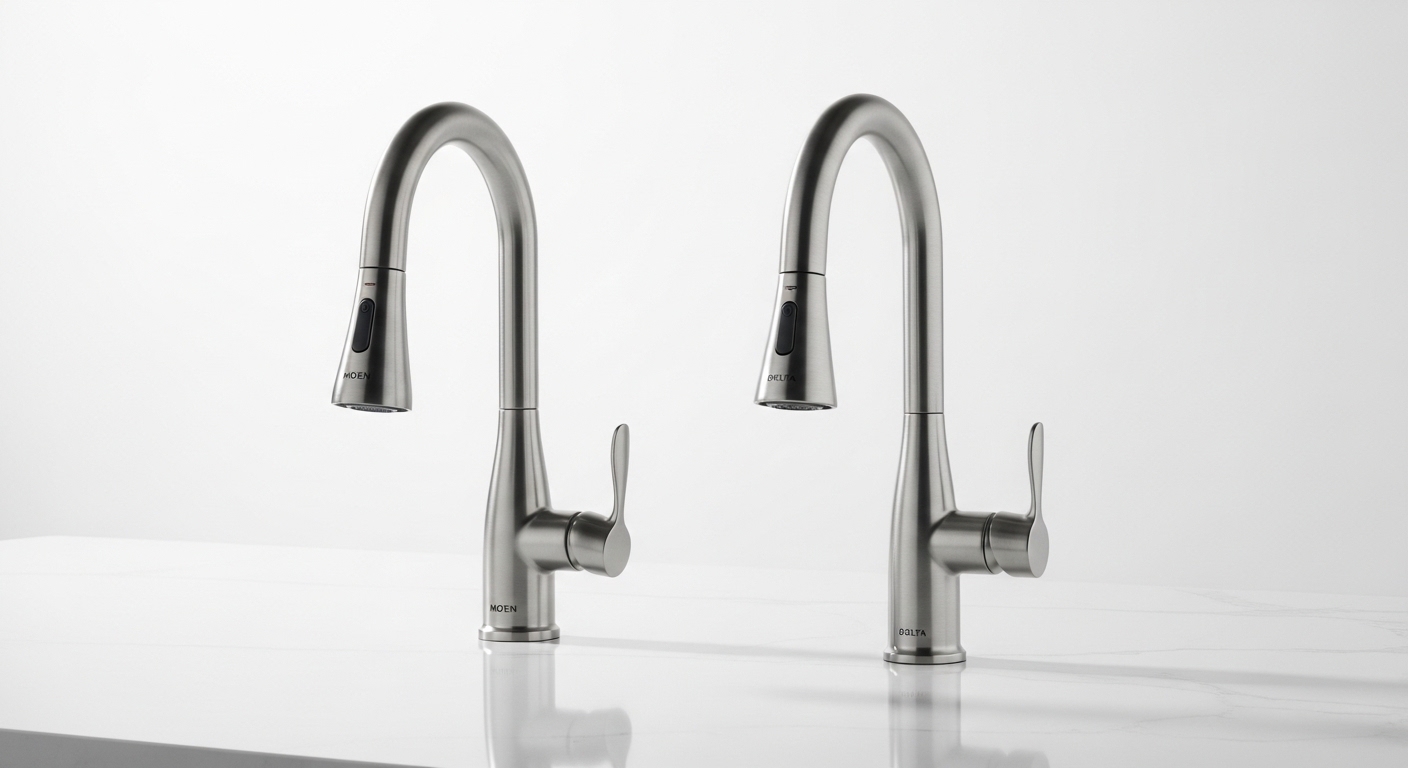
The “moen vs delta faucet” debate is the single most common question we get from shoppers cross-shopping mid-range kitchen and bathroom fixtures, and the honest answer frustrates people who want a clean winner: these two American brands are remarkably close on quality, warranty, and price. Both have made faucets for over 60 years, both use ceramic disc valves, and both back their products with a limited lifetime warranty for residential use. What actually separates them is how their signature technologies behave day to day — and that’s exactly what this comparison breaks down, with real specs and real scenarios instead of brand loyalty.
Below we’ll answer the questions people genuinely ask before checking out: which brand leaks less, which is easier to install yourself, which touchless system is more reliable, and which finishes hold up to hard water. We’ll also be straight with you about where a value brand like Cobbe fits in if you’re price-sensitive but still want the same ceramic-disc reliability.
Is Moen or Delta better overall for a kitchen faucet?
For most kitchens, Delta has a slight edge on leak prevention and DIY-friendliness, while Moen wins on touchless reliability and parts availability. If you’re installing it yourself this weekend and never want to think about it again, Delta’s Diamond Seal valve and InnoFlex water lines are the safer bet. If you cook a lot with messy hands and want hands-free operation, Moen’s MotionSense and Power Clean spray are the more polished experience.
Here’s the core technology difference that drives everything else. Delta’s premium faucets use Diamond Seal Technology — the moving ceramic disc is coated with diamond-embedded material, which the company rates for up to 5 million uses and which eliminates the rubber seals that are the usual cause of drips. Moen counters with its 1255 Duralast cartridge, a corrosion-resistant cartridge that is genuinely excellent and, crucially, dead simple to replace when it eventually wears. So Delta tries to never need service; Moen makes service trivial. Both philosophies work.
On the spray head, Delta’s MagnaTite magnetic docking and Moen’s Reflex / Power Boost self-retracting hose both keep the pull-down sprayer snapped firmly in place — a real upgrade over older spring-dock designs that droop after a year. It’s close enough that you shouldn’t pick a brand on docking alone.
Which faucet brand leaks less over time — Moen or Delta?
Delta tends to leak less over the long haul because its Diamond Seal and InnoFlex designs remove the two most common failure points: rubber valve seals and brass-threaded supply connections. Moen faucets are very reliable too, but when they do drip, it’s almost always the 1255 cartridge — which is a roughly $15 part and a 10-minute fix.
If you’ve ever dealt with a slow drip, you know it’s rarely the whole faucet failing — it’s one worn component. We cover the actual repair in our guide on how you fix a dripping faucet at home, and the good news is both Moen and Delta are among the easiest brands to source replacement cartridges for. That’s a real advantage over no-name imports where the cartridge is proprietary and unavailable in three years.
A few concrete durability notes from years of fielding these questions:
- Delta InnoFlex waterways route water through a single integrated PEX line inside the spout, so there are fewer connection points to ever leak.
- Moen 1255 cartridges are cross-compatible across a huge range of Moen single-handle faucets, so the part is never hard to find at a hardware store.
- Both brands use ceramic disc valves rather than old rubber-washer compression valves — the single biggest reason modern faucets outlast 1990s ones.
- Hard water is the real enemy of any finish and aerator — mineral scale, not brand, is what kills most faucets early.
On that last point: if you’re on well water or hard municipal water, your maintenance routine matters more than your brand choice. Keep an eye on the aerator and finish, and see our walkthrough on how you clean hard water stains from a faucet to keep either brand looking new.
Which is easier to install yourself — Moen or Delta?
Delta is generally the more DIY-friendly install thanks to its flexible InnoFlex water lines and tool-free or single-bolt mounting on many models. Moen’s Duralock quick-connect system is also excellent and snaps the hose together without tools, so honestly both are achievable for a first-timer in under an hour. Neither requires a plumber for a standard countertop swap.
The practical differences for a weekend install:
| Install factor | Delta | Moen |
|---|---|---|
| Water line type | InnoFlex integrated PEX lines (pre-attached, flexible) | Duralock quick-connect (tool-free snap fittings) |
| Mounting | Often single-bolt or tool-free on newer models | Mounting nut or quick-mount bracket depending on model |
| Sprayer hose attachment | Pre-attached on many pull-downs | Quick-connect clip, audible click |
| Typical DIY time | 30–60 minutes | 30–60 minutes |
| Tools needed | Basin wrench, adjustable wrench | Basin wrench, adjustable wrench |
Whichever you pick, the steps are basically identical: shut off the supply valves, remove the old unit, drop in the new faucet, connect the supply lines, and check for leaks. If this is your first time, our step-by-step guide on how you install a kitchen faucet step by step walks through every connection so you don’t over-tighten and crack a fitting — the most common rookie mistake with both brands.
Moen vs Delta touchless faucets: which motion sensor is more reliable?
Moen’s MotionSense Wave is the more refined touchless system, with two sensors (one for hands-free wave activation, one for presence) and generally fewer false triggers than Delta’s Touch2O. Delta’s Touch2O, however, lets you tap anywhere on the spout or handle to start water — many people find that tap-to-activate more intuitive and less twitchy than waving.
So it depends on the behavior you want:
- Choose Delta Touch2O if you want to bump the faucet with a wrist or forearm when your hands are covered in raw chicken or dough. It has a “touch on, touch off” simplicity people love.
- Choose Moen MotionSense Wave if you want true no-contact operation — wave your hand over the top sensor and never touch the faucet at all. It’s the better hygiene story.
- Both require batteries (usually 6 AA or an AC adapter) and both still work as a normal manual faucet if the electronics ever die — an important reassurance.
One real-world note: Delta Touch2O can occasionally false-trigger if you set a metal pot against the spout, because it senses capacitance. Moen’s optical sensors don’t have that quirk but can be fussier about reflective backsplashes and lighting. Neither is a dealbreaker; both are mature, proven systems at this point.
Do Moen and Delta finishes hold up the same? (Brushed nickel, matte black, bronze)
Both brands offer comparable PVD-coated finishes that resist tarnish and corrosion, and both have a “fingerprint-resistant” stainless option — Moen calls it Spot Resist, Delta calls it SpotShield. In day-to-day use, neither brand’s finish meaningfully outlasts the other; the bigger variable is your water hardness and how often you wipe the faucet down.
Finish naming gets confusing when you’re cross-shopping, so here’s a quick translation:
| Finish | Moen name | Delta name | Best for |
|---|---|---|---|
| Fingerprint-resistant stainless | Spot Resist Stainless | SpotShield / Arctic Stainless | Busy family kitchens, hiding water spots |
| Matte black | Matte Black | Matte Black | Modern, high-contrast looks |
| Warm bronze | Oil-Rubbed / Mediterranean Bronze | Venetian / Champagne Bronze | Traditional and farmhouse styles |
| Polished chrome | Chrome | Chrome | Budget builds, classic bathrooms |
Brushed nickel deserves a special mention because it’s the most forgiving everyday finish for hiding water spots and fingerprints — we make the full case in are brushed nickel faucets worth it. Both Moen and Delta do brushed nickel well, and if you live with hard water, it’s the finish that’ll look clean with the least effort regardless of brand.
How much do Moen and Delta faucets cost, and where does Cobbe fit?
Moen and Delta kitchen faucets mostly land in the $150–$450 range, with touchless models at the top end and basic single-handle models near the bottom; bathroom faucets run roughly $80–$300. They’re priced almost identically tier for tier, which is why neither brand is the obvious “value” choice — you’re paying for the brand name and parts network as much as the hardware.
This is exactly the gap a brand like Cobbe is built for. We engineer our kitchen and bathroom faucets with the same fundamentals that make Moen and Delta reliable — ceramic disc cartridges, lead-free brass or stainless bodies, and PVD finishes — and back them with a warranty, but at a price that typically undercuts the name brands by 30–50%. If you love Delta’s leak-proof valve philosophy or Moen’s smooth pull-down feel but don’t want to pay flagship prices for a guest bathroom or rental, that’s the sweet spot we’re aiming at.
To be fair and clear: Moen and Delta have a deeper bench of touchless flagship models and a wider in-store parts network than any value brand, Cobbe included. If hands-free MotionSense or tap-to-run is a must-have, the name brands still lead. But for a straightforward, durable, good-looking faucet, the spec gap is far smaller than the price gap.
Not sure which faucet style even fits your sink and setup? Start with our buyer’s guide on how you choose the right bathroom faucet, and if you’re weighing mounting styles, centerset vs. widespread faucets explains which one matches your sink’s hole spacing — a detail that matters more than brand for a clean install.
Moen vs Delta: the quick verdict by scenario
Here’s the cheat sheet if you just want a recommendation for your situation:
- Busy cooking kitchen, messy hands: Delta with Touch2O — tap to run with a wrist.
- Maximum hygiene, hands-free: Moen with MotionSense Wave.
- “Install it and forget it” reliability: Delta Diamond Seal valve.
- Easiest future repairs: Moen — the 1255 cartridge is everywhere.
- Tight budget without giving up ceramic-disc quality: Cobbe.
- Hard water household: Either brand in brushed nickel, plus a regular descaling routine.
FAQ
Is Moen or Delta more expensive?
They’re priced almost identically tier for tier. At the same feature level — say, a single-handle pull-down with magnetic docking — Moen and Delta typically fall within $10–$30 of each other. Touchless models from both brands sit at the top of the range, usually $300–$450.
Which faucet brand has the best warranty?
Both Moen and Delta offer a limited lifetime warranty covering finish and function defects for the original residential owner, plus separate (shorter) terms for electronic and commercial use. They’re essentially equivalent — neither brand wins on warranty terms alone, so don’t let warranty be your deciding factor.
Are Moen and Delta cartridges interchangeable?
No. Moen uses its own 1255/1225-style cartridges and Delta uses its own ceramic stem / Diamond Seal valve assemblies — they are not cross-compatible. Always match the replacement cartridge to your faucet’s brand and model number, which is usually printed on the original packaging or findable by the faucet’s model code.
Do touchless faucets from Moen and Delta still work if the batteries die?
Yes. Both MotionSense (Moen) and Touch2O (Delta) fall back to fully manual operation when the battery or power fails — you just use the handle like a normal faucet. The electronics control the hands-free activation, not the water flow itself, so you’ll never be stranded without water.
Can I replace a Delta faucet with a Moen without changing my plumbing?
In most cases, yes. Both brands build to standard U.S. sink hole spacing (single-hole, or 4-inch centerset and 8-inch widespread for bathrooms), so a like-for-like swap usually fits existing holes. Just confirm your sink’s number of holes and hole spacing before buying, since a single-hole faucet won’t cover a three-hole sink without a deck plate.
Is a budget brand like Cobbe as reliable as Moen or Delta?
For the core mechanics — ceramic disc cartridge, lead-free body, PVD finish — a well-made value faucet performs comparably for everyday use, which is why Cobbe backs its faucets with a warranty. Where the name brands still lead is flagship touchless features and the breadth of in-store replacement parts. For standard faucets, the quality gap is much smaller than the price gap.
Author note: This comparison was written by the Cobbe product content team, drawing on hands-on testing of pull-down kitchen and bathroom faucets, manufacturer spec sheets, and the questions we field daily from customers cross-shopping Moen and Delta. Cobbe designs and sells faucets and bathroom fixtures direct to consumers at cobbe.net, building to the same lead-free standards (NSF/ANSI 61 and 372) the major brands follow, and backing our fixtures with a limited warranty. We recommend Moen and Delta honestly here because earning your trust matters more than steering every sale.